
Successful subscription! Thank you for subscribing.
Successful subscription! Thank you for subscribing.

May 18, 2026
Here is a claim that will make some of us uncomfortable: the moment you decide you know why someone is doing what they are doing; why they volunteered, why they disagreed with you, why they pushed back on your idea, you have stepped out of your lane as a human being and into territory the Quran explicitly reserves for Allah alone. The Prophet صلى الله عليه وسلم himself taught that all deeds are judged by their intentions, and that what each person earns is according to what they intended (Sahih al-Bukhari 1).[1] That accounting is with Allah, not with us.
Judging intentions is not just a bad habit according to the Quran, it is one of Shaytaan’s most reliable entry points into Muslim organizations.
The Assumption That Looks Like Discernment
In Surah Al-Isra, Allah warns us that Shaytaan will cause friction between people (17:53).[2] The first step of that friction is almost never a dramatic conflict but a quiet thought: I am here for the right reasons, but I am not sure about them. That thought, left unchecked, becomes a lens through which you see everything the other person does and once the lens is there, you stop seeing what they do and start seeing what you have decided they must mean.
Nobody who volunteers at a masjid, serves on a board or teaches at a Sunday school tells themselves they are doing it for the wrong reasons. Every single person, at the moment they walked through the door, believed they were there for Allah. The question is whether we are willing to extend to them the assumption we extend to ourselves.
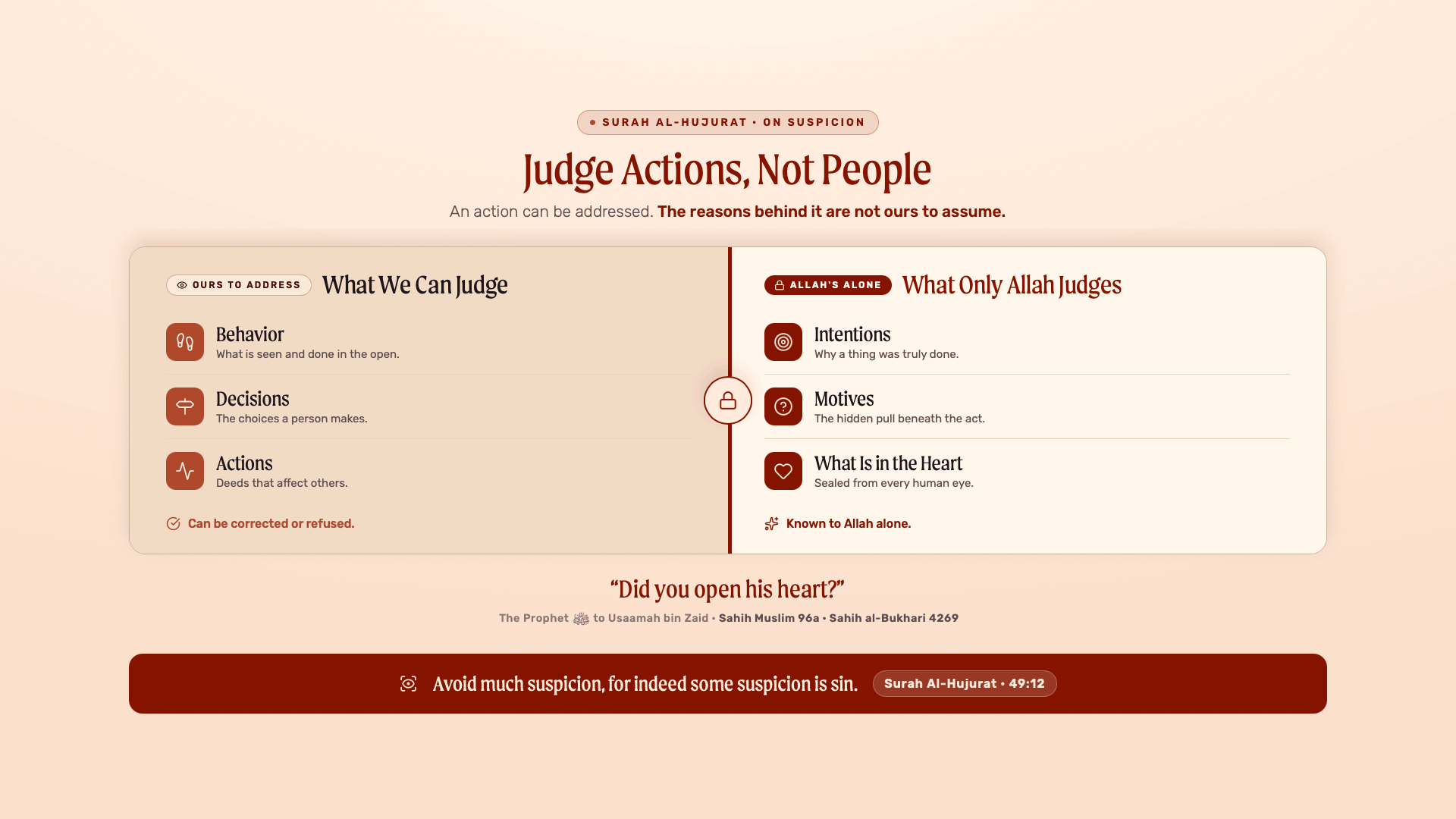
Ustadh Nouman raises the most extreme possible case study: Usaamah bin Zaid (RA), in battle, kills a man who declared the Shahadah at the moment his sword was raised. From any rational view, the case for questioning the man’s sincerity was overwhelming. The Prophet ﷺ was devastated and repeated one question over and over: “Did you open his heart?” (Sahih Muslim 96a; Sahih al-Bukhari 4269).[3] Not: was it reasonable to doubt him. Not: what were the circumstances. But: did you see what was inside him?
If the Prophet ﷺ would not allow us to judge intentions in that case, we have no case to make.
The Difference Between Judging Actions and Judging People
There is a distinction the Quran draws with great care: we can judge behavior and we cannot judge people. A behavior can be wrong, an action can be called out, corrected or refused but the leap from “what they did was wrong” to “they did it for the wrong reasons” is a leap the Quran does not permit us to make. Allah commands the believers directly: avoid much suspicion, for indeed some suspicion is sin, and do not spy on one another or backbite one another (49:12).[4]
This matters enormously in community contexts because most conflicts in Muslim organizations do not actually begin with bad actions, they begin with assigned motives. “He’s only doing this to gain influence.” “She just wants to be seen.” “They are trying to take over.” These are not observations. They are accusations dressed up as insight and they are the single fastest way to destroy an organization from the inside.
The Standard the Quran Actually Sets
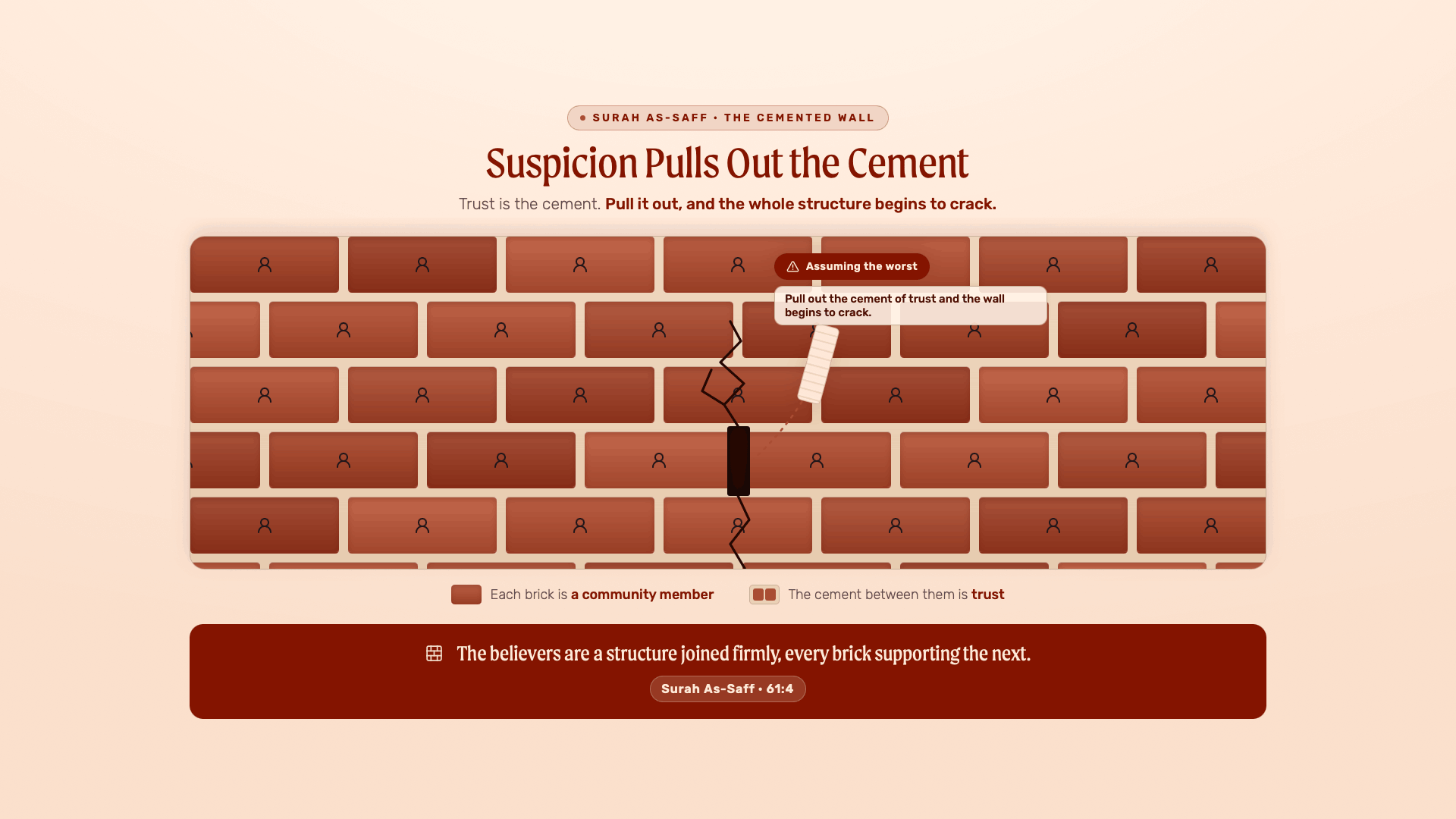
The standard Allah sets for the believing community in Surah As-Saff is a cemented wall: every brick in its place, held to the next by a bond that does not crack (61:4).[5] Each brick has a different role; no brick is trying to be the other. When someone assumes the worst about a fellow community member, they are not strengthening the wall. They are pulling out the cement.
Walls do not argue about which brick is more important. They hold together because each piece trusts the others to stay in place. For human communities, that trust requires as a starting condition that we stop claiming to know what is in another person’s heart.
The practical question is not whether we will ever disagree; because we will. The question is whether our disagreements will be about actions and decisions or whether we will allow Shaytaan to turn them into judgments about souls.
Ustadh Nouman goes deep into these principles and their Quranic foundations in his Leadership course on Bayyinah TV. If your community is navigating conflict or if you want to build the kind of institution that does not crack under pressure, this course is essential. Start exploring now.
Notes
[1] Sahih al-Bukhari 1, narrated by Umar (RA), on actions being judged by their intentions — https://sunnah.com/bukhari:1
[2] Al-Quran, 17:53 — https://quran.com/17/53
[3] Sahih Muslim 96a; Sahih al-Bukhari 4269 — https://sunnah.com/muslim:96a | https://sunnah.com/bukhari:4269
[4] Al-Quran, 49:12 — https://quran.com/49/12
[5] Al-Quran, 61:4 — https://quran.com/61/4

At Bayyinah, we are dedicated to helping you connect directly with the words of Allah beyond translation. Founded by Ustadh Nouman Ali Khan, our mission is to create transformative experiences that deepen your understanding and engagement with the Quran.
Study the Quran and Arabic in a systematic and personalized way through Bayyinah TV. Get started today for free.
Check out our newest articles, fresh off the press and ready for you to dive into!