
Successful subscription! Thank you for subscribing.
Successful subscription! Thank you for subscribing.

May 18, 2026
There is no Muslim organization that never disagrees. Disagreement is not the problem; what we do with it is the problem. The Prophet ﷺ dealt with disagreement among the Companions and Quranic Ayat came down to address how believers should navigate conflict within their own ranks.
Here are four Quranic principles for handling disagreement in Muslim organizations, drawn from Ustadh Nouman Ali Khan’s Leadership Workshop teachings.
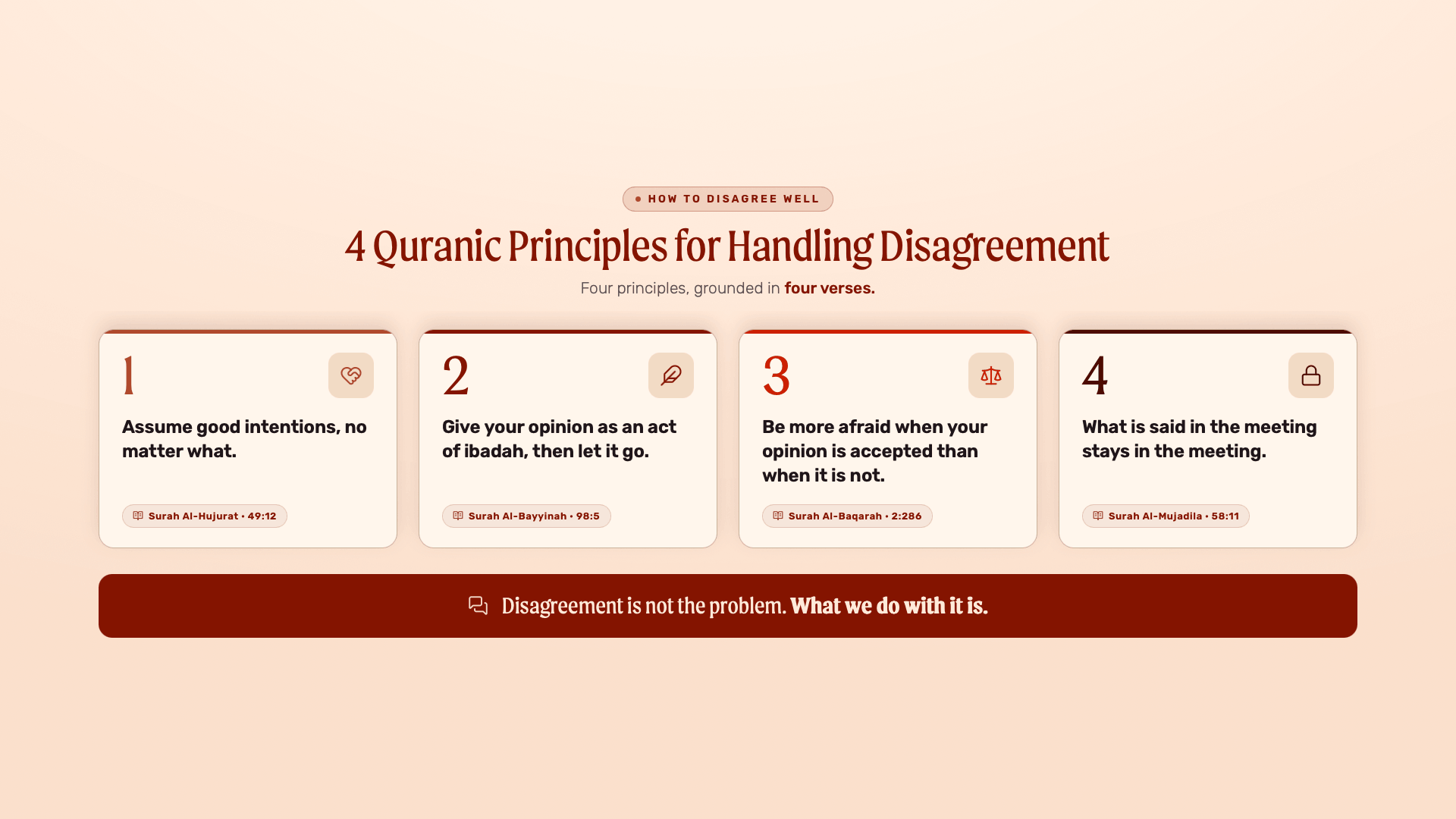
1. Assume Good Intentions, No Matter What
Every person who volunteers, serves or participates in an Islamic organization is, until proven otherwise by their own admission, doing so for the sake of Allah. You and I have no right to question that. Allah commands the believers in Surah Al-Hujuratto avoid much suspicion, since some suspicion is sin (49:12).[1] This is the baseline the Prophet ﷺ set when he rebuked Usaamah bin Zaid (RA) for questioning the sincerity of a man who declared the Shahadah (Sahih Muslim 96a; Sahih al-Bukhari 4269).[2] If we are not allowed to question sincerity in the most extreme possible scenario, we certainly cannot question it in a masjid board meeting.
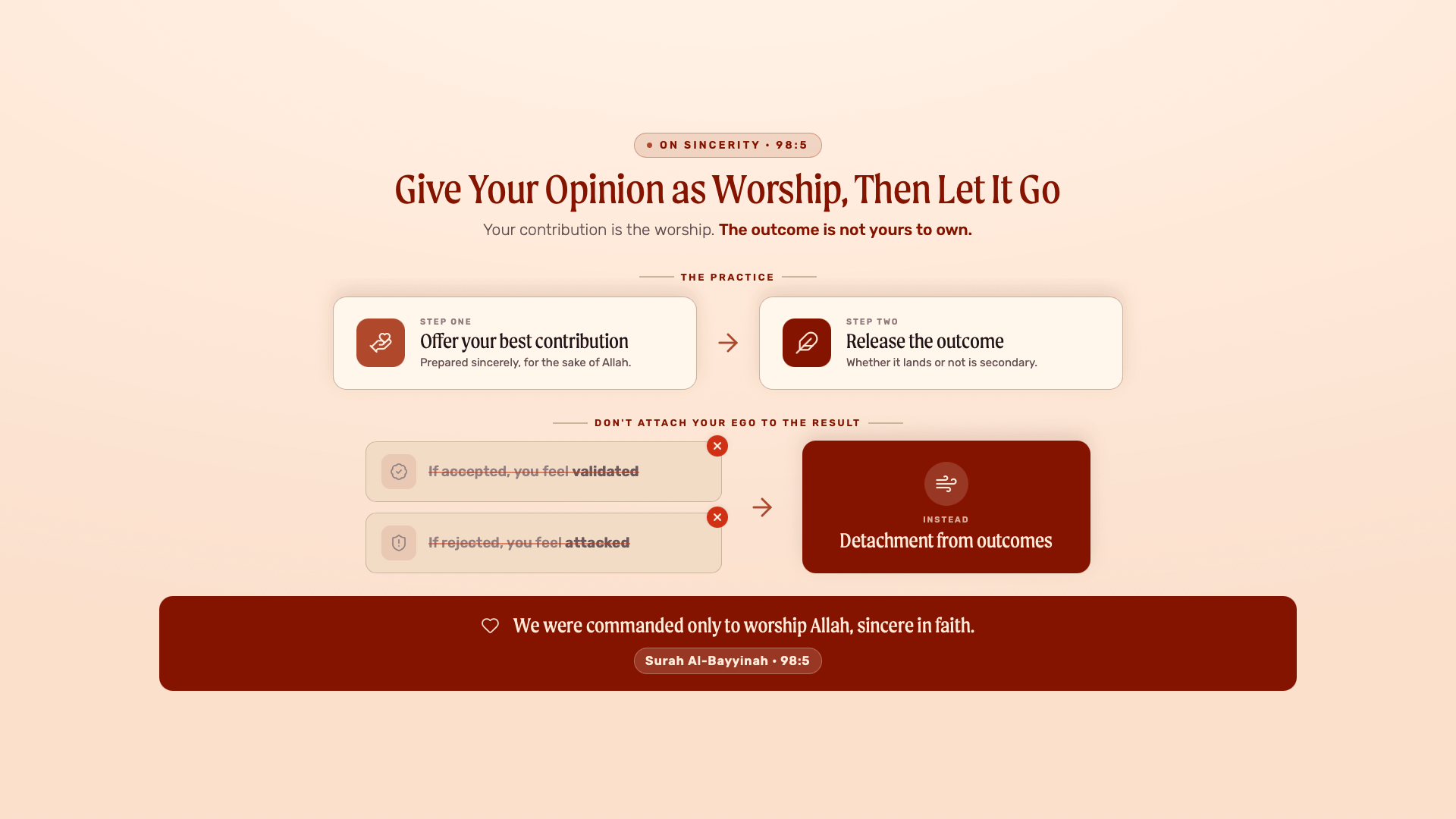
2. Give Your Opinion as an Act of ’Ibaadah, Then Let It Go
When you prepare a contribution for a meeting; research, a proposal, a recommendation, you are doing it for Allah. The Quran reminds us that we were commanded to nothing other than to worship Allah, devoting our religion sincerely to Him (98:5).[3] The one who needed to account for that sincere effort has already done so. Whether your idea is accepted or rejected by the group is secondary. The danger comes when you attach your ego to the outcome. If it is accepted, you feel validated. If it is rejected, you feel attacked. Neither of those reactions is appropriate. The Quran calls for a level of detachment from outcomes that most of us have not been trained to practice.
3. Be More Afraid When Your Opinion Is Accepted Than When It Is Not
This is counterintuitive, but it follows from the logic of sincere service. If your opinion becomes the basis for a community decision, then the outcomes of that decision rest, in part, on your judgment. That is a heavy weight. Allah reminds us that He does not burden any soul beyond what it can bear (2:286),[4] which is precisely why a serious person treats accepted advice as a trust, not a trophy. Ustadh Nouman emphasizes that the person whose idea was accepted should feel the most sober, not the most proud. You are now accountable for what follows.
4. What Is Said in the Meeting Stays in the Meeting
The Prophet ﷺ taught that gatherings are based on trust. A hadith narrated by Jabir ibn Abdullah (RA) and recorded in Sunan Abi Dawud (4869) states: “Meetings are confidential.” (Note: this hadith is graded Da’if but is widely cited for its ethical principle.)[5]
In Surah Al-Mujadila, there is direct guidance about how believers should conduct themselves in meetings: make room for one another when room is asked of you and rise when it is time to rise (58:11).[6]
The “meeting after the meeting,” where three or four people debrief and undermine the decisions just made, is not an informal habit. It is, according to Ustadh Nouman, one of the most consistent sources of organizational destruction in Muslim communities.
These principles are practical, Quran-grounded and exactly what Muslim organizations need to function with integrity. Ustadh Nouman covers all of this and much more in his Leadership course on Bayyinah TV. Start exploring the course here.
Notes
[1] Al-Quran, 49:12 — https://quran.com/49/12
[2] Sahih Muslim 96a; Sahih al-Bukhari 4269 — https://sunnah.com/muslim:96a | https://sunnah.com/bukhari:4269
[3] Al-Quran, 98:5 — https://quran.com/98/5
[4] Al-Quran, 2:286 — https://quran.com/2/286
[5] Sunan Abi Dawud 4869 — https://sunnah.com/abudawud:4869
[6] Al-Quran, 58:11 — https://quran.com/58/11

At Bayyinah, we are dedicated to helping you connect directly with the words of Allah beyond translation. Founded by Ustadh Nouman Ali Khan, our mission is to create transformative experiences that deepen your understanding and engagement with the Quran.
Study the Quran and Arabic in a systematic and personalized way through Bayyinah TV. Get started today for free.
Check out our newest articles, fresh off the press and ready for you to dive into!