
Successful subscription! Thank you for subscribing.
Successful subscription! Thank you for subscribing.

May 18, 2026
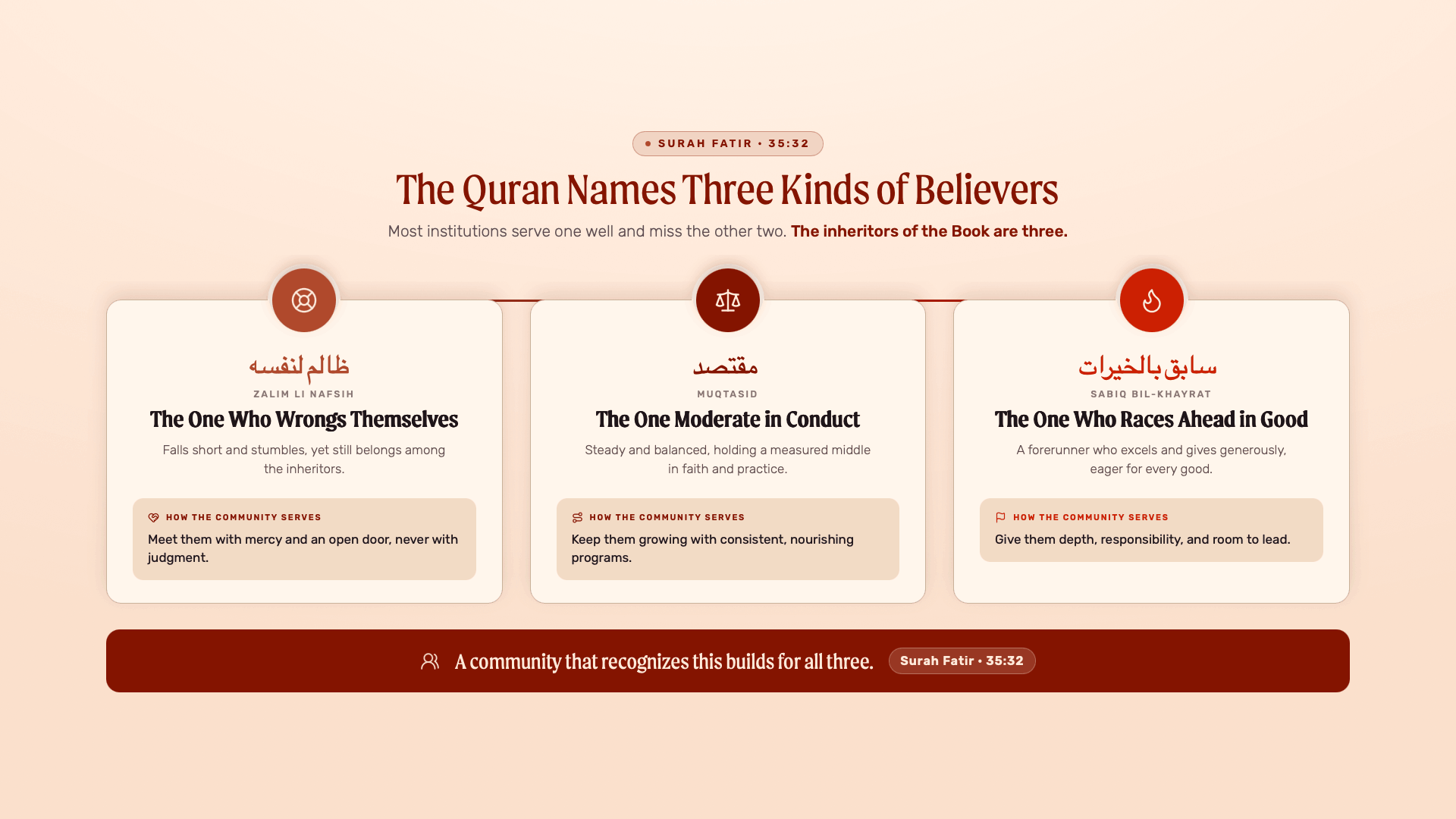
There is a Muslim in your community who has not set foot in the masjid in years. There is another who comes for Jumu’ah and little else. There is a third who shows up regularly and wants to go deeper but does not know how. Most Islamic institutions serve one of these people well and struggle to reach the other two. That is not because they do not care. It is because they have not built a structure that accounts for different levels of connection. The Quran itself acknowledges that the believers who have inherited the Book are of three categories: the one who wrongs themselves, the one moderate in conduct and the one who races ahead in good (35:32).[1] A community that recognizes this builds for all three.
Ustadh Nouman Ali Khan has described a three-stage framework: enrichment, awareness and education, that he has used to guide both Bayyinah’s work and his thinking about Islamic community-building more broadly.
Stage One: Enrichment
Enrichment is not a religious concept in the narrow sense. It is about giving people a reason to show up before they are ready for anything deeper and it is what makes a place feel alive, welcoming and worth returning to. Ustadh Nouman gives a striking example: a masjid in Dallas started a volleyball night. Muslim men who had not come to the masjid in years showed up to play. They were not ready for a halaqah. They were not looking for a class. But they came and they kept coming. Over time, some of them began to stay for ’Isha. Some started asking questions. Some eventually enrolled in programs.
That was enrichment. It reaches the Muslim who would never come for a class and creates attachment to a community before any formal invitation to faith has been extended. Allah instructs the Prophet ﷺ to call to the way of His Lord with wisdom and good instruction (16:125).[2] Wisdom includes meeting people where they are. Without it, all the education in the world stays locked inside a building that most of your community never enters.
Stage Two: Awareness
Awareness is the bridge. Once someone feels a connection to the community, they become open to learning something about why the community exists. Awareness content is designed for the person who has never studied Islam seriously but is curious. It is not a full course. It is a 3-5 minute video, a Friday khutbah highlight, a short post that makes someone think. Allah asks in the Quran: who is better in speech than one who invites to Allah, does righteous deeds and says, “I am of the Muslims” (41:33).[3] Awareness work is exactly that, the patient, public invitation that opens doors. Ustadh Nouman points to what Quran Weekly was: short, accessible pieces of Quranic reflection that reached millions of people who would never have enrolled in a ten-week course. That is awareness.
Stage Three: Education
Education is for the person who has already said yes. They want depth and they want to understand, not just be inspired. They are ready to learn Arabic, to sit with a Surah for weeks, to take a course that challenges them. Allah asks in the Quran: are those who know equal to those who do not know? (39:9).[4] The believing community is built on those who have committed themselves to knowing. This is Bayyinah’s core strength: deep Quranic education. But the key insight, the one that most institutions miss, is that education alone cannot carry the full burden of community building. If your institution only serves the person already committed to study, you are serving a small fraction of your community and then wondering why the rest feels disconnected.
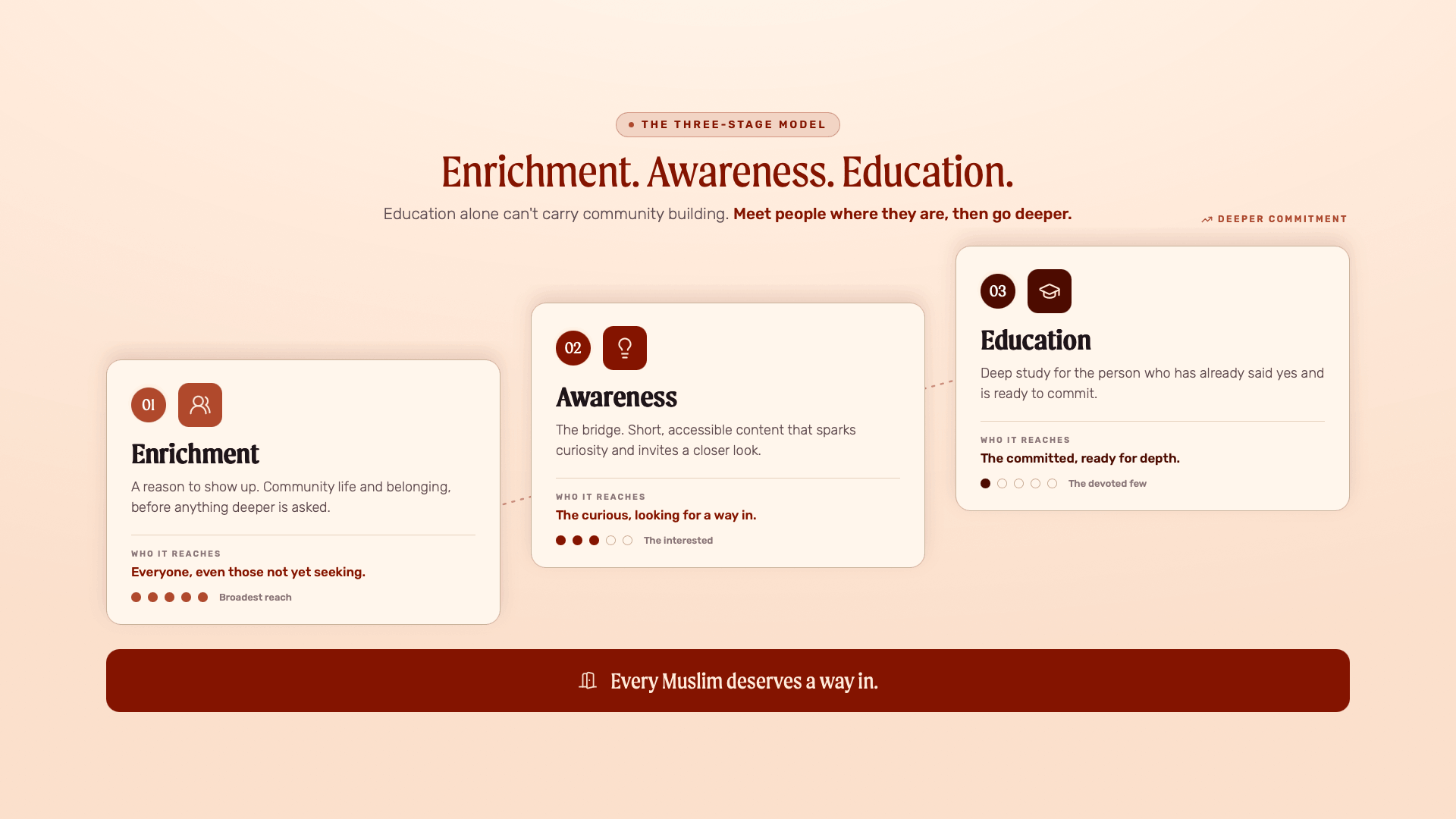
Every Muslim deserves to find a way in and the role of our institutions is to make sure the door is wide enough. Ustadh Nouman explores this framework and much more in his Leadership course on Bayyinah TV.
Start exploring the course here.
Notes & References
[1] Al-Quran, 35:32 — https://quran.com/35/32
[2] Al-Quran, 16:125 — https://quran.com/16/125
[3] Al-Quran, 41:33 — https://quran.com/41/33
[4] Al-Quran, 39:9 — https://quran.com/39/9

At Bayyinah, we are dedicated to helping you connect directly with the words of Allah beyond translation. Founded by Ustadh Nouman Ali Khan, our mission is to create transformative experiences that deepen your understanding and engagement with the Quran.
Study the Quran and Arabic in a systematic and personalized way through Bayyinah TV. Get started today for free.
Check out our newest articles, fresh off the press and ready for you to dive into!