
Successful subscription! Thank you for subscribing.
Successful subscription! Thank you for subscribing.

May 18, 2026
If you have sat in enough masjid planning meetings, you know the feeling. Someone proposes a project, energy builds and then someone else raises their hand: “But what about the youth? What about the sisters? What about the new Muslims?” Each concern is valid. Each one adds weight to an agenda that was already too heavy. By the time the meeting ends, five initiatives have been proposed, none have a clear owner and everyone leaves with a vague sense that things will get done.
Nothing gets launched and the community quietly loses trust in the process.
The Problem With Owning Everything
In the last century, several major Islamic revivalist movements arose with a shared conviction: our banner should represent all of Islam. Every concern, every cause, every population, come under our umbrella. The intention was sincere but the effect was a set of organizations that tried to do everything and, in many cases, did nothing deeply. Ustadh Nouman points out that this model has been tried and what replaced it was more effective.
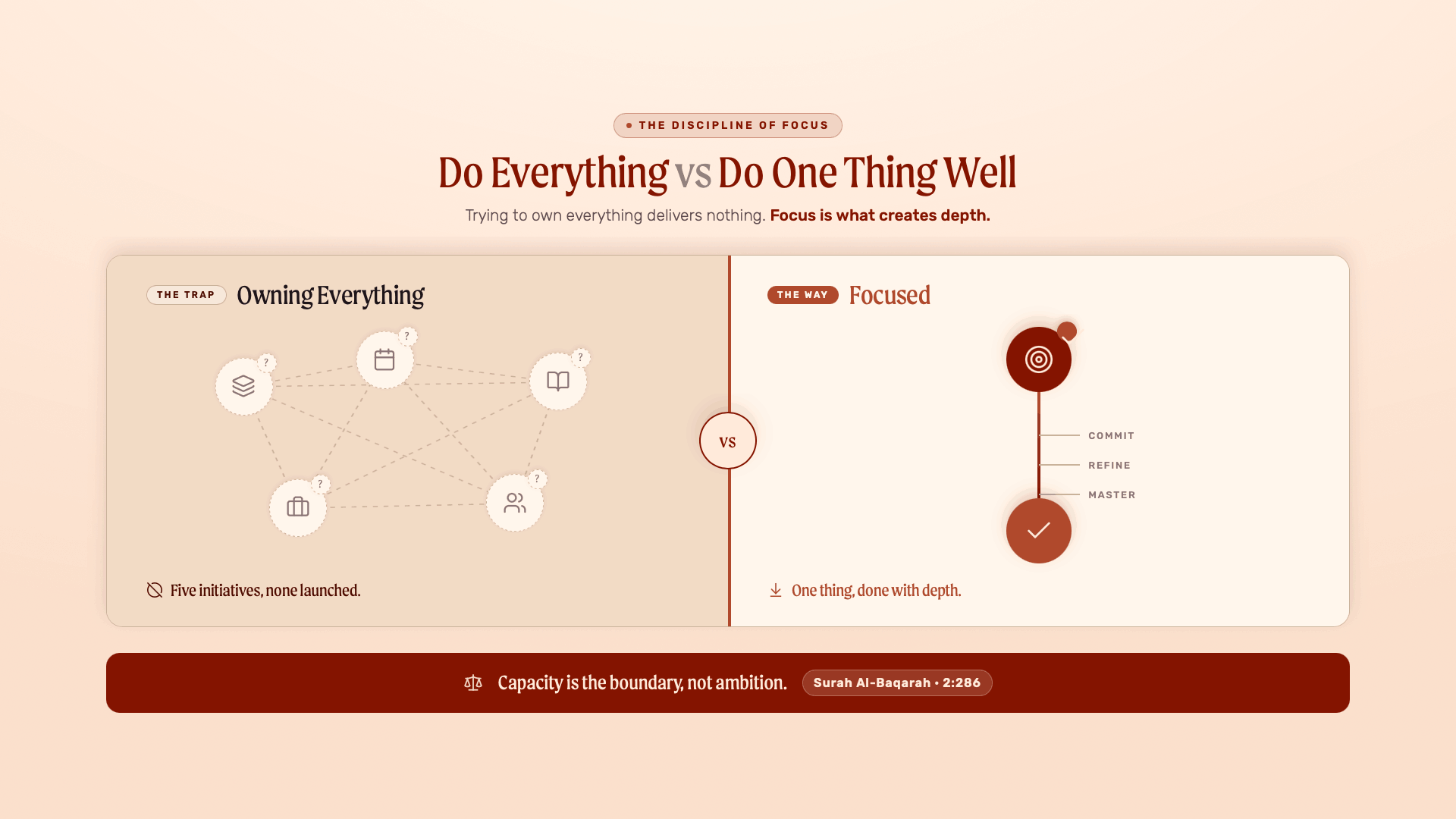
What followed was a shift toward specialization and it worked. Organizations that said, “we do this one thing” and meant it began to actually deliver. Bayyinah itself was built on this principle: Arabic and Quran. Not fiqh, not seerah, not everything an Islamic institution could hypothetically teach. The clarity of focus is what allowed depth of impact.
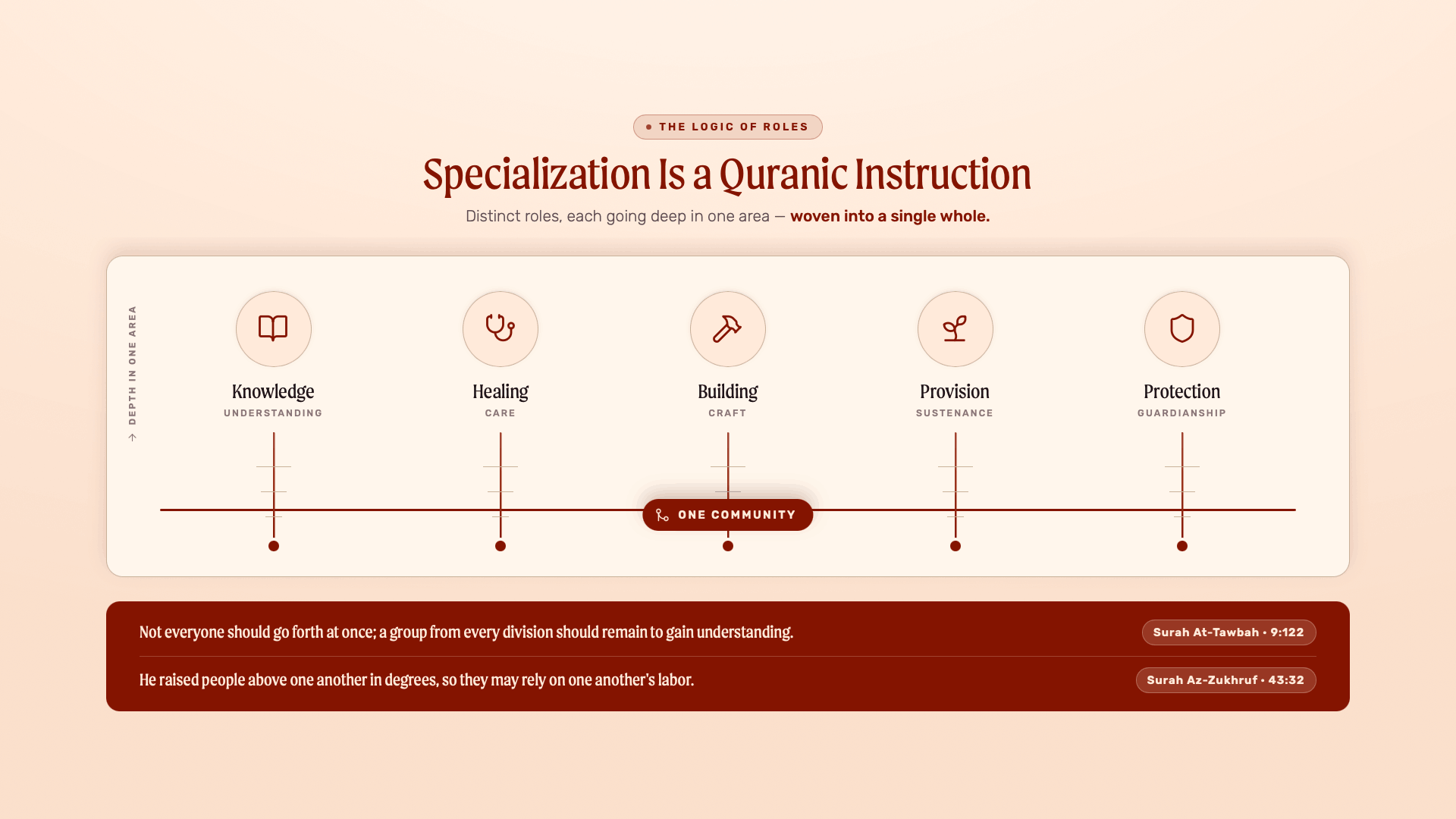
This is not a management strategy. It is a reflection of how Allah distributes talent and responsibility across a community. The Quran tells us directly that Allah has raised people above one another in degrees so that they may rely on one another’s distinct labor (43:32) [1] . The instruction in Surah At-Tawbah is even more explicit: not everyone should go forth at once, a group from every division should remain to gain understanding in the religion (9:122) [2]. Specialization is not a modern management idea. It is a Quranic instruction.
The Danger of the “Important” Meeting
One of the most effective ways to kill a good project is to keep adding things to it. In meeting after meeting, every legitimate concern dilutes the focus until the organization is committed to a list of ten things and can execute none of them. Ustadh Nouman has observed this firsthand and across dozens of communities: the “important” meeting where everything gets discussed is the one where nothing gets decided.
The Quran sets the principle for how a community should prioritize. Allah does not charge any soul beyond its capacity (2:286) [3]. Capacity is the boundary, not ambition. You identify what you can actually execute and be transparent with your people about what is on the list and what is not ready yet. You launch the first thing, do it well, evaluate and then consider what comes next. The Prophet ﷺ said the most beloved deeds to Allah are those done consistently, even if small (Al-Bukhari) [4]. This is not a business model. It is a Quranic ethic of stewardship.
What Focus Actually Asks of Us
Focus requires saying out loud to your community, to your volunteers, to yourself that not every important thing is something your organization will address this year. This is genuinely hard and can feel like you are letting people down. But the alternative, promising everything and delivering nothing, lets people down far more.
The enrichment, awareness and education model that Bayyinah uses is not just a programming philosophy. It is a recognition that different people need different entry points and that trying to reach everyone with the same depth at the same time is a formula for mediocrity. The Quran itself acknowledges this when it tells us that each community was given a distinct law and method, and that the call is to race to all that is good (5:48) [5]. Different paths, the same destination.
A community that tries to do everything is a community that has not yet decided what it believes in enough to commit to. Allah warns us not to dispute among ourselves, lest we lose courage and our strength departs (8:46) [6]. The Quran calls us to something more defined, more unified and more honest than the agenda we keep pretending we can carry.
Ustadh Nouman unpacks these principles in detail in his Leadership course on Bayyinah TV. If you lead a Muslim organization or want to support one more effectively, it is worth your time.
Notes & References

At Bayyinah, we are dedicated to helping you connect directly with the words of Allah beyond translation. Founded by Ustadh Nouman Ali Khan, our mission is to create transformative experiences that deepen your understanding and engagement with the Quran.
Study the Quran and Arabic in a systematic and personalized way through Bayyinah TV. Get started today for free.
Check out our newest articles, fresh off the press and ready for you to dive into!