
Successful subscription! Thank you for subscribing.
Successful subscription! Thank you for subscribing.

July 23, 2026
Surah Yusuf is one of the most distinctive surahs in the Quran and the moment it was given matters as much as its content. It came to the Prophet Muhammad ﷺ during the Year of Grief, the year his beloved wife Khadijah (RA) and his uncle Abu Talib both passed and opposition in Makkah grew sharper than ever. From both the inside and the outside, he was carrying a great deal. In that state, Allah gave him this surah.
This post explores why Surah Yusuf was the gift the Prophet ﷺ needed in that moment: where Yusuf (AS) sits in the story of the prophets, why his life is a turning point in history and why the surah tells his story the way it does.
A Story Told Like No Other
نَحْنُ نَقُصُّ عَلَيْكَ أَحْسَنَ ٱلْقَصَصِ
“We relate to you the best of narratives.”
(12:3)
Right at the start, Allah calls this the best of narratives (12:3).1 Scholars often link the name Yusuf to a root meaning sorrow and his life held a great deal of it: torn from his family, years in prison and hurtful words even at his reunion. That resonance with sorrow is part of why this surah, in this year, was such a fitting gift. What sets it apart is not only what it tells but how it tells it, with an intimacy and emotional closeness that invites you into the private grief of Yaqub (AS) and the inner world of Yusuf (AS) rather than reciting history from a distance.
A Grandson of Ibrahim
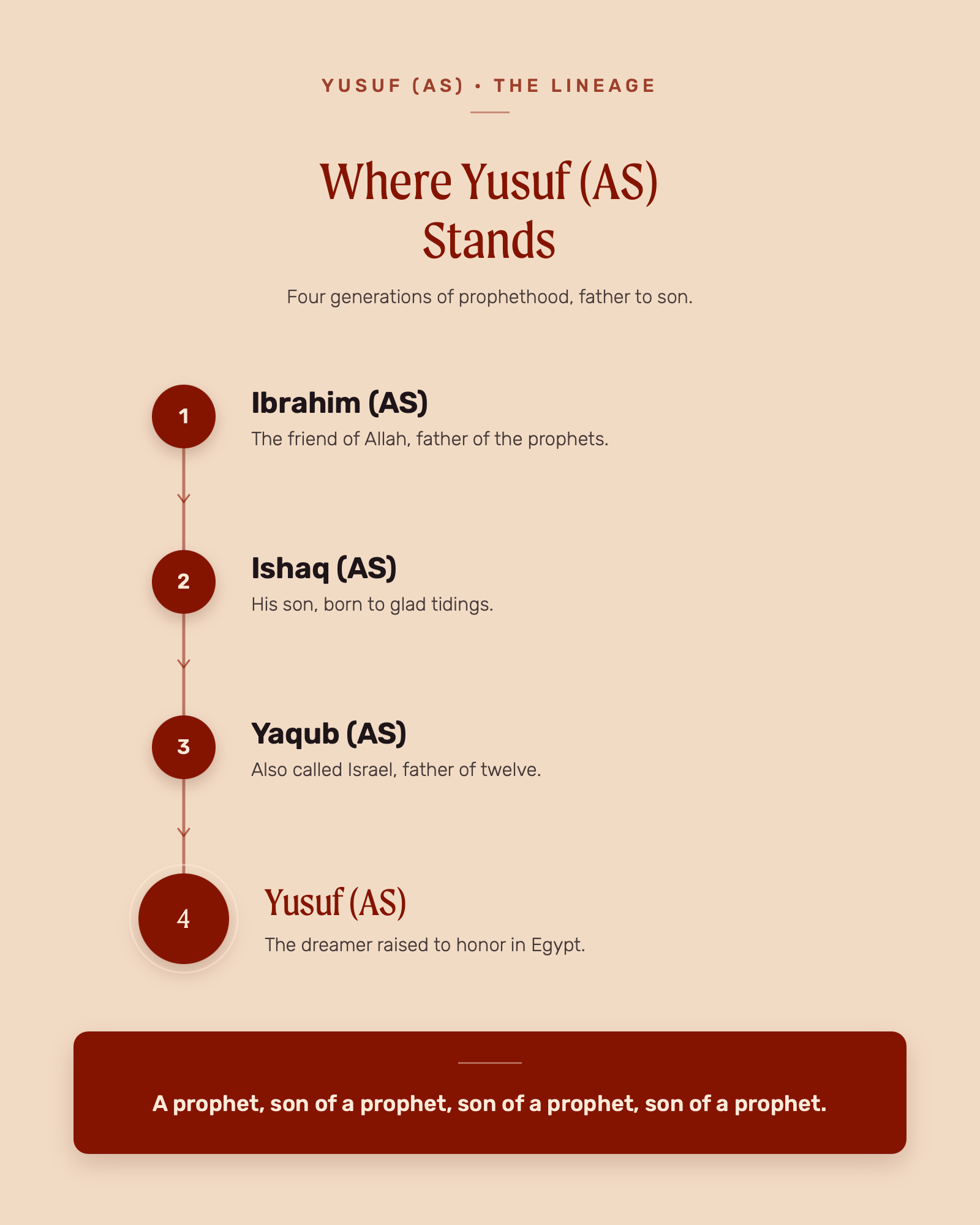
Yusuf (AS) is no isolated figure. He is the son of Yaqub (AS), the grandson of Ishaq (AS) and the great-grandson of Ibrahim (AS), four generations of prophets in a row. He knew exactly where he stood in that line; even in prison he described his way as the faith of his fathers (12:38).2
وَٱتَّبَعْتُ مِلَّةَ ءَابَآءِىٓ إِبْرَٰهِيمَ وَإِسْحَٰقَ وَيَعْقُوبَ
“And I follow the faith of my fathers, Ibrahim, Ishaq and Yaqub.”
(12:38)
That lineage carries a particular concern. When Allah made Ibrahim (AS) a leader for humanity, Ibrahim (AS) immediately asked about his descendants and was told that the covenant does not reach the wrongdoers among them (2:124).3 He also prayed for a messenger to be raised from his offspring (2:129).4 Where the earlier scriptures tie Ibrahim’s legacy to the promise of a land, the Quran ties it to something else entirely: leadership earned through righteousness and a people drawn not to a homeland but to the house of Allah.
The Hinge of a Much Bigger Story
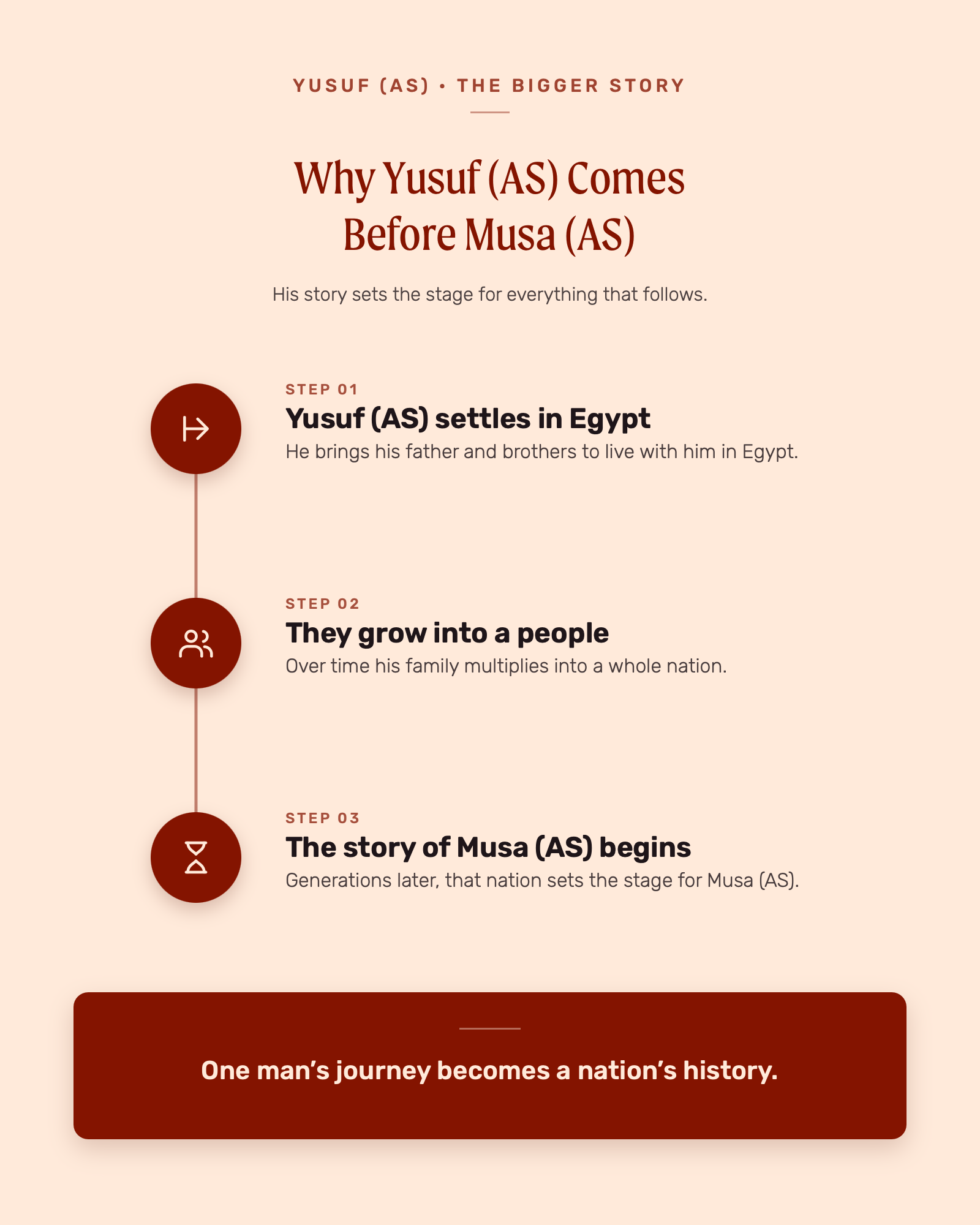
Yusuf (AS) is also where a much larger history turns. It was through him that his family left Canaan and settled in Egypt, where they grew into a people, until generations later that same people, under a new Pharaoh, were enslaved and the story of Musa (AS) began. You cannot understand Musa (AS), the most mentioned prophet in the Quran, without Yusuf (AS) before him. Remarkably, the Quran preserves a scene where a believing man in Pharaoh’s own court reminds the Egyptians that Yusuf (AS) had come to them long before with clear proofs and that when he died they had said Allah would never send another messenger (40:34).5 Even Pharaoh’s court remembered Yusuf (AS); his legacy was on the record.
A Gift Meant to Be Felt
All of this is why Surah Yusuf was the gift the Prophet ﷺ needed in the Year of Grief. It is history, but it is told as something deeply personal, a story of loss, patience and reunion meant to be felt rather than merely studied. It is the kind of account that reaches people in their darkest moments precisely because it does not hide the pain along the way.
The Takeaway
Surah Yusuf rewards a particular posture. It asks us to come to it not with conclusions we are looking to prove, but with humility, letting the words of Allah speak for themselves and lead us to their own meaning. Approached that way, a story revealed in one of the hardest years of the Prophet’s life becomes a gift for every hard year of ours.
There is far more in Surah Yusuf than a single article can hold. You can explore the full Yusuf: A Deeper Look series on Bayyinah TV, alongside the other surahs being opened up in the Deeper Look collection.
Related reading: What Surah Yusuf Teaches About Beautiful Patience and Grief (the companion post in this series).
Notes
[1] Quran, 12:3, https://quran.com/12/3 ↩
[2] Quran, 12:38, https://quran.com/12/38 ↩
[3] Quran, 2:124, https://quran.com/2/124 ↩
[4] Quran, 2:129, https://quran.com/2/129 ↩
[5] Quran, 40:34 (Surah Ghafir), https://quran.com/40/34 ↩

At Bayyinah, we are dedicated to helping you connect directly with the words of Allah beyond translation. Founded by Ustadh Nouman Ali Khan, our mission is to create transformative experiences that deepen your understanding and engagement with the Quran.
Study the Quran and Arabic in a systematic and personalized way through Bayyinah TV. Get started today for free.
Check out our newest articles, fresh off the press and ready for you to dive into!