
Successful subscription! Thank you for subscribing.
Successful subscription! Thank you for subscribing.

July 23, 2026
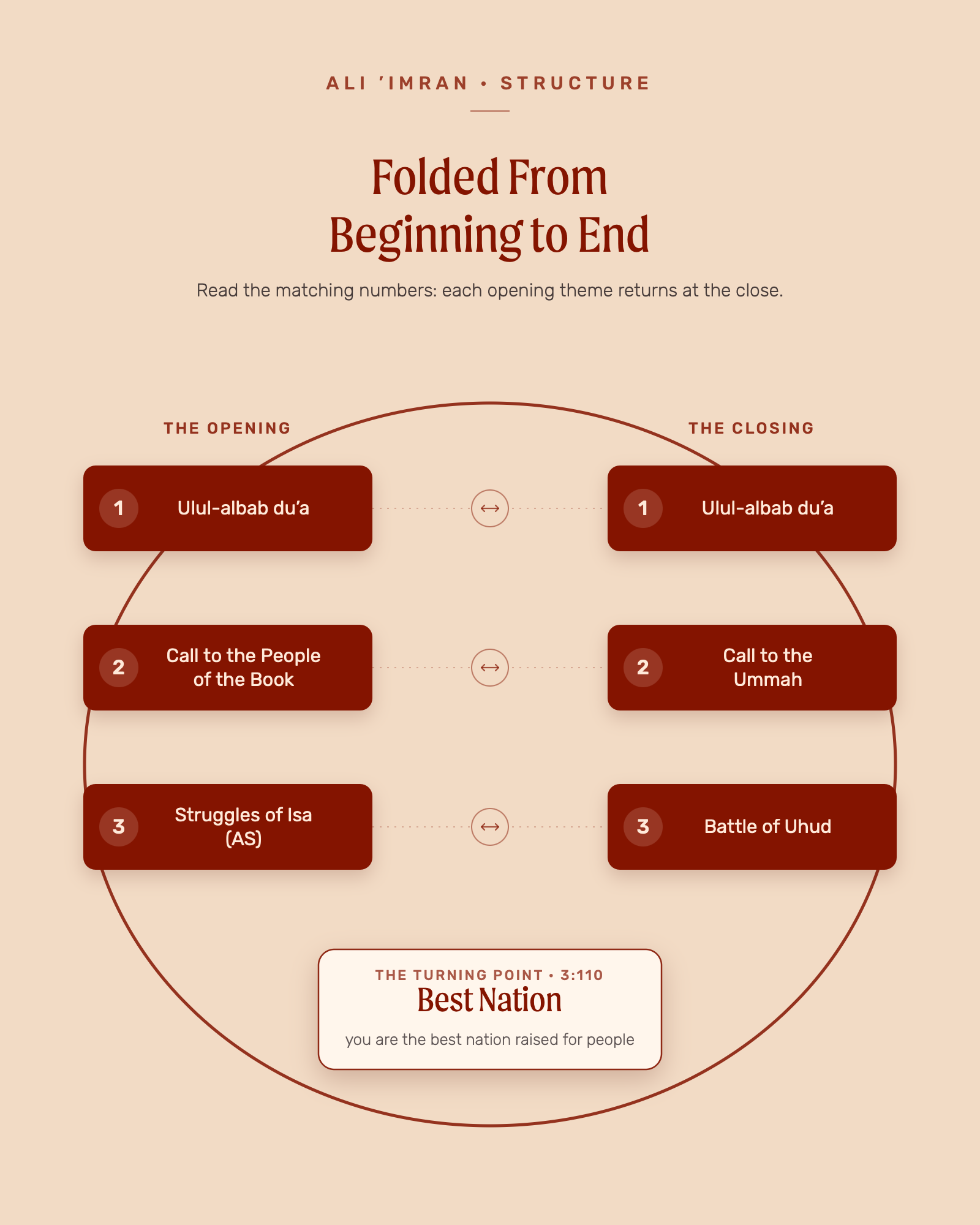
Surah Ali ‘Imran can look, at first glance, like a series of loosely connected topics: revelation, a long passage on the People of the Book, the family of ‘Imran, the battle of Uhud, then a closing call to patience. Map it out, though and a careful symmetry appears. The surah is folded so that its opening speaks to its closing, its two halves answer one another and its center holds the point of the whole thing.
This post traces that structure, from the mirrored opening and closing passages, to the two great halves, to the heart of the surah.
An Opening and Closing That Mirror Each Other
The surah opens (ayat 1-20) and closes (ayat 190-200) on the same notes. Both describe the people of sound minds, ulul-albab and in both places they immediately turn to du’a. Near the start they pray, “Our Lord, do not let our hearts deviate after You have guided us” (3:8).1 Near the end, after reflecting on the creation of the heavens and the earth, they pray, “Our Lord, You did not create this without purpose” (3:191).2 The first group contemplates the signs in revelation, the second contemplates the signs in creation and both arrive at the same humility and the same prayer. Both passages even close on the same idea, that Allah never breaks His promise (3:194).3
Two Halves: The People of the Book and the Ummah
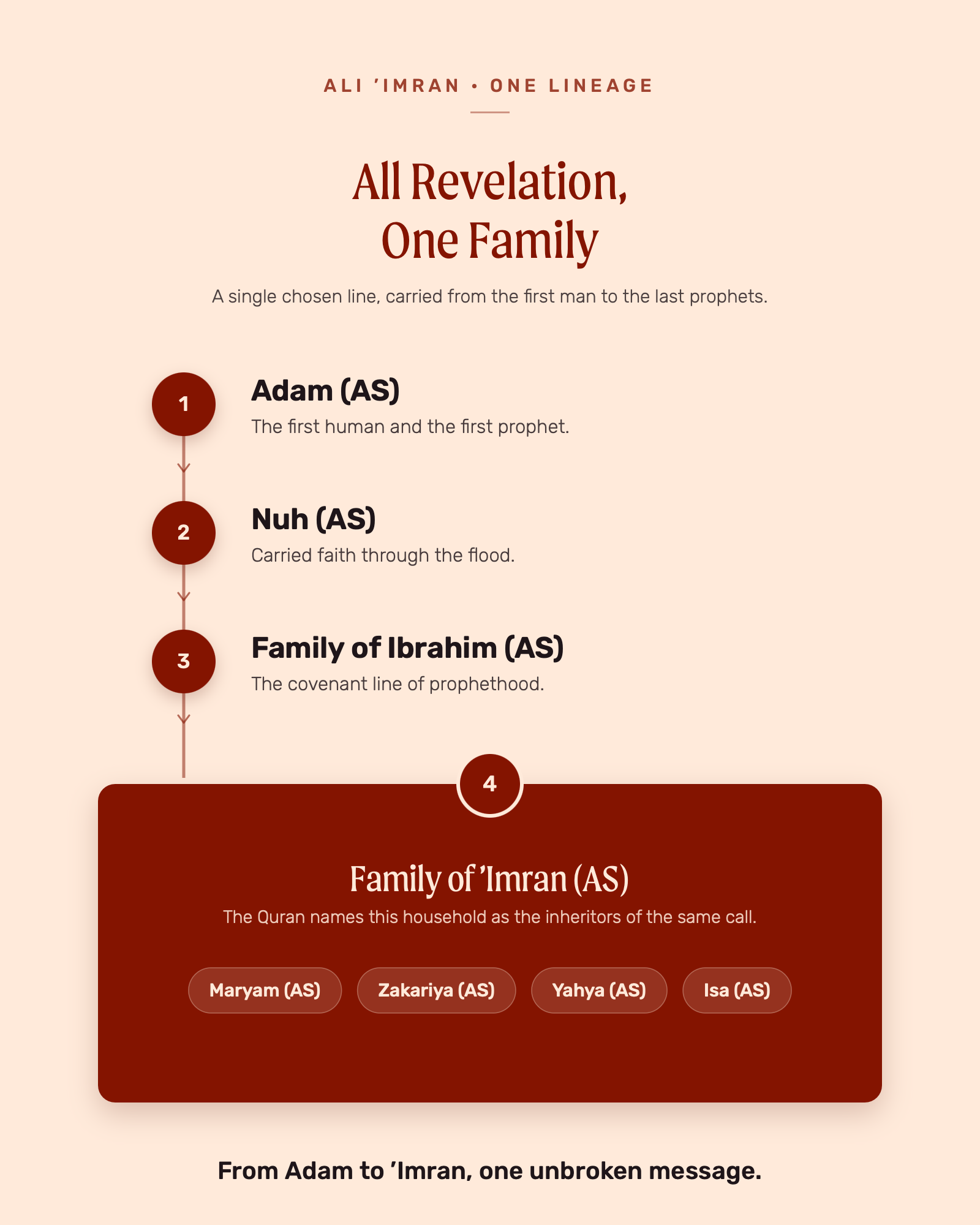
The body of the surah falls into two large halves. The first calls on the People of the Book and the second turns to the Muslim community, mirroring the way Al-Baqarah devoted its first half to the Israelites and its second to this ummah. Before the criticism and the call, the surah grounds everything in a single idea: all revelation comes from one source and the prophets are one family. Allah chose Adam (AS), Nuh (AS), the family of Ibrahim (AS) and the family of ‘Imran (3:33),4 a lineage that runs through Maryam (AS), Zakariya (AS), Yahya (AS) and Isa (AS). The point of that history is that Isa (AS) himself pointed away from himself and toward Allah, saying, “Allah is my Lord and your Lord, so worship Him” (3:51).5
Two Centers That Speak to Each Other
The struggles of Isa (AS) in the first half and the battle of Uhud in the second half sit opposite each other and they rhyme. Both involve scheming to kill a messenger, pressure from hypocrites within and a larger hostile force without, a moment that looks like defeat and a turn that Allah makes into something else. Where Isa (AS) was raised, the believers at Uhud are taught that their loss was not humiliation but something that could strengthen and redeem them. The surah is, in a sense, continuing the same story across centuries.
The Heart of the Surah
At the very center, the surah names what this community is for.
كُنتُمْ خَيْرَ أُمَّةٍ أُخْرِجَتْ لِلنَّاسِ
“You are the best nation brought forth for humanity.”
(3:110)
This center (3:110)6 mirrors the center of Al-Baqarah, where this community was first named a middle nation (2:143).7 Where Al-Baqarah inaugurated the ummah, Ali ‘Imran gives it its agenda: to call to good and forbid wrong and to do so together. That is why, right at the heart, the surah commands the believers to hold fast to Allah’s rope and not to splinter.
وَٱعْتَصِمُوا۟ بِحَبْلِ ٱللَّهِ جَمِيعًا وَلَا تَفَرَّقُوا۟
“And hold firmly to the rope of Allah, all together and do not become divided.”
(3:103)
The surah is careful not to let this harden into judging entire groups of people. Even as it warns the believers not to become like those who broke from their scripture, it reminds them that among the People of the Book are upright believers who recite Allah’s words in the night and prostrate (3:113).8 The standard is to oppose wrong behavior without writing off whole communities.
The Takeaway
Surah Ali ‘Imran is not a loose collection of subjects. It is a deliberate design, folded so that its end returns to its beginning, its two halves answer one another and its center tells this community who it is and what it is for. Reading it this way, as a single connected whole rather than a string of separate passages, is exactly how the Quran asks to be read, because the Quran explains itself, part by part.
There is far more symmetry in Surah Ali ‘Imran than a single article can hold. You can explore the full Ali ‘Imran: A Deeper Look series on Bayyinah TV, alongside the other surahs being opened up in the Deeper Look collection.
Related reading: The Opening of Surah Ali ‘Imran: Why It Begins With Al-Hayy and Al-Qayyum (the companion post in this series).
Notes
[1] Quran, 3:8, https://quran.com/3/8 ↩
[2] Quran, 3:191, https://quran.com/3/191 ↩
[3] Quran, 3:194, https://quran.com/3/194 ↩
[4] Quran, 3:33, https://quran.com/3/33 ↩
[5] Quran, 3:51, https://quran.com/3/51 ↩
[6] Quran, 3:110, https://quran.com/3/110 ↩
[7] Quran, 2:143, https://quran.com/2/143 ↩
[8] Quran, 3:113 (and 3:114, 3:199 on upright People of the Book), https://quran.com/3/113 ↩

At Bayyinah, we are dedicated to helping you connect directly with the words of Allah beyond translation. Founded by Ustadh Nouman Ali Khan, our mission is to create transformative experiences that deepen your understanding and engagement with the Quran.
Study the Quran and Arabic in a systematic and personalized way through Bayyinah TV. Get started today for free.
Check out our newest articles, fresh off the press and ready for you to dive into!