
Successful subscription! Thank you for subscribing.
Successful subscription! Thank you for subscribing.

July 23, 2026
Surah Yusuf is a surah people feel as much as they study. Readers across the world describe finding themselves in it, returning to it in their darkest moments, drawn to the fact that it is, at heart, a story of redemption. Much of that pull comes from how honestly it treats grief and from the way it quietly corrects something many of us misunderstand about patience.
This post explores what Surah Yusuf teaches about beautiful patience, why grief is treated as human rather than as a failure of faith and why the surah works like a mirror.
Beautiful Patience Is Not the Absence of Grief
When Yaqub (AS) is shown his son’s shirt and a false story of his death, he responds with sabrun jameel, beautiful patience (12:18).1
فَصَبْرٌ جَمِيلٌ
“So beautiful patience.”
(12:18)
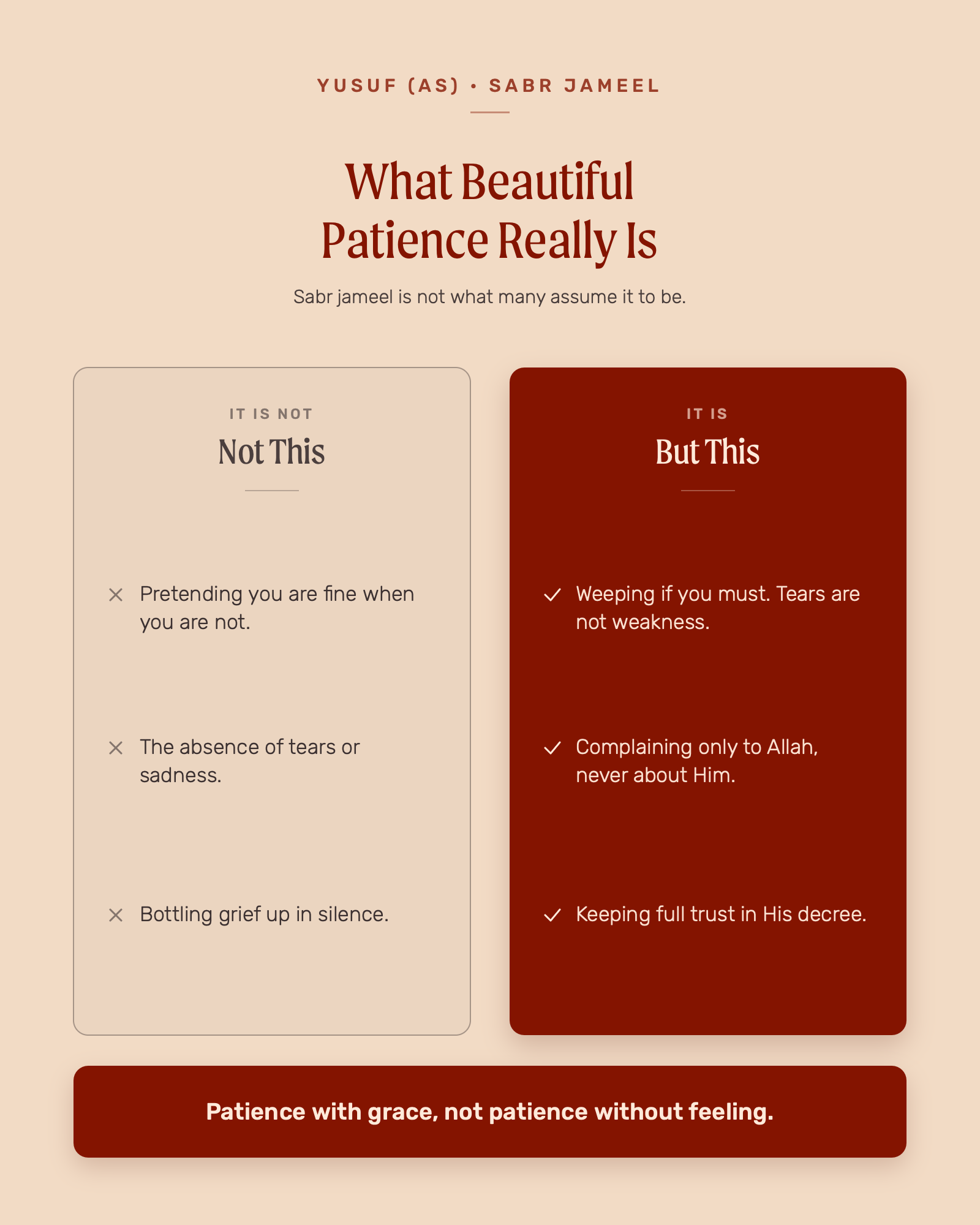
Yet the same surah tells us that he wept until his eyes lost their sight from grief (12:84),2 and that he said he complained of his sorrow and grief to Allah alone (12:86).3
إِنَّمَآ أَشْكُوا۟ بَثِّى وَحُزْنِىٓ إِلَى ٱللَّهِ
“I only complain of my anguish and grief to Allah.”
(12:86)
Put together, these ayat redraw what patience actually means. Beautiful patience is not pretending you are fine and it is not the absence of tears. It is what you do with the grief: where you take it, who you complain toand whether you keep your trust in Allah’s decree intact. A person can weep, ache and still be patient in the most beautiful way, as long as the complaint goes upward to Allah rather than outward in despair.
Grief Is Human and People Grieve Differently
Because of this, the surah refuses to treat grief as weakness. Prophets grieved. People with strong faith grieved. And just as people differ in physical strength or pain threshold, they differ in how much emotional weight they can carry and how quickly they recover, which means we should be slow to impose our own timeline of healing on anyone else.
One of the most moving illustrations of this comes from outside the surah itself. Imam Fakhruddin al-Razi, one of the great commentators on the Quran, was writing his tafsir of Surah Yusuf when his own son Muhammad passed away. At the end of that surah he set down lines of grieving poetry and asked readers to recite Al-Fatihah for his son and he took refuge in the very du’a of Yusuf (AS) (12:101).4
تَوَفَّنِى مُسْلِمًا وَأَلْحِقْنِى بِٱلصَّٰلِحِينَ
“Cause me to die in submission and join me with the righteous.”
(12:101)
Centuries later, readers still pause over those words and make du’a for him. That is part of what this surah does: it connects grieving hearts across time and points every one of them in the same direction, toward Allah.
A Mirror, Not Just a Hero Story
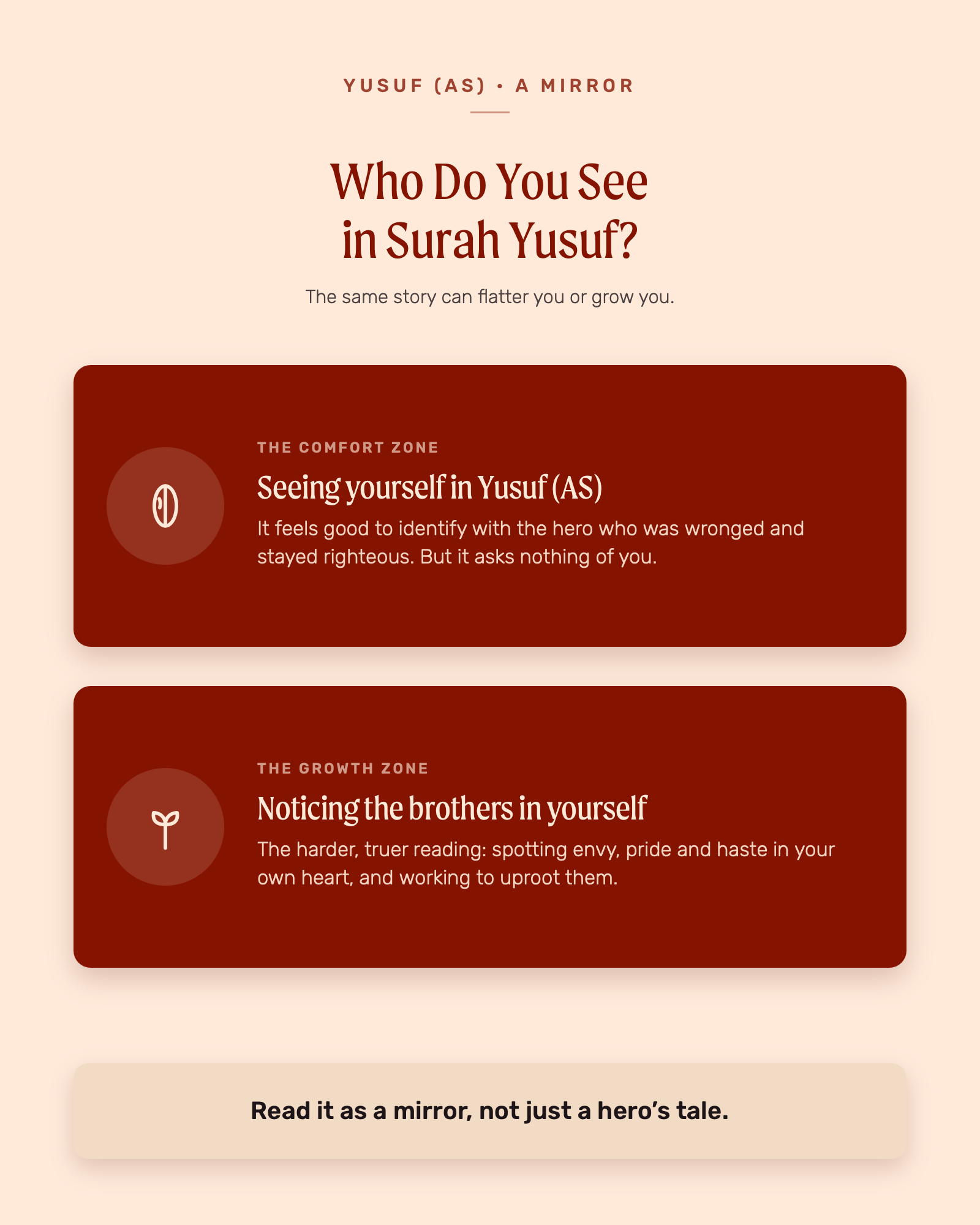
The other reason Surah Yusuf reaches people so deeply is that it works like a mirror. Every reader wants to see themselves in Yusuf (AS), the wronged and patient one, but the surah is honest enough that we also recognize the brothers in ourselves, the envy, the rashness, the things we would rather not admit. Even Yusuf (AS) refuses to claim his own innocence, saying that he does not absolve his own self (12:53).5 That kind of self-honesty is the hard, growthful part of reading the story and it is what turns a beautiful narrative into something that changes the reader.
The Takeaway
Allah says that in the stories of the prophets there is a lesson for people of understanding (12:111).6 Surah Yusuf heals so many people not by pretending pain away, but by being completely honest about it, naming grief, allowing tears and then carrying all of it to Allah. That is beautiful patience and it is why this surah keeps finding people exactly where they are.
There is far more in Surah Yusuf than a single article can hold. You can explore the full Yusuf: A Deeper Look series on Bayyinah TV, alongside the other surahs being opened up in the Deeper Look collection.
Related reading: Why Surah Yusuf Was the Gift Given in the Year of Grief (the companion post in this series).
Notes
[1] Quran, 12:18, https://quran.com/12/18 ↩
[2] Quran, 12:84, https://quran.com/12/84 ↩
[3] Quran, 12:86, https://quran.com/12/86 ↩
[4] Quran, 12:101, https://quran.com/12/101 ↩
[5] Quran, 12:53, https://quran.com/12/53 ↩
[6] Quran, 12:111, https://quran.com/12/111 ↩

At Bayyinah, we are dedicated to helping you connect directly with the words of Allah beyond translation. Founded by Ustadh Nouman Ali Khan, our mission is to create transformative experiences that deepen your understanding and engagement with the Quran.
Study the Quran and Arabic in a systematic and personalized way through Bayyinah TV. Get started today for free.
Check out our newest articles, fresh off the press and ready for you to dive into!