
Successful subscription! Thank you for subscribing.
Successful subscription! Thank you for subscribing.

July 23, 2026
Surah Ali ‘Imran is the next large surah after Al-Baqarah and like it, it is Madani and opens with Alif Lam Mim (3:1).1 What comes immediately after those letters, though, is unexpected. Before the surah says anything about its message, it names Allah in two specific ways and those two names quietly set the tone for everything that follows.
This post explores the first three ayat of Surah Ali ‘Imran: the two names of Allah it opens with and the way it describes the Book being sent down. Read carefully, the opening is doing a great deal of work before the surah has formally begun its argument.
Two Names That Echo Ayat al-Kursi
ٱللَّهُ لَآ إِلَٰهَ إِلَّا هُوَ ٱلْحَىُّ ٱلْقَيُّومُ
“Allah, there is no god but He, the Ever-Living, the Sustainer of all.”
(3:2)
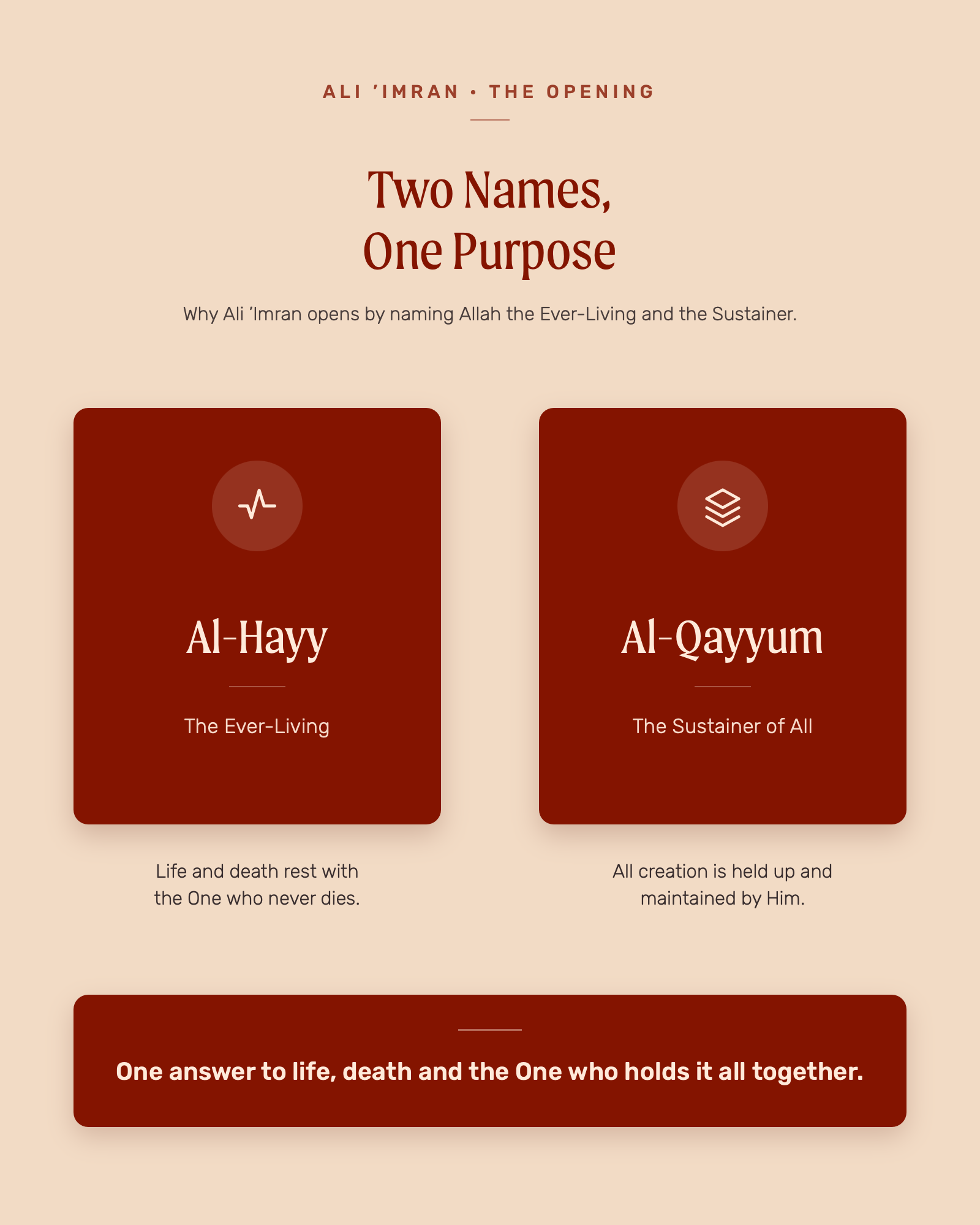
These are the same words that open Ayat al-Kursi (2:255),2 which the reader has only recently passed in Al-Baqarah, so the surah is picking up a thread the heart already recognizes. The names are chosen with care. Al-Hayy, the Ever-Living and al-Qayyum, the One who maintains everything else, speak directly to a conversation this surah is about to have with the Christians of its audience (3:2).3 Questions about whether God could live or die, who was sustaining the universe during the events of the crucifixion and who gives and takes life run straight into these two names. Life is, in fact, a recurring theme across this whole passage and the surah front-loads it.
A Book Sent Down With Purpose
نَزَّلَ عَلَيْكَ ٱلْكِتَٰبَ بِٱلْحَقِّ >
“He sent down to you the Book in truth.”
(3:3)
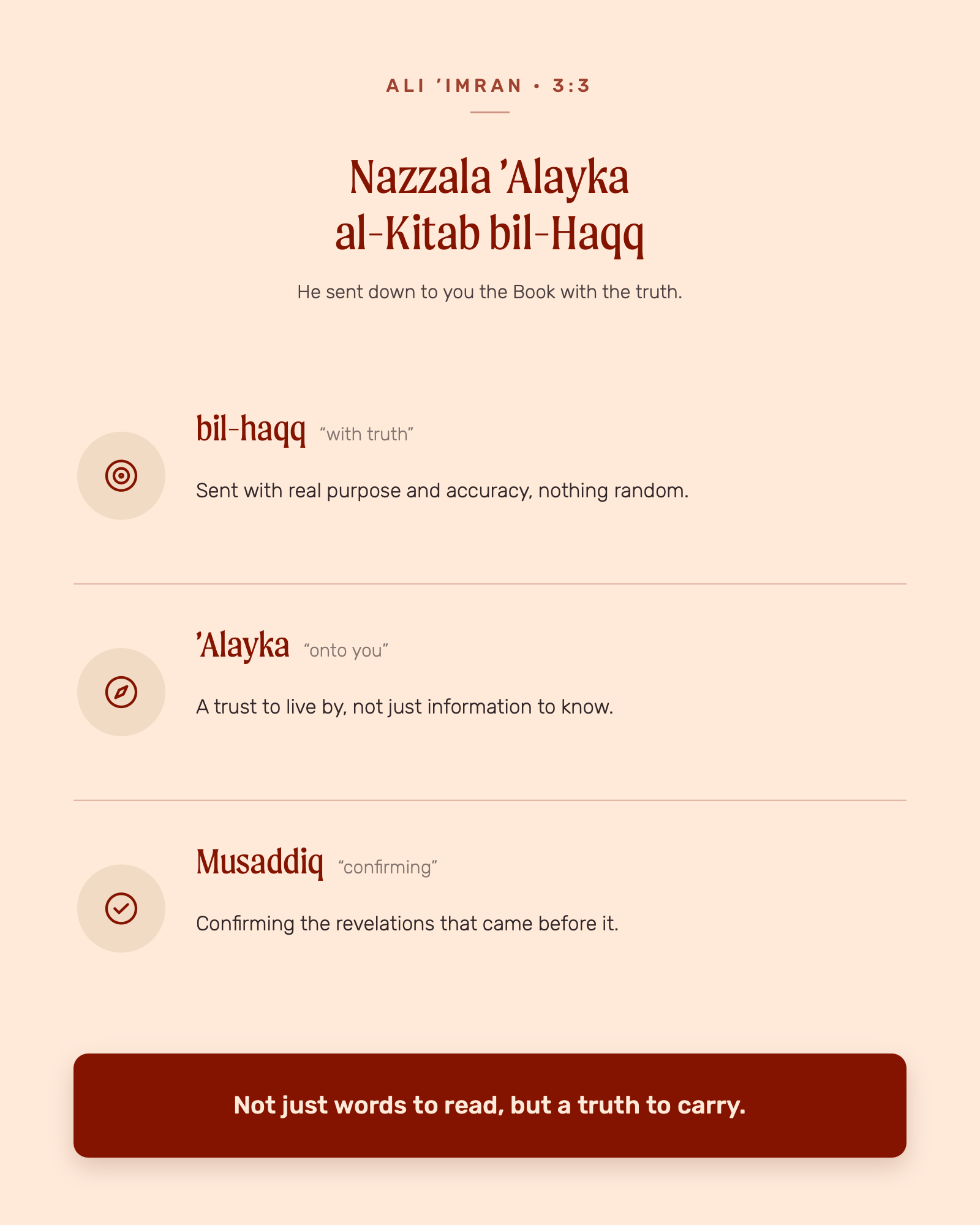
The wording here is deliberate (3:3).4 Saying that Allah is the one who sent the Book down answers those who claimed the revelation came from anywhere but God. The phrase bil-haqq carries several layers at once: the Book was sent with purpose and an agenda, it was sent accurately and without tampering and it came to the one who rightly deserved to receive it. The same ayah adds that it confirms what came before it, authenticating whatever true revelation remained in earlier scripture and making clear what had been added to it.
Sent Onto You, Not Just To You
There is a small preposition doing big work. Surah Al-Baqarah described revelation as sent “to” the Prophet ﷺ (2:4),5 a wording that highlights favor and being chosen. Here Surah Ali ‘Imran says it was sent “onto” him and in Arabic that carries the sense of a responsibility placed on someone, something to be carried and lived by. This matters because part of the surah speaks to a belief that the law no longer needs to be practiced. By saying the Book came as something to be implemented, the opening answers that idea before it is even raised: revelation is a trust to act on, not merely information to receive.
The Tawrat and the Injeel
The ayah then mentions that Allah also sent down the Tawrat and the Injeel, using a slightly lighter verb for them than the emphatic one used for the Quran and noting that the Quran was still being revealed over time while the earlier scriptures had already come down in full. The names themselves are rich. The root behind Tawrat carries meanings of knowledge, guidance, evidence and light and the Quran elsewhere describes the Tawrat as containing guidance and light (5:44).6 The word Injeel, at its root, means something clear and evident, even a clarifier, which fits how the Quran presents Isa (AS) as coming with clear signs to clarify what people were differing about.
The Takeaway
Before Surah Ali ‘Imran makes a single argument, its opening has already framed everything. It names Allah as the Ever-Living and the Sustainer, it insists the Book came from Him with purpose and accuracy, it presents that Book as a trust to live by and it places this revelation in one line with the scriptures that came before. Studying the Quran well asks for exactly this kind of reorientation, again and again: remembering whose words these are before we form an opinion about them.
There is far more in these opening ayat than a single article can hold. You can explore the full Ali ‘Imran: A Deeper Look series on Bayyinah TV, alongside the other surahs being opened up in the Deeper Look collection.
Related reading: The Hidden Symmetry of Surah Ali ‘Imran, From First Passage to Last (the companion post in this series).
Notes
[1] Quran, 3:1, https://quran.com/3/1 ↩
[2] Quran, 2:255 (Ayat al-Kursi), https://quran.com/2/255 ↩
[3] Quran, 3:2, https://quran.com/3/2 ↩
[4] Quran, 3:3, https://quran.com/3/3 ↩
[5] Quran, 2:4, https://quran.com/2/4 ↩
[6] Quran, 5:44 (the Tawrat as guidance and light; cf. 5:46 for the Injeel), https://quran.com/5/44 ↩

At Bayyinah, we are dedicated to helping you connect directly with the words of Allah beyond translation. Founded by Ustadh Nouman Ali Khan, our mission is to create transformative experiences that deepen your understanding and engagement with the Quran.
Study the Quran and Arabic in a systematic and personalized way through Bayyinah TV. Get started today for free.
Check out our newest articles, fresh off the press and ready for you to dive into!