
Successful subscription! Thank you for subscribing.
Successful subscription! Thank you for subscribing.

July 24, 2026
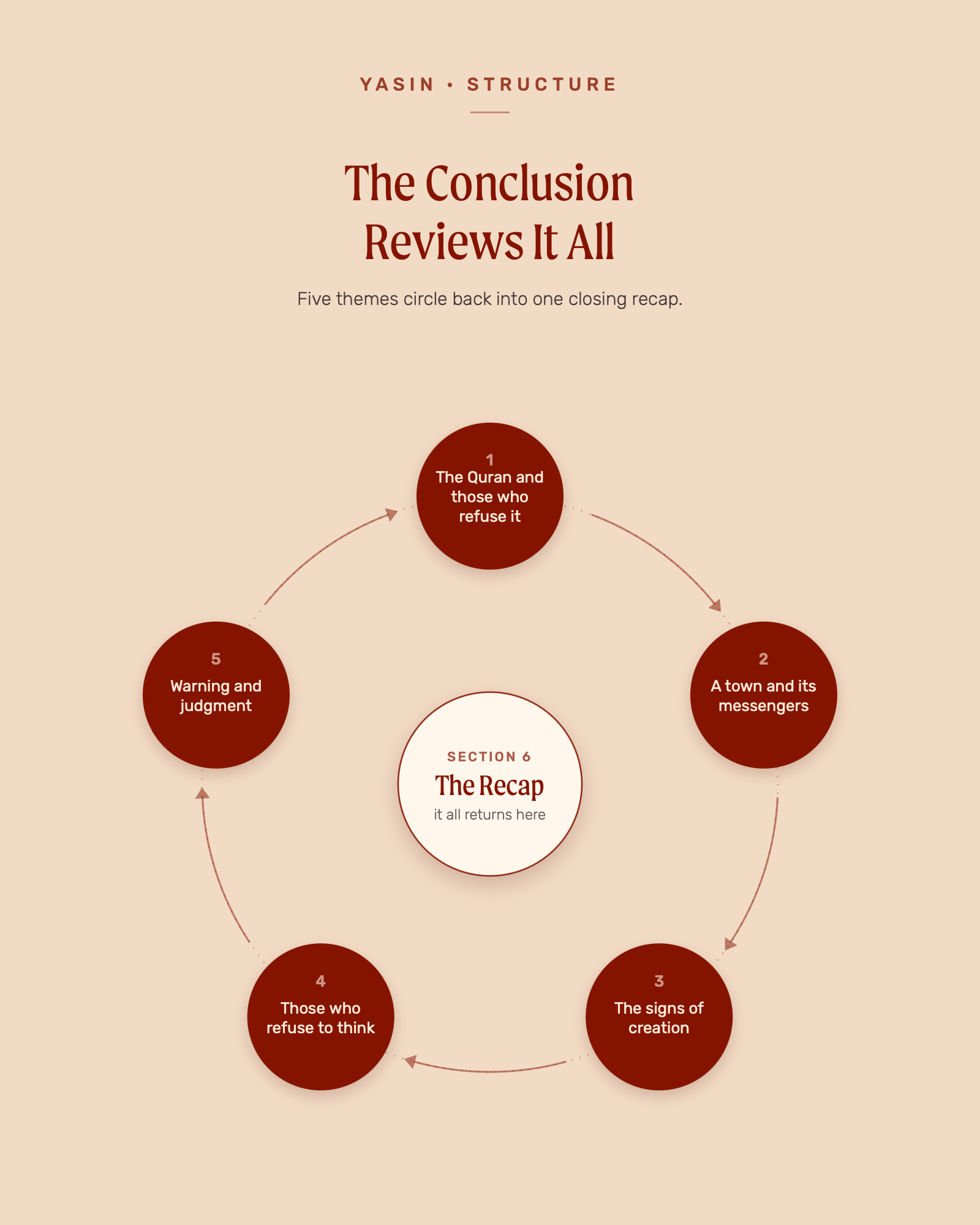
Surah Yasin moves through six sections and the last one is not new material. It is a conclusion and a deliberate one. In its closing verses, Allah revisits the core idea of every earlier section, one after another, so the listener leaves with the whole surah gathered up in a single review. Read this way, the ending does not feel abrupt. It feels like a circle quietly closing. This post walks that final section and shows how each piece of it reaches back to something the surah already said.
Six Sections, One Recap
Before the conclusion, the surah covers five movements: an opening about the Quran and those who refuse to respond to it, with consolation for the Prophet ﷺ; a history of a town, its three messengers and one lone believer; the signs of creation all around us and how we are meant to think about them; the people who simply refuse to think; and a section on warning and judgment. The sixth section takes each of these and brings it back, so that the surah’s guiding lessons are reviewed on the way out.
“We Did Not Teach Him Poetry”
The conclusion opens by returning to the very first claim of the surah (36:69)1.
وَمَا عَلَّمْنَاهُ الشِّعْرَ وَمَا يَنبَغِي لَهُ
“We did not teach him poetry, nor is it befitting for him.”
(36:69)
The Prophet ﷺ loved poetry and kept the company of great poets, but he himself could not compose it, famously stumbling even when he tried to repeat a line. This is no accident. The verse closes by calling the Quran a reminder and a clear recital. A reminder, dhikr, is for the heart; clarity is for the mind. So the Quran is meant to be spiritual and intellectual at once, moving the heart while clearing the mind. That is the same Quran called Hakeem at the very start of the surah, now described again from a different angle.
The Signs You Already Own
Next the conclusion reaches back to the signs of creation, but this time through the animals we own (36:71)2. We did not make them; they were made for us, humbled before us, so that we ride them, eat from them and drink from them. There is a quiet lesson folded into the image: the cattle are submitted to their owners and serve a purpose and an owner does not tolerate an animal that refuses its purpose. If even the things you own are humbled to you, why have you not humbled yourself before the One who owns you? And yet, the surah notes, people still turn to false gods for help (36:74)3, help those gods could never give.
When Pride Starts an Argument
Then the conclusion confronts the real disease underneath the denial: pride. Did the human being not see that We made him from a mere drop and then suddenly he stands up as an open opponent (36:77)4? He even dares to ask who could possibly give life to bones once they have crumbled to dust, forgetting his own beginning. The answer is given plainly: the One who made them the first time will give them life again. The same power that started you can restart you.
Fire From a Green Tree
Then comes one of the most striking images in the surah (36:80)5.
الَّذِي جَعَلَ لَكُم مِّنَ الشَّجَرِ الْأَخْضَرِ نَارًا
“He who produces fire for you from the green tree.”
(36:80)
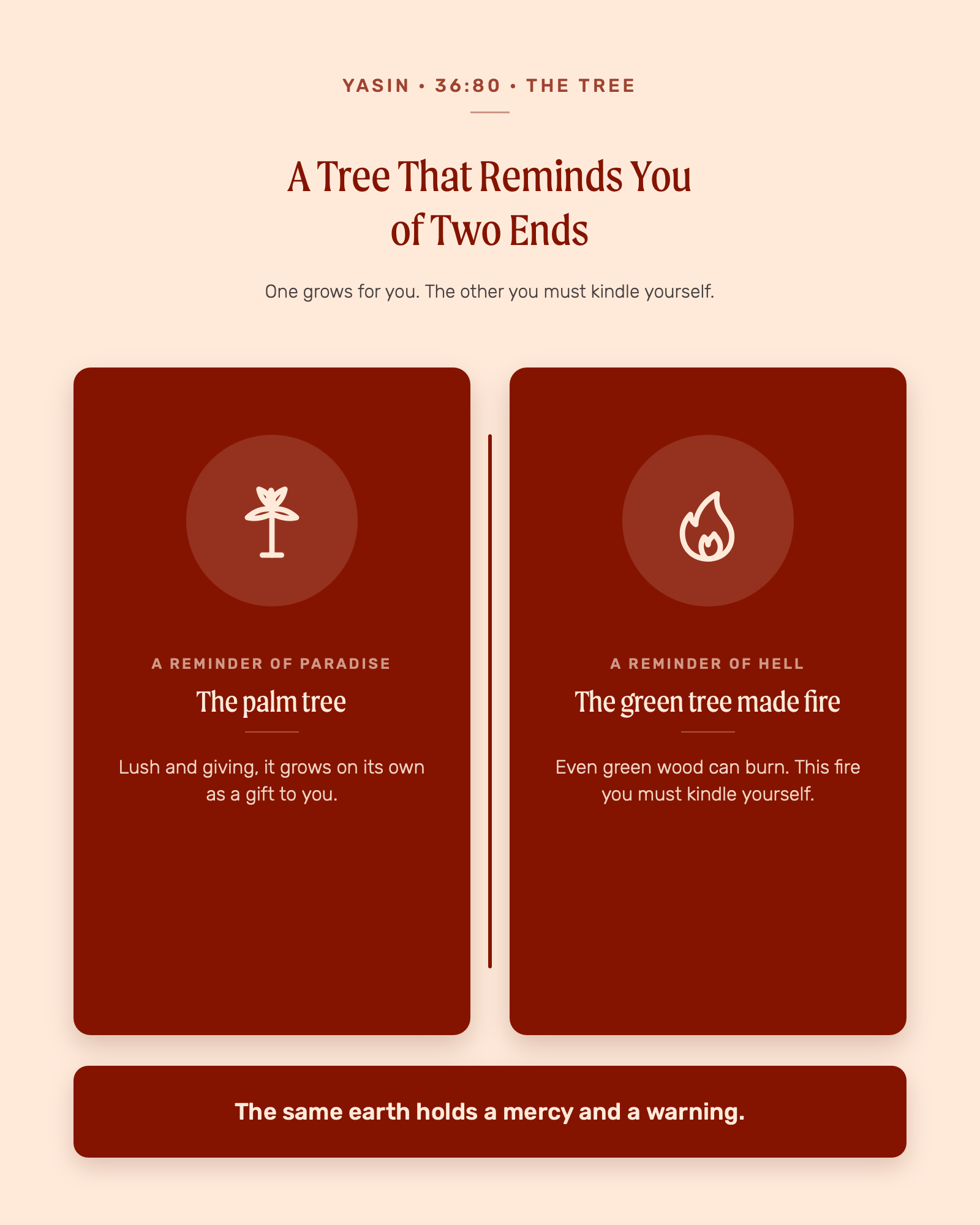
Earlier in the surah, the palm tree was a reminder of Paradise. Now a tree appears again, but this one is turned into fire, a reminder of Hell. And here is the lesson woven into it: the fruit of a tree grows on its own, but a green, living tree does not burst into flame by itself. You have to take something good and work to set it alight. The path to the Garden is natural; the fire of Hell is something a person goes out of their way to kindle for themselves. Allah did not throw you into the fire. You lit it.
“Be and It Is”
Having reopened the question of resurrection, the surah settles it. Is the One who created the heavens and the earth not able to create the like of them again? Of course He is, for His command is simple (36:82)6.
إِنَّمَا أَمْرُهُ إِذَا أَرَادَ شَيْئًا أَن يَقُولَ لَهُ كُن فَيَكُونُ
“His command, when He intends a thing, is only that He says to it ‘Be,’ and it is.”
(36:82)
Destroying a people, the surah had said, takes only a single blast. Recreating them is easier still: a single word. And there is a beautiful echo here. The word kun brings physical life and the Quran, also the word of Allah, brings life to dead hearts. Two dimensions of the same divine speech, both at work in this surah.
Returned to Him
The surah ends by gathering ownership and return into one final glorification (36:83)7.
فَسُبْحَانَ الَّذِي بِيَدِهِ مَلَكُوتُ كُلِّ شَيْءٍ وَإِلَيْهِ تُرْجَعُونَ
“So glory be to the One in whose hand is the dominion of all things and to Him you will be returned.”
(36:83)
You owned cattle; Allah owns everything. And the closing line, to Him you will be returned, is itself a return to the lone believer from the history section, the man who told his people that he believed in their Lord and that they would all be returned to Him. They killed him for saying it. Now Allah says it Himself, in His own voice, as the final word of the surah. The circle is complete.
The Takeaway
Surah Yasin does not trail off; it folds back on itself. Its last section is a careful recap, returning to the Quran, the signs of creation, human pride, resurrection and the certainty of return, each tied back to where it first appeared. The green tree that becomes fire and the single word that gives life are not random wonders. They are the surah reminding you, on the way out, of everything it already taught and leaving you with the One in whose hand everything rests.
There is far more order and depth in Surah Yasin than a single article can hold. You can explore the full Yasin: A Deeper Look series on Bayyinah TV, alongside the other surahs being opened up in the Deeper Look collection.
Related reading: Why Surah Yasin Opens by Calling the Quran “Hakeem” (the companion post in this series).
Notes
[1] Quran, 36:69, https://quran.com/36/69 ↩
[2] Quran, 36:71, https://quran.com/36/71 ↩
[3] Quran, 36:74, https://quran.com/36/74 ↩
[4] Quran, 36:77, https://quran.com/36/77 ↩
[5] Quran, 36:80, https://quran.com/36/80 ↩
[6] Quran, 36:82, https://quran.com/36/82 ↩
[7] Quran, 36:83, https://quran.com/36/83 ↩

At Bayyinah, we are dedicated to helping you connect directly with the words of Allah beyond translation. Founded by Ustadh Nouman Ali Khan, our mission is to create transformative experiences that deepen your understanding and engagement with the Quran.
Study the Quran and Arabic in a systematic and personalized way through Bayyinah TV. Get started today for free.
Check out our newest articles, fresh off the press and ready for you to dive into!