
Successful subscription! Thank you for subscribing.
Successful subscription! Thank you for subscribing.

July 24, 2026
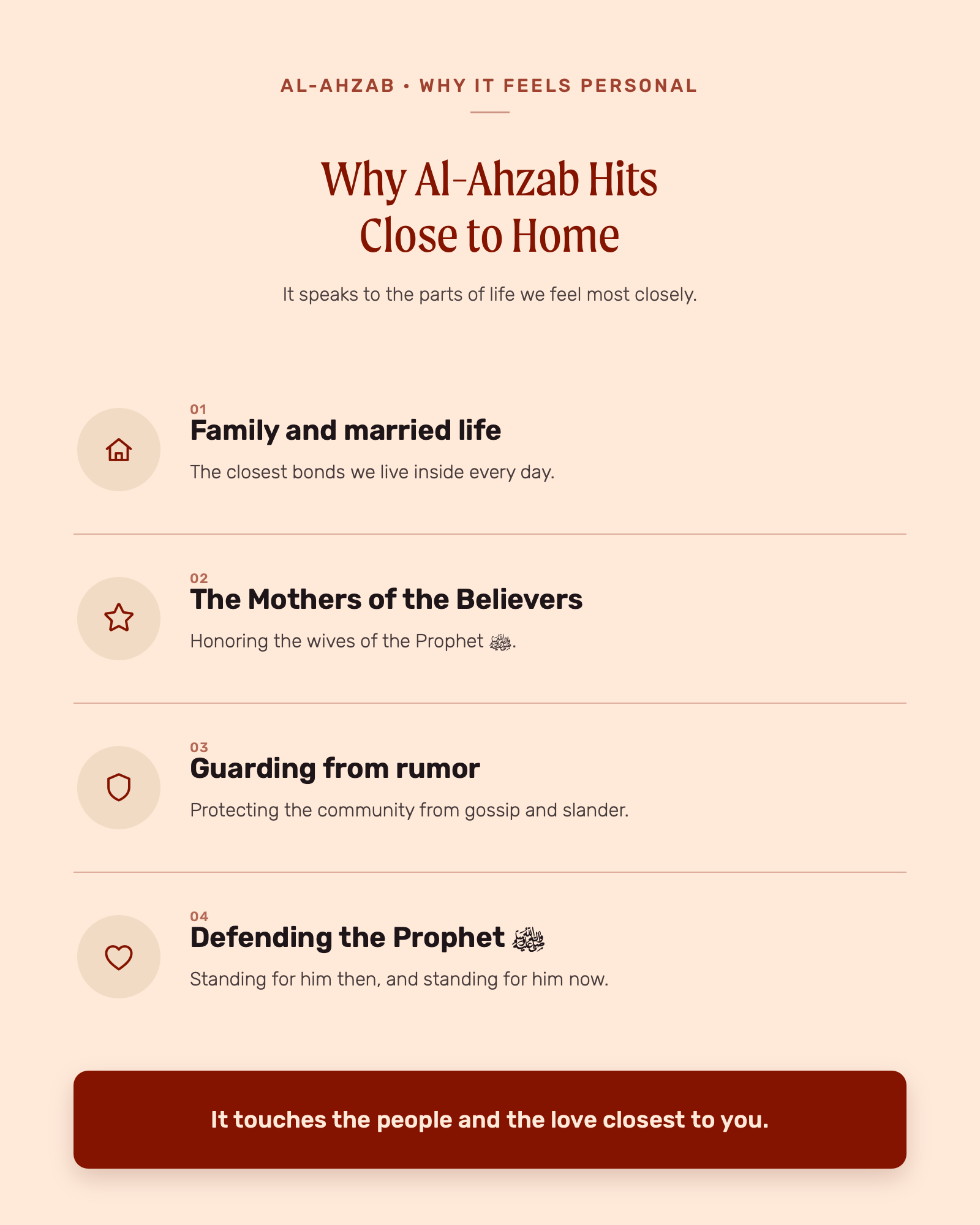
Surah Al-Ahzab does not read like most of the Quran people are used to. It is a Madani surah, with longer verses and a focus that is far more social than purely theological. It moves through family, the Prophet’s married life, the Mothers of the Believers, hypocrisy and the conduct of men and women, all against a tense political and military backdrop. For many readers, that makes it feel unusually close to home and unusually challenging.
This post explores why Surah Al-Ahzab feels so personal: the social ground it covers, the criticisms it answers and why its questions are still ours today.
A Different Kind of Surah
Where much of the Makkan Quran argues for belief itself, Al-Ahzab is largely concerned with how a believing community actually lives: how families work, how spouses treat one another, how a community guards itself from rumor and chaos. The theological never disappears, it simply runs underneath a very human, very social surface. That is part of what gives the surah its intimate, sometimes uncomfortable feel.
Real Names, Real Relationships
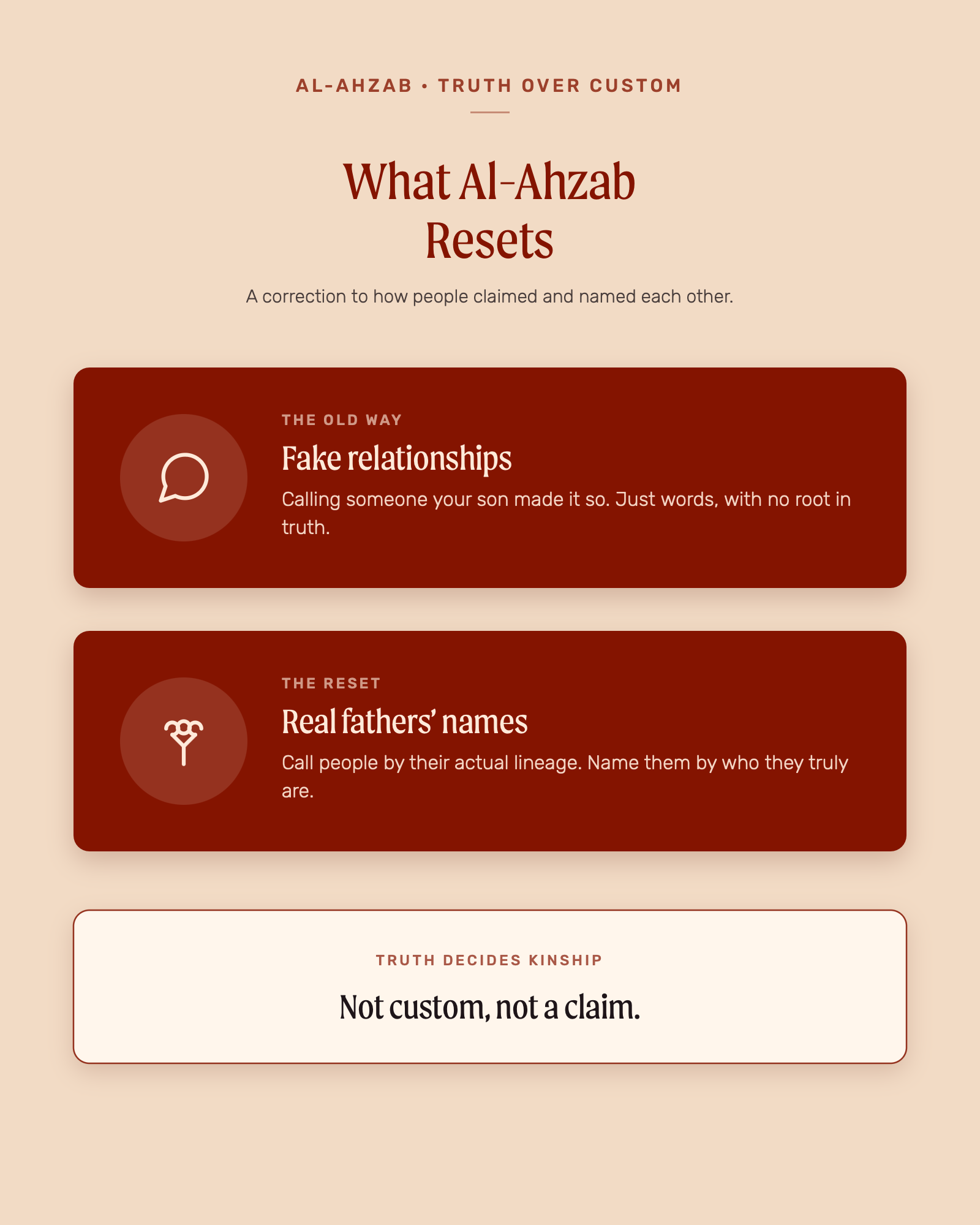
One of its first moves is to reset how relationships are defined. Adopted sons are not to be treated as biological sons; people are to be called by their real fathers’ names (33:5).1 Fake relationships are just words and the surah quietly insists that truth, not custom or sentiment, decides who is actually kin.
Our Mothers
From there the surah gives the wives of the Prophet ﷺ a unique status: they are the mothers of the believers (33:6).2
وَأَزْوَٰجُهُۥٓ أُمَّهَٰتُهُمْ
“And his wives are their mothers.”
(33:6)
This is also where the surah addresses the marriage to Zaynab (RA), an episode that drew criticism then and still does now. The Quran frames it not as scandal but as the dismantling of a false taboo, so that there would be no blame on the believers in a matter Allah had made permissible (33:37).3 The striking thing is that the core of the criticisms aimed at the Prophet ﷺ and the Quran in that moment is essentially the same core we hear today. Understanding how Allah answers them then equips us to answer them now.
A Model to Hold Onto
Through all of this, the surah never lets reverence for the Prophet ﷺ slip. In the middle of the most socially charged material, it reminds us that in the Messenger of Allah there is a beautiful example to follow (33:21).4
لَّقَدْ كَانَ لَكُمْ فِى رَسُولِ ٱللَّهِ أُسْوَةٌ حَسَنَةٌ
“There is certainly for you in the Messenger of Allah an excellent example.”
(33:21)
And it asks the believers to send their prayers and blessings upon him (33:56),5 so that even as difficult subjects are discussed, the heart’s posture toward him stays one of love and honor.
The Takeaway
Surah Al-Ahzab feels personal because it refuses to stay abstract. It walks into our homes, our relationships and our reputations and it defends the Prophet ﷺ in the face of objections that have barely changed in fourteen centuries. Read with the right questions, asking why Allah says what He says and how He is reshaping our view of the Prophet ﷺ, it stops being intimidating and starts feeling like it was written for exactly the conversations we are still having.
There is far more to Surah Al-Ahzab than a single article can hold. You can explore the full Al-Ahzab: A Deeper Look series on Bayyinah TV, alongside the other surahs being opened up in the Deeper Look collection.
Related reading: The Hidden Order of Surah Al-Ahzab and the Trust at Its Heart (the companion post in this series).
Notes
[1] Quran, 33:5, https://quran.com/33/5 ↩
[2] Quran, 33:6, https://quran.com/33/6 ↩
[3] Quran, 33:37, https://quran.com/33/37 ↩
[4] Quran, 33:21, https://quran.com/33/21 ↩
[5] Quran, 33:56, https://quran.com/33/56 ↩

At Bayyinah, we are dedicated to helping you connect directly with the words of Allah beyond translation. Founded by Ustadh Nouman Ali Khan, our mission is to create transformative experiences that deepen your understanding and engagement with the Quran.
Study the Quran and Arabic in a systematic and personalized way through Bayyinah TV. Get started today for free.
Check out our newest articles, fresh off the press and ready for you to dive into!