
Successful subscription! Thank you for subscribing.
Successful subscription! Thank you for subscribing.
July 24, 2026
Surah Al-Ahzab is one of the surahs critics most often point to when they claim the Quran is disorganized. It moves from family to a besieging army to the Prophet’s marriages to laws and warnings, seemingly without a thread. Look closer, though and a deliberate order appears, one that folds the whole surah around its center and resolves, in its very last verse, into a single idea: the trust.
This post traces that structure and then arrives at the amana, the trust, that the surah was building toward all along.
The Surah Critics Call Chaotic
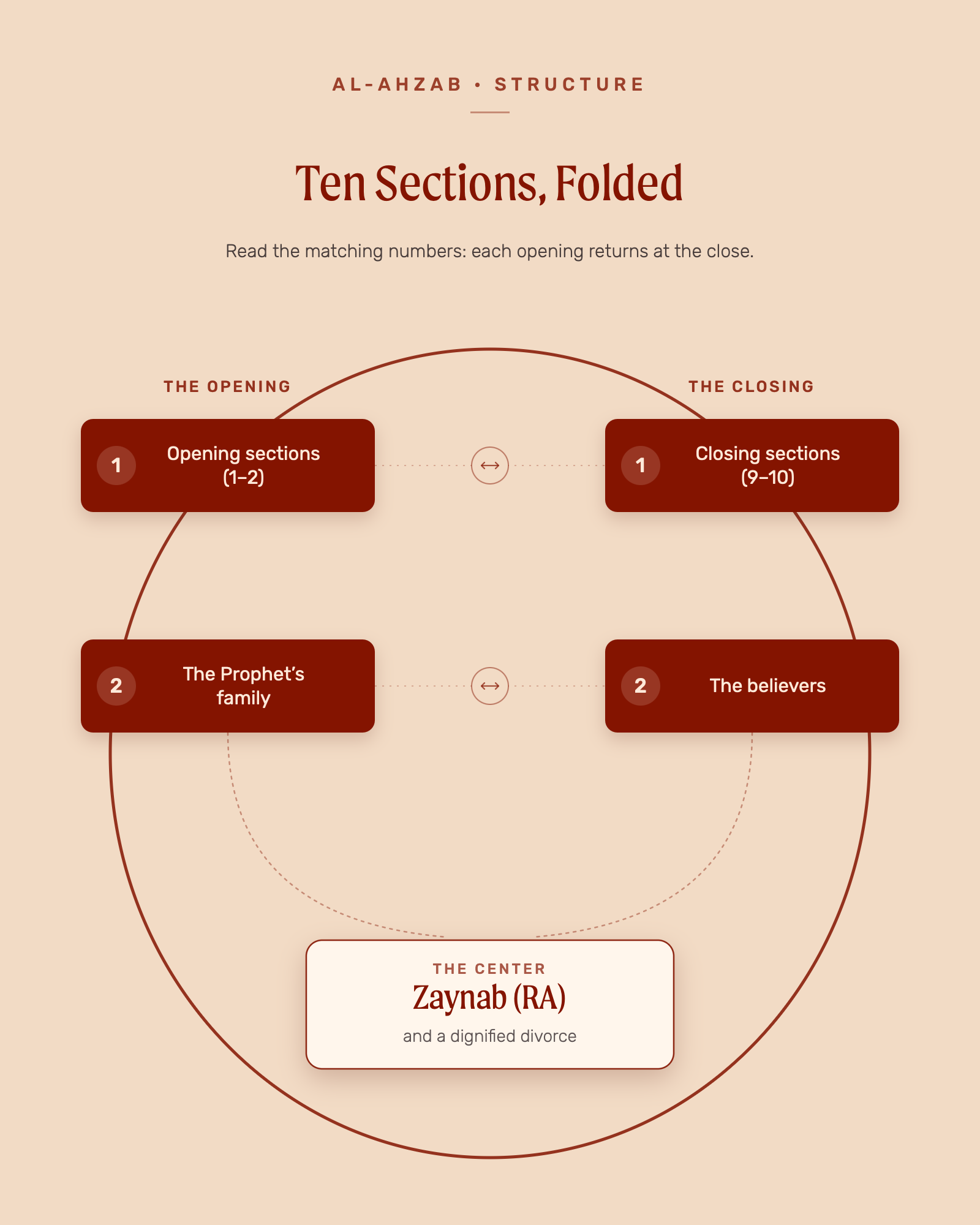
Mapped carefully, Al-Ahzab falls into ten sections and they are not thrown together. The opening two sections mirror the closing two and the six sections in between alternate between the Prophet’s family and the believers, with the most unusual material, the marriage to Zaynab (RA) and the etiquette of a dignified divorce, sitting at the dead center. What looks like chaos is in fact a ring, folded symmetrically around its core.
The Foreshadowing in the Confederates
The one section that seems to break the pattern is the account of the Confederates, the allied armies that besieged Madinah (33:9).1 Read closely, it foreshadows the rest of the surah. The enemy came from every side, eyes deviated and hearts reached the throats (33:10),2 and those very images return as the surah’s later themes: a community whose homes are threatened with fitna, eyes that must be lowered, hearts that must be kept in place and the danger of assumptions and sharp tongues. The military siege quietly previews the spiritual and social sieges that follow.
The Trust at the End
All of this builds to the surah’s closing statement, one of the heaviest in the Quran (33:72).3
إِنَّا عَرَضْنَا ٱلْأَمَانَةَ عَلَى ٱلسَّمَٰوَٰتِ وَٱلْأَرْضِ وَٱلْجِبَالِ فَأَبَيْنَ أَن يَحْمِلْنَهَا
“We offered the trust to the heavens, the earth and the mountains, but they declined to bear it.”
(33:72)
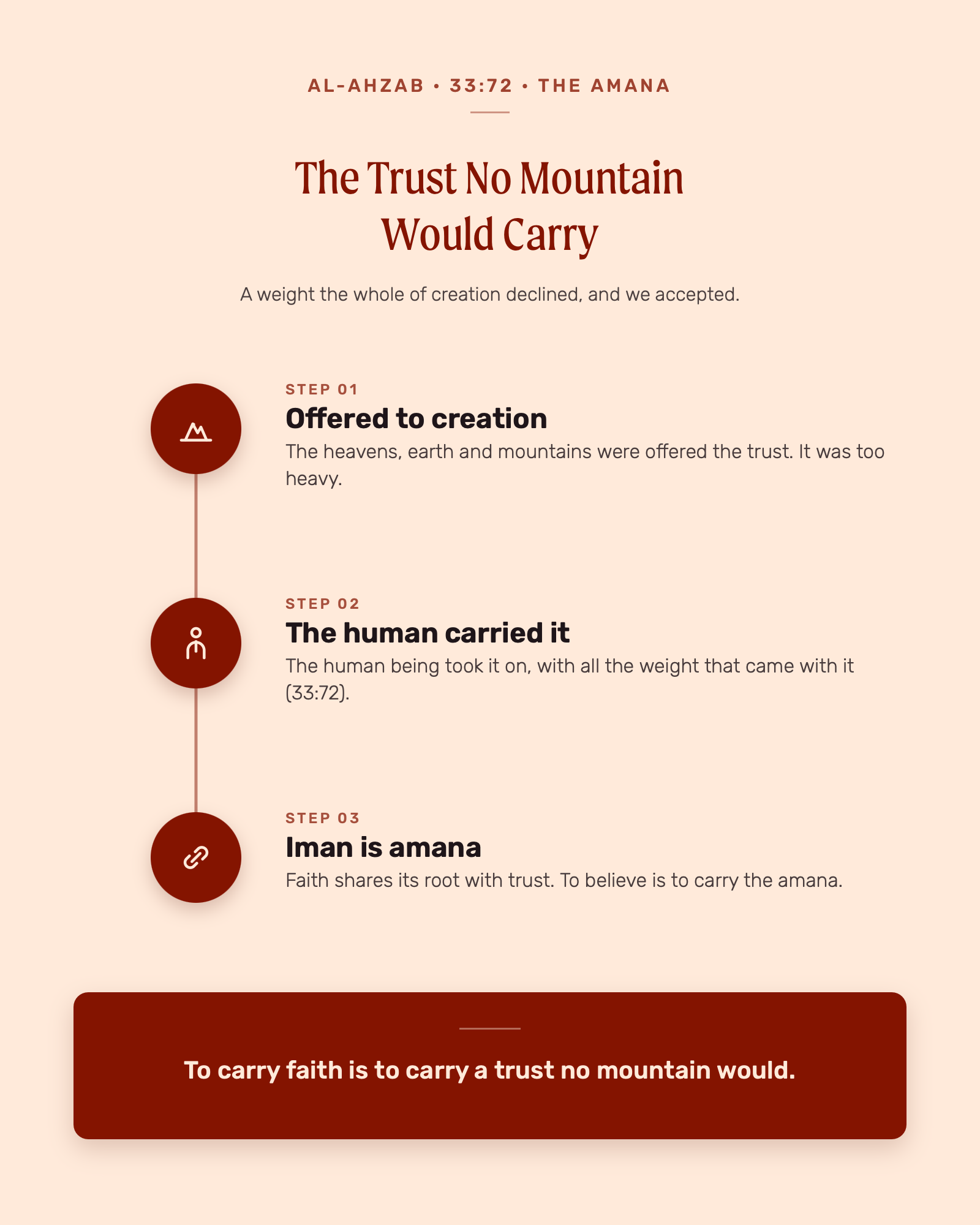
The heavens, the earth and the mountains were offered the trust and were too weak to carry it, yet the human being took it on. Just how heavy this trust is becomes clear elsewhere, where Allah says that had this Quran been sent down on a mountain, you would have seen it humbled and split apart from the fear of Allah (59:21).4
What Makes Us Able to Carry It
So what could make a human being capable of carrying what mountains could not? The answer the surah points to is the ruh, the soul Allah breathed into us, a light meant to meet the light of His revelation (24:35).5
نُّورٌ عَلَىٰ نُورٍ
“Light upon light.”
(24:35)
The light placed inside every human being and the light sent down as revelation are made for each other. That is why the trust verse (33:72) calls the human being zalum jahul, deeply unjust and ignorant: not because taking the trust was a mistake, but because, having taken it, we so often forget its weight and fall short of it. The trust does not demand that we never fall. It demands that we keep getting back up, which is exactly what repentance is.
The Trust That Holds Everything Together
The very next verse shows why this matters: the consequence of the trust is that Allah will hold the hypocrites and idolaters to account and turn in mercy to the believing men and women (33:73).6 The hypocrites broke the heaviest trust ever given, so they are dealt with first; the believers falter too, but they never let go of their commitment and so their repentance is accepted. The Arabic for trust, amana, shares its root with iman, faith. In the end, our faith simply is the trust and every smaller trust in our lives, with parents, spouses, neighbors and community, flows out of it.
The Takeaway
Surah Al-Ahzab is not chaos. It is a carefully folded whole that gathers family, community, the Prophet ﷺ and a besieging army into one design and then names what was underneath all of it: a trust offered to all creation that only the human being agreed to carry. Read it that way and its last verse does not feel like a sudden ending. It feels like the point the entire surah was quietly moving toward.
There is far more order and depth in Surah Al-Ahzab than a single article can hold. You can explore the full Al-Ahzab: A Deeper Look series on Bayyinah TV, alongside the other surahs being opened up in the Deeper Look collection.
Related reading: Why Surah Al-Ahzab Feels So Personal (the companion post in this series).
Notes
[1] Quran, 33:9, https://quran.com/33/9 ↩
[2] Quran, 33:10, https://quran.com/33/10 ↩
[3] Quran, 33:72, https://quran.com/33/72 ↩
[4] Quran, 59:21, https://quran.com/59/21 ↩
[5] Quran, 24:35, https://quran.com/24/35 ↩
[6] Quran, 33:73, https://quran.com/33/73 ↩

At Bayyinah, we are dedicated to helping you connect directly with the words of Allah beyond translation. Founded by Ustadh Nouman Ali Khan, our mission is to create transformative experiences that deepen your understanding and engagement with the Quran.
Study the Quran and Arabic in a systematic and personalized way through Bayyinah TV. Get started today for free.
Check out our newest articles, fresh off the press and ready for you to dive into!