
Successful subscription! Thank you for subscribing.
Successful subscription! Thank you for subscribing.

July 24, 2026
Before opening Surah Al-Kahf, it is worth pausing on something we usually skip: how we come to the Quran in the first place. Studying Arabic or grammar has only academic prerequisites, but the Quran has something more important, a set of inner, psychological prerequisites. You can learn a great deal about the Book and still walk away without its guidance if the heart is in the wrong posture.
This post explores that posture: the mindset the Quran asks of us before it opens up its guidance.
Guidance Asks Something of Us
We treat the words Quran and guidance as almost interchangeable and we ask for guidance every time we recite Al-Fatihah (1:6).1
ٱهْدِنَا ٱلصِّرَٰطَ ٱلْمُسْتَقِيمَ
“Guide us to the straight path.”
(1:6)
Yet we rarely ask what it actually takes to receive that guidance. The Book does not hand it over automatically to anyone who reads the words. It responds to a certain emotional and spiritual state and the rest of these prerequisites are really about reaching that state.
Keep Your Moral Compass Intact
Every human being is born with a moral compass, a basic sense of decency the Prophet ﷺ described as the fitrah that every child is born upon (Al-Bukhari 1385).2 Across every culture, people recognize gratitude, honesty, patience, kindness and humility as good and recoil from injustice. These are the very qualities the Quran calls us back to, which means they were meant to be alive in us already. When that compass is buried, even a person with a great deal of religious knowledge can read the Quran and get no guidance from it, because the part of them that responds to guidance has gone quiet.
Come as a Seeker, Not a Critic
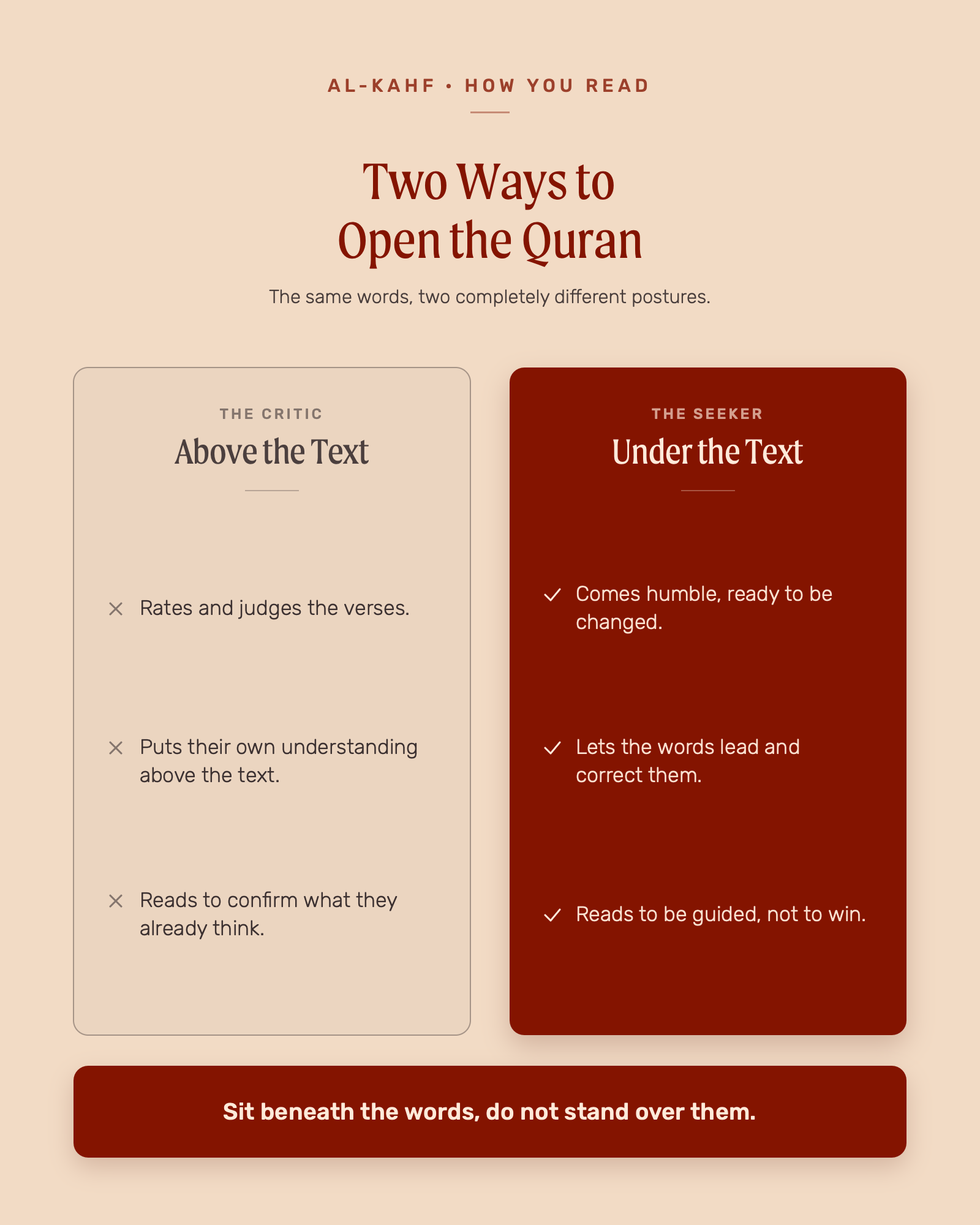
We are trained to critique everything: books, films, restaurants, even people. Bring that habit to the Quran and you have quietly placed your own understanding above the words of Allah, deciding that anything that does not immediately satisfy you must fall short. That posture closes the door to guidance before it opens.
This is part of why the second surah opens not with a lesson you can master but with three letters, Alif Lam Mim (2:1).3 The first thing the student of the Quran learns is that they do not know, an attitude check before anything else. It is also why the same Book guides many and lets many go astray (2:26);4 the difference is the attitude the reader brings. None of this means we cannot ask hard questions. We can absolutely critique a scholar’s interpretation, because that is a human attempt to understand the Book. What we do not sit in judgment over is the word of Allah itself.
Be Ready to Let Go of What You Assumed
Coming for guidance means being willing to change your mind when the Quran shows you something different from what you assumed, even when it is costly. Take a common assumption in some cultures that a husband may demand his wife’s wealth. The Quran ties a husband’s role as caretaker of the household precisely to the fact that he spends from his own wealth (4:34),5 which turns that assumption on its head. If the word of Allah is not powerful enough to move you to change, then you have not really come to it for guidance.
What Guidance Actually Does
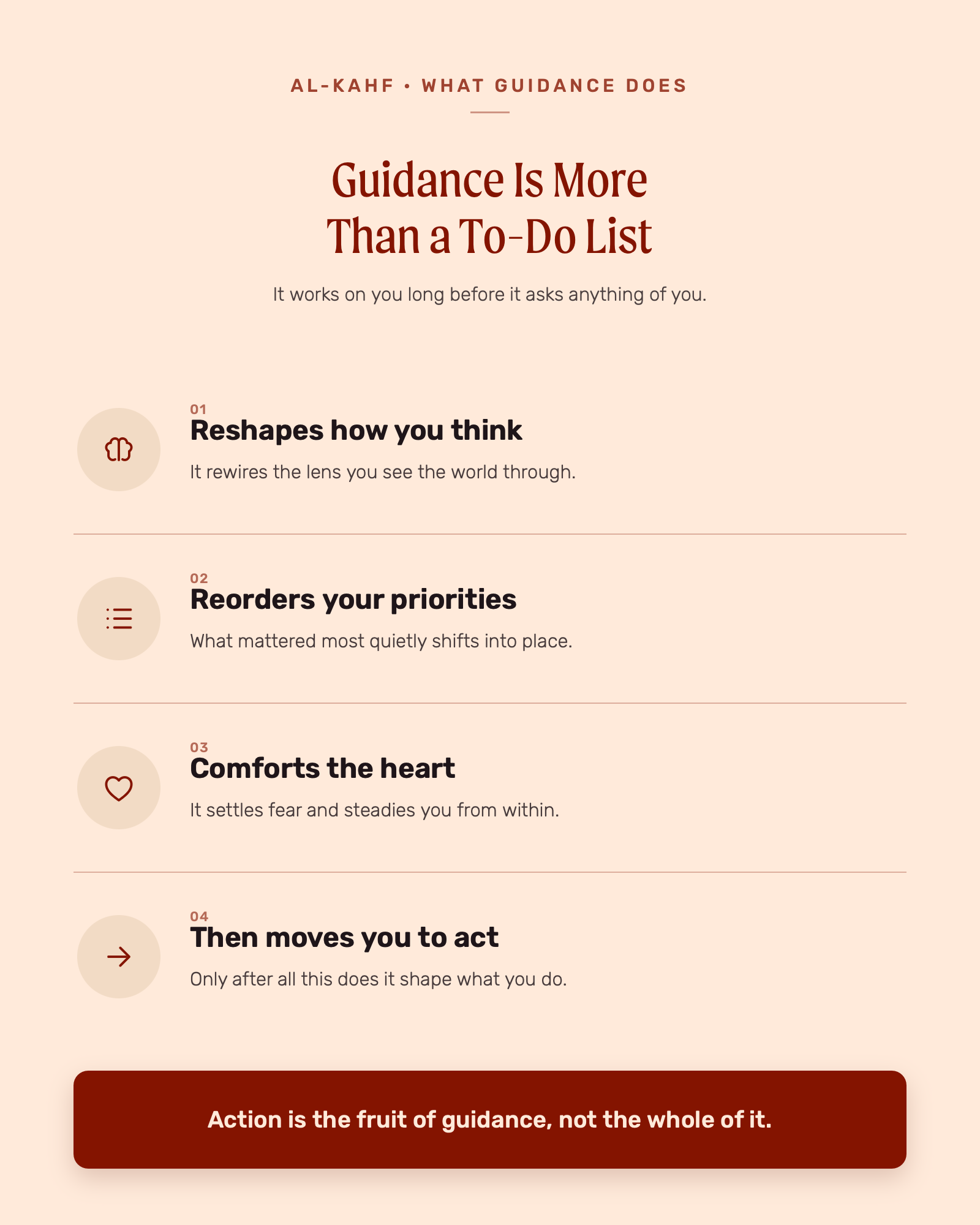
Guidance is not only a list of actions. Before it asks anything of your hands, it reshapes how you think and see the world, so that a field of flowers or rain on dry ground becomes a reminder of resurrection rather than just scenery. It reorders your priorities, moving what is truly valuable to the front. And it comforts the heart in hardship, so that opening the Book in a difficult moment brings exactly the reassurance you needed. Only then does it move you to act and even then the One who legislates tells us He intends ease for us, not hardship (2:185).6
The Slave, Not the Consumer
People sometimes ask why the Quran is in Arabic rather than tailored to each reader’s language and taste. Underneath that question is a consumer mindset, where the customer is always right and gets to set the terms. But we are not customers of the Quran and Allah is not selling us anything. The whole premise is the reverse: we are the servants and He is the Master. Once that is clear, the posture of demanding that revelation be customized to our preferences simply dissolves.
The Takeaway
Surah Al-Kahf, like the rest of the Quran, rewards a particular posture. Come to it with your conscience awake, as a seeker rather than a critic, ready to let it reshape how you think and what you value and humble enough to receive rather than to demand. Approach it that way and the same words that pass others by begin to guide you.
There is far more to gain from Surah Al-Kahf than a single article can hold. You can explore the full Al-Kahf: A Deeper Look series on Bayyinah TV, alongside the other surahs being opened up in the Deeper Look collection.
Related reading: How Surah Al-Kahf Is Built: The Symmetry Behind Its Stories (the companion post in this series).
Notes
[1] Quran, 1:6, https://quran.com/1/6 ↩
[2] Sahih al-Bukhari 1385 (every child is born upon the fitrah), https://sunnah.com/bukhari:1385 ↩
[3] Quran, 2:1, https://quran.com/2/1 ↩
[4] Quran, 2:26, https://quran.com/2/26 ↩
[5] Quran, 4:34, https://quran.com/4/34 ↩
[6] Quran, 2:185, https://quran.com/2/185 ↩

At Bayyinah, we are dedicated to helping you connect directly with the words of Allah beyond translation. Founded by Ustadh Nouman Ali Khan, our mission is to create transformative experiences that deepen your understanding and engagement with the Quran.
Study the Quran and Arabic in a systematic and personalized way through Bayyinah TV. Get started today for free.
Check out our newest articles, fresh off the press and ready for you to dive into!