
Successful subscription! Thank you for subscribing.
Successful subscription! Thank you for subscribing.

July 24, 2026
Surah Al-Fath is one of the most remarkable surahs in the Quran and one of the most counterintuitive. It was revealed about an event, the treaty of Hudaybiyah, that many of the believers at the time experienced as a humiliating setback. And yet its very first word from Allah is victory. To understand the surah, you first have to understand the story behind it and why Allah would call a moment that felt like defeat a clear and open triumph. This post walks through that backdrop and the question at the heart of the surah: what actually counts as victory?
The Most Beloved Surah
The Prophet ﷺ said of this surah that there had been revealed to him a surah dearer to him than everything the sun rises upon (Sahih al-Bukhari)1. That is an extraordinary statement and it tells us that whatever happened at Hudaybiyah, far from being a loss, was something the Prophet ﷺ treasured above the entire world. The rest of the story explains why.
One Year After the Siege
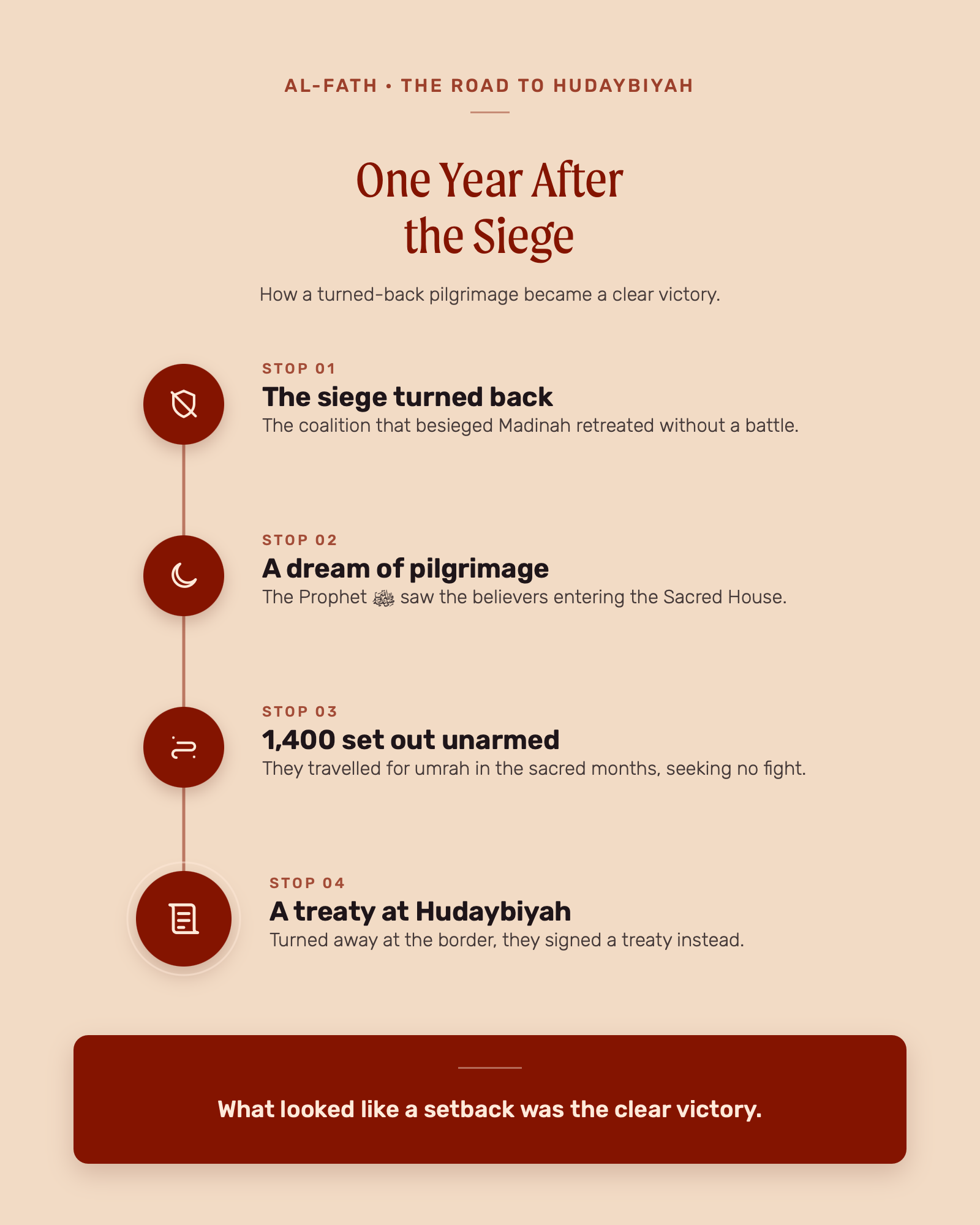
Only a year earlier, Madinah had nearly been wiped out. A coalition of tribes, ten thousand strong, had besieged the city for almost a month, with treachery brewing on the inside, before Allah turned them back with wind and unseen armies. The wound was still fresh. Then the Prophet ﷺ announced that he had seen a dream of making pilgrimage at the Kaaba and the dream of a prophet is revelation. So fourteen hundred believers set out for Makkah, the very people who had nearly destroyed them, not to fight but to worship. They left in a sacred month and traveled openly, in the simple cloth of pilgrimage rather than armor, making their peaceful intention unmistakable.
A Road No One Would Take
When the Quraysh blocked the main road and set an ambush, the believers were guided onto a brutal path: a waterless valley of burning black rock and thorns that tore their feet as they walked it in a single line for a full day. At the end of it, at a near-dry well, the Prophet ﷺ revived the water until fourteen hundred people and their animals drank their fill. Through all of it, the surah later tells us, Allah was sending down tranquility into the hearts of the believers (48:4)2, a calm that did not come from their circumstances but from Him.
هُوَ ٱلَّذِىٓ أَنزَلَ ٱلسَّكِينَةَ فِى قُلُوبِ ٱلْمُؤْمِنِينَ
“It is He who sent down tranquility into the hearts of the believers.”
(48:4)
When a Setback Is Named a Victory
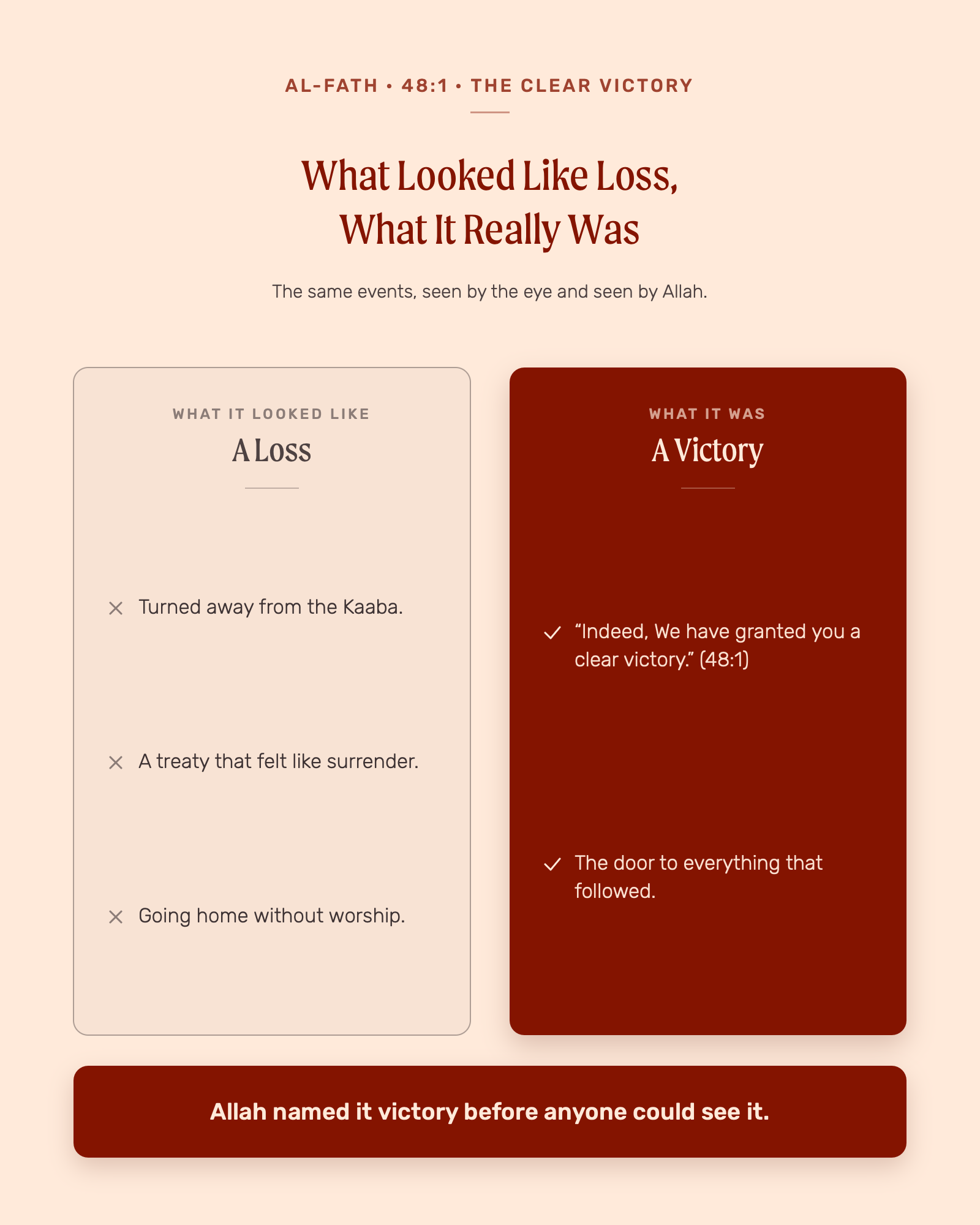
At Hudaybiyah the believers were turned away from the Kaaba and made to sign a treaty whose terms felt, to many of them, like surrender. They had come to worship and were going home without it. And it was precisely in that moment that Allah revealed (48:1)3.
إِنَّا فَتَحْنَا لَكَ فَتْحًا مُّبِينًا
“Indeed, We have granted you a clear victory.”
(48:1)
Not we will grant, but we have granted, already, in the very thing that looked like a loss. The treaty that felt like a defeat opened the door to everything that followed and the believers who made that painful journey with sincere hearts were the ones Allah was pleased with when they pledged themselves to the Prophet ﷺ (48:18)4. What looked like the end of the mission was in fact its turning point.
The Takeaway
Surah Al-Fath begins by redefining victory. The believers measured success by whether they reached the Kaaba; Allah measured it by something they could not yet see. The lesson is not that setbacks do not hurt, they clearly did, but that our reading of a situation is not the final word on it. What feels like a closed door can be the exact thing Allah uses to open everything. Reading the surah with that in mind, its opening line stops being a puzzle and becomes a kind of training for the heart: to trust Allah’s definition of victory over our own.
There is far more to Surah Al-Fath than a single article can hold. You can explore the full Al-Fath: A Deeper Look series on Bayyinah TV, alongside the other surahs being opened up in the Deeper Look collection.
Related reading: Surah Al-Fath and the Real Meaning of Victory (the companion post in this series).
Notes
[1] Sahih al-Bukhari 4177, https://sunnah.com/bukhari:4177 ↩
[2] Quran, 48:4, https://quran.com/48/4 ↩
[3] Quran, 48:1, https://quran.com/48/1 ↩
[4] Quran, 48:18, https://quran.com/48/18 ↩

At Bayyinah, we are dedicated to helping you connect directly with the words of Allah beyond translation. Founded by Ustadh Nouman Ali Khan, our mission is to create transformative experiences that deepen your understanding and engagement with the Quran.
Study the Quran and Arabic in a systematic and personalized way through Bayyinah TV. Get started today for free.
Check out our newest articles, fresh off the press and ready for you to dive into!