
Successful subscription! Thank you for subscribing.
Successful subscription! Thank you for subscribing.
July 24, 2026
Surah Al-Fath opens with the word victory and most readers assume it is pointing toward the conquest of Makkah. But the surah’s closing verses and its hidden structure, quietly redirect us to something far deeper. By the end, victory is not a city captured or a government established. It is a people transformed and a door to forgiveness thrown open. This post follows the surah’s conclusion and the way the whole chapter is folded around a single, surprising idea.
The Dream Was True
The surah’s final movement returns to the dream that started everything. Allah confirms that He fulfilled His Messenger’s vision in truth: the believers would indeed enter the Sacred Mosque in security, heads shaved or shortened, without fear (48:27)1. The verse adds the words ‘if Allah wills,’ teaching us never to speak of the future without them and reminds the believers that entering Makkah would never be about their power but about Allah’s will. He knew, the verse says, what they did not know. In their grief at Hudaybiyah they could not see the good being set in motion, including a nearer victory soon to come.
What “Prevail Over All Religion” Really Means
Then comes one of the surah’s most quoted verses (48:28)2.
هُوَ ٱلَّذِىٓ أَرْسَلَ رَسُولَهُۥ بِٱلْهُدَىٰ وَدِينِ ٱلْحَقِّ لِيُظْهِرَهُۥ عَلَى ٱلدِّينِ كُلِّهِۦ
“It is He who sent His Messenger with guidance and the religion of truth, to make it prevail over all religion.”
(48:28)
Notice who acts in this verse. It opens with ‘It is He,’ Allah, who sends and who makes the truth prevail; victory is never something the verse hands to human ambition. And the Quran explains its own words. The same phrase about a faith made to prevail appears with the followers of Isa (AS), where those who believed were aided by Allah and became dominant (61:14)3, even though they founded no kingdom and their prophet was taken from them. ‘Prevailing,’ then, is the truth being vindicated and made manifest, not a mandate to seize political power. The whole surah is about reaching the Kaaba to perform the rites of pilgrimage, which is to say it is about restoring the legacy of Ibrahim (AS), whose prayer the Prophet ﷺ was sent to answer.
The Prophet’s Real Harvest
The surah’s final verse paints a portrait of the believers themselves (48:29)4.
مُّحَمَّدٌ رَّسُولُ ٱللَّهِ ۚ وَٱلَّذِينَ مَعَهُۥٓ أَشِدَّآءُ عَلَى ٱلْكُفَّارِ رُحَمَآءُ بَيْنَهُمْ
“Muhammad is the Messenger of Allah and those with him are firm against the deniers, merciful among themselves.”
(48:29)
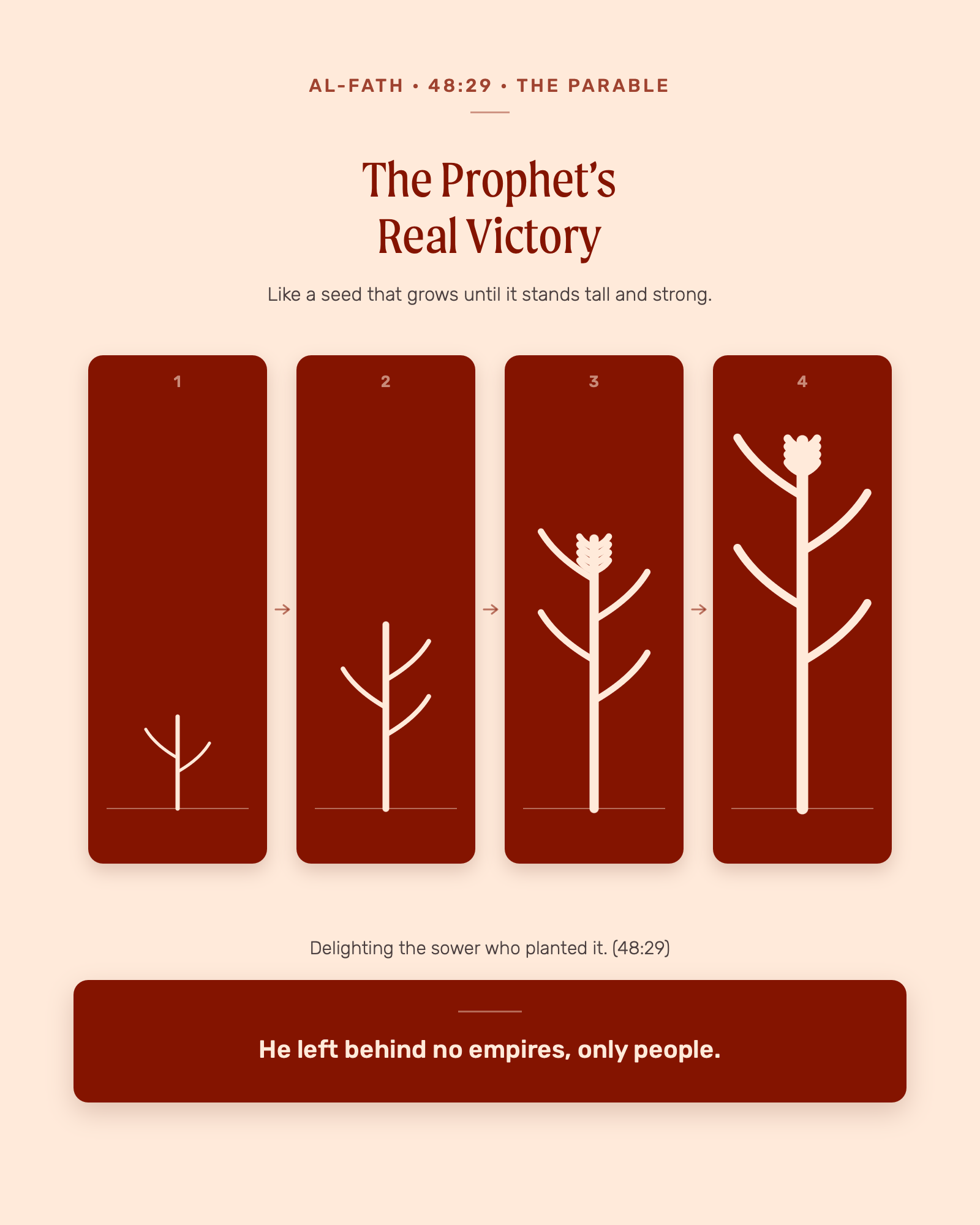
The wording is precise. It says those with him, not simply those who believe, because at Hudaybiyah these were the people who never left his side even when obeying him was almost unbearable. And it calls them firm against the deniers in the very episode where they did not lift a hand, teaching that strength is not always shown by force. The verse then describes them bowing and prostrating, seeking Allah’s grace and pleasure, marked on their faces by the trace of prostration, the humility of people who keep putting their pride on the ground. Finally it likens them, in the Gospel, to a seed that sends out its shoot, grows strong and thick andstands firm on its stalk, delighting the farmer who sowed it. The Prophet ﷺ is that farmer and the believers are his crop. He left behind no buildings or empires. He left behind people and they were his true victory.
A Surah Folded Around Forgiveness
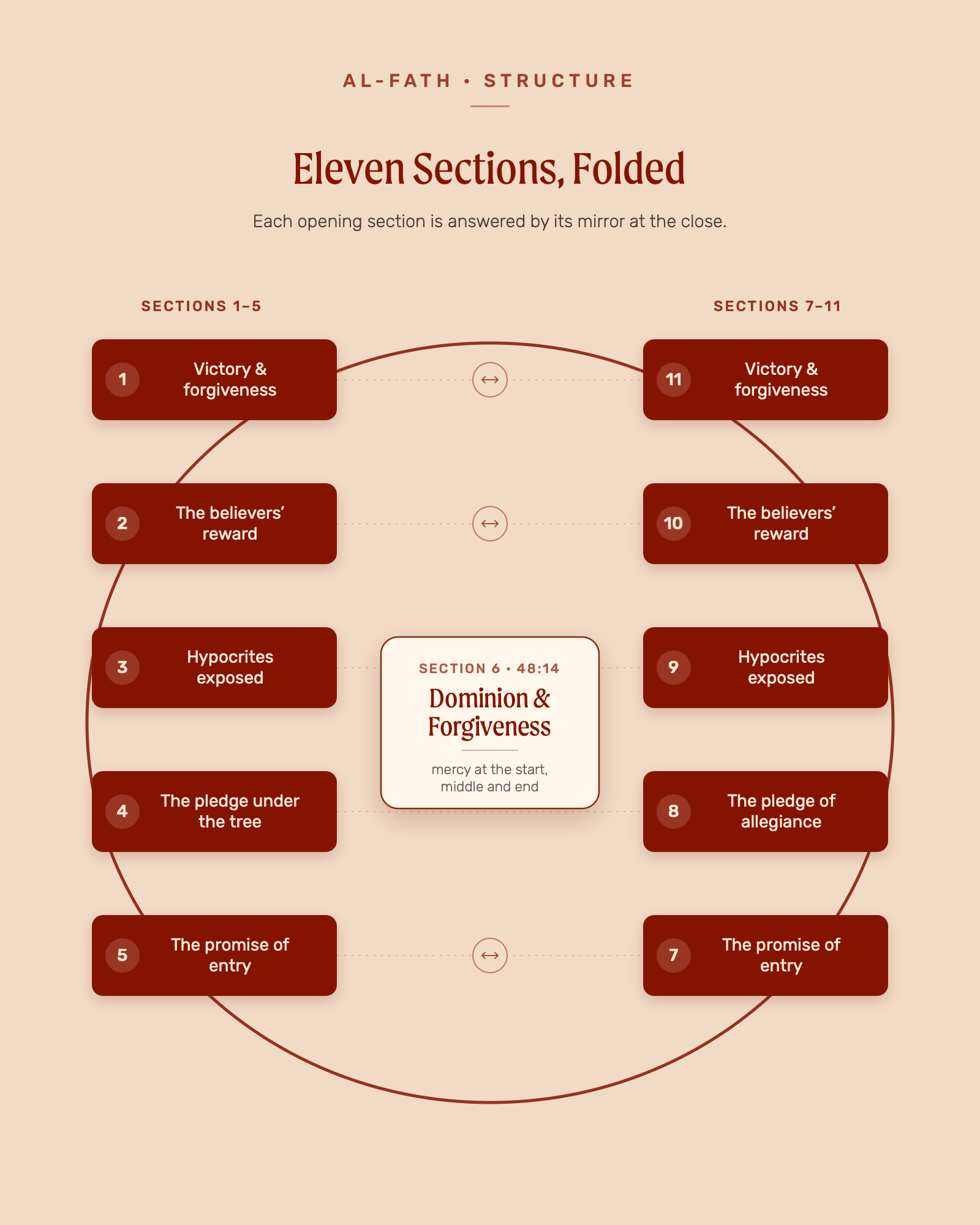
Step back and the whole surah turns out to be built as a ring of eleven sections, folded around a center. The middle section, section six, is a single verse declaring that to Allah belongs the dominion of the heavens and the earth, that He forgives whom He wills (48:14)5. The sections on either side mirror each other outward in matching pairs, until the outermost pair, the first section and the last, speak to one another: the opening promise of victory and the closing promise of forgiveness and a great reward.
And that is the surah’s quiet revelation. Forgiveness sits at its beginning, its exact middle and its end. The believers wanted Makkah because they wanted to perform the pilgrimage and the purpose of the pilgrimage is forgiveness. So when they were turned back, Allah granted them what they had truly come for without the pilgrimage itself. The victory of the opening verse (48:1)6 was a gift to the Prophet ﷺ; the gift to the rest of us is the forgiveness the whole surah keeps returning to.
The Takeaway
Surah Al-Fath completely reshapes what victory means. It begins with what sounds like political triumph and ends with prostrating faces, a maturing crop and an open door to mercy. The conquest was the Prophet’s gift; forgiveness is ours. Read this way, the surah is not really the story of a treaty or a city at all. It is the story of what Allah was actually offering all along and of a community grown mature enough to receive it.
There is far more order and depth in Surah Al-Fath than a single article can hold. You can explore the full Al-Fath: A Deeper Look series on Bayyinah TV, alongside the other surahs being opened up in the Deeper Look collection.
Related reading: Why Allah Calls the Setback at Hudaybiyah a “Clear Victory” (the companion post in this series).
Notes
[1] Quran, 48:27, https://quran.com/48/27 ↩
[2] Quran, 48:28, https://quran.com/48/28 ↩
[3] Quran, 61:14, https://quran.com/61/14 ↩
[4] Quran, 48:29, https://quran.com/48/29 ↩
[5] Quran, 48:14, https://quran.com/48/14 ↩
[6] Quran, 48:1, https://quran.com/48/1 ↩

At Bayyinah, we are dedicated to helping you connect directly with the words of Allah beyond translation. Founded by Ustadh Nouman Ali Khan, our mission is to create transformative experiences that deepen your understanding and engagement with the Quran.
Study the Quran and Arabic in a systematic and personalized way through Bayyinah TV. Get started today for free.
Check out our newest articles, fresh off the press and ready for you to dive into!