
Successful subscription! Thank you for subscribing.
Successful subscription! Thank you for subscribing.
July 24, 2026
One of the oldest criticisms leveled at the Quran is that it is disorganized, that it jumps from topic to topic without a plan. Surah Qaf is a quiet, complete answer to that charge. Mapped carefully, it turns out to be built as a near-perfect mirror, folding symmetrically around its center, with each passage neatly bracketed at its opening and close. This post traces that structure and shows how the surah’s shape is itself part of its message.
It Ends Where It Begins
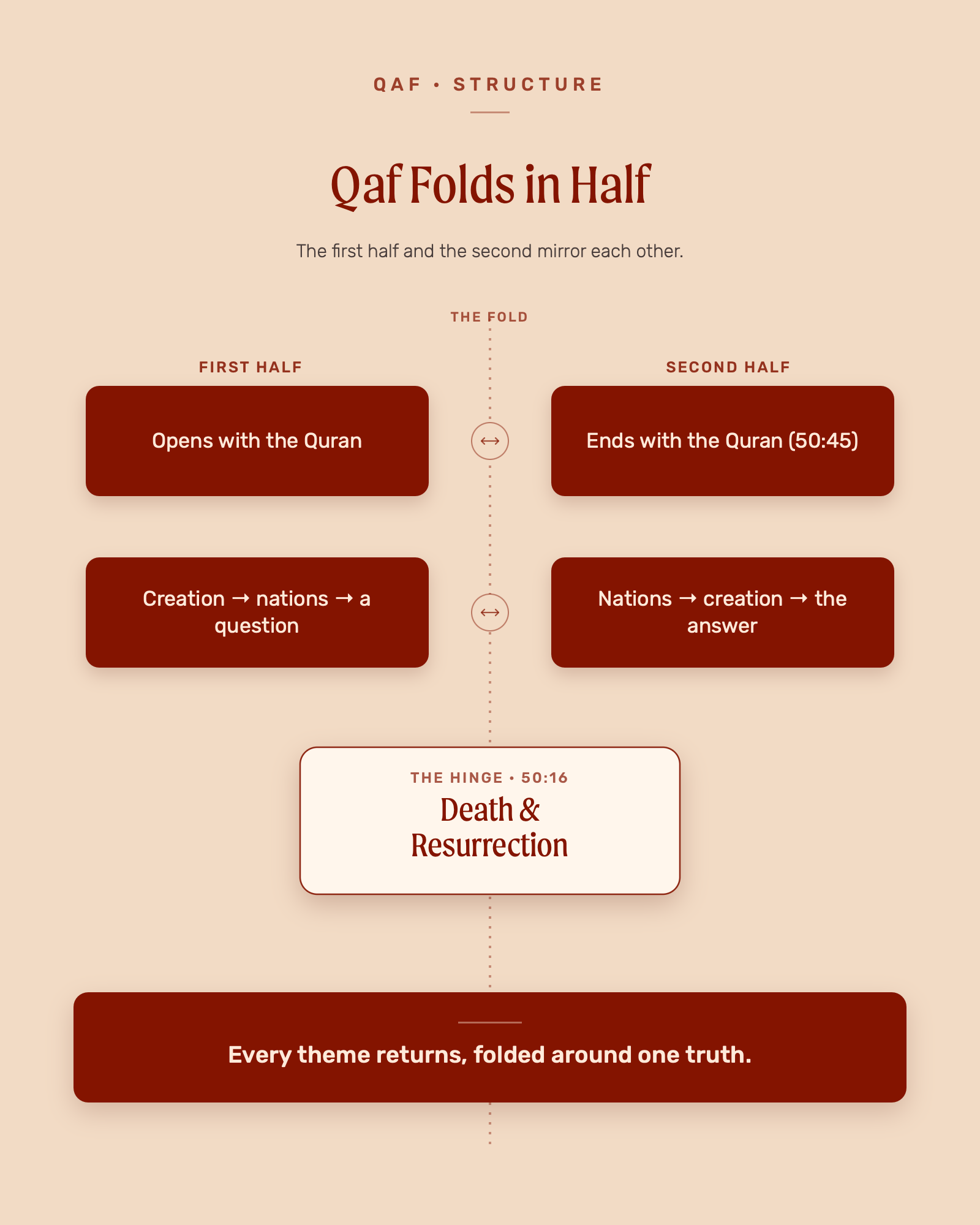
The surah opens with an oath by the glorious Quran, followed immediately by the deniers’ reaction to it (50:1)1. They found two things hard to accept: that a warner had come at all and that they could be brought back to life after death and decay. Now look at how the surah ends. After all the evidence is laid out, it returns to the Prophet ﷺ and tells him how to respond to that same denial and it closes, once again, on the Quran (50:45)2.
فَذَكِّرْ بِٱلْقُرْءَانِ مَن يَخَافُ وَعِيدِ
“So remind by the Quran whoever fears My warning.”
(50:45)
The surah opened with the Quran and the deniers’ stance; it ends with the Prophet’s response and the Quran. The two ends are mirror images of one another. And the response Allah prescribes is telling: be patient over what they say, pray and keep reminding. Where the deniers called the truth a lie and turned away, the Prophet ﷺ is told to do the opposite, to affirm the truth through prayer and to keep reminding by the Quran, leaving their words to Allah.
Folded Around a Center
Work inward and the mirror holds. Near the start, the surah moves from the beauty and purpose of creation, to the nations destroyed before, to a piercing question: were We exhausted by the first creation (50:15)3? Near the end, the very same elements return in reverse, the destroyed nations, then the creation of the heavens and the earth and then the answer to that question (50:38)4.
وَلَقَدْ خَلَقْنَا ٱلسَّمَٰوَٰتِ وَٱلْأَرْضَ وَمَا بَيْنَهُمَا فِى سِتَّةِ أَيَّامٍ وَمَا مَسَّنَا مِن لُّغُوبٍ
“We created the heavens and the earth and what is between them in six days and no fatigue touched Us.”
(50:38)
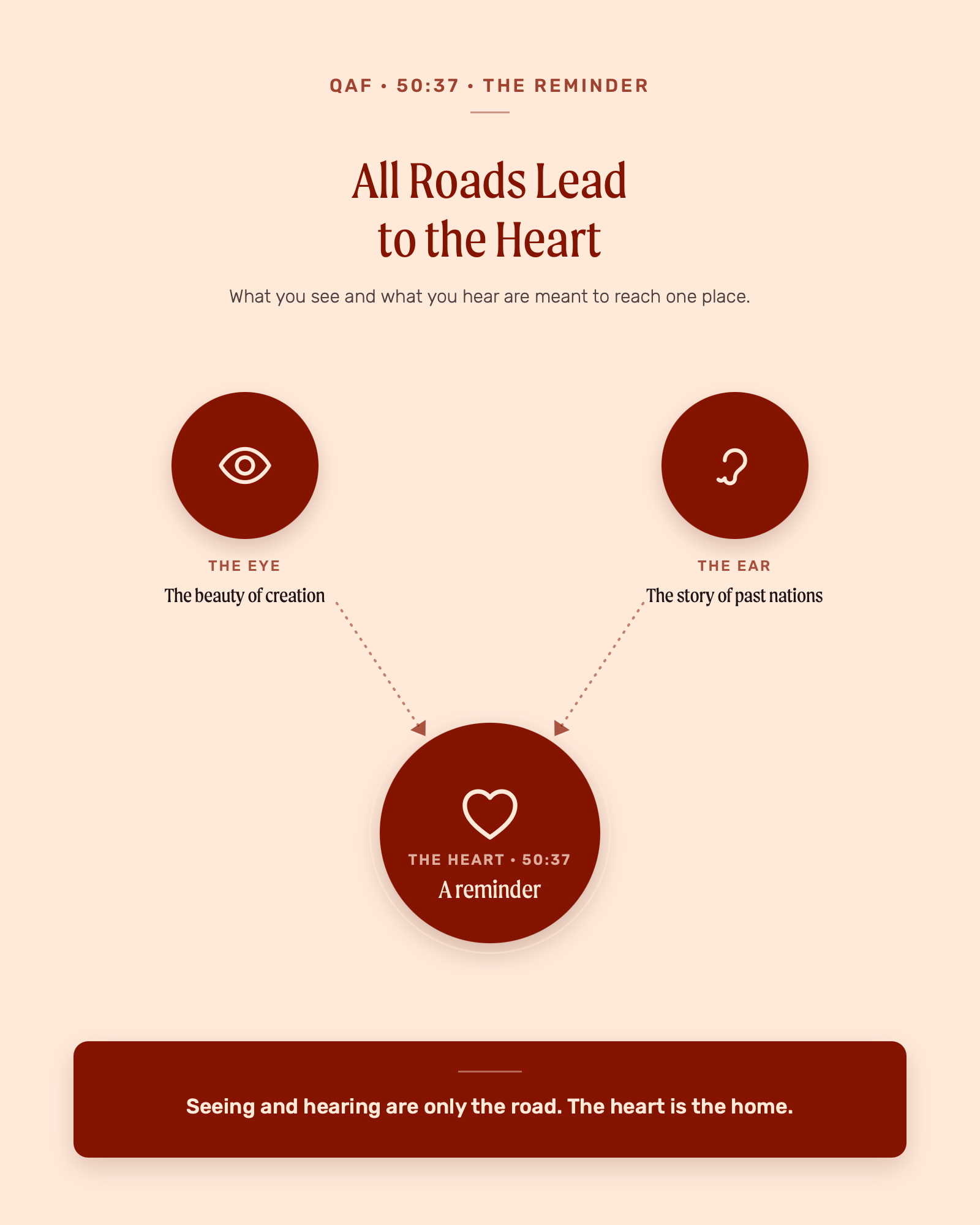
There is a beautiful refinement in the mirroring. When the surah first speaks of creation, it calls it something to see and reflect on; when it first speaks of history, it is something to hear about. By the end, it tells us that history too is a reminder for the heart. Sight, hearing and heart, the very faculties the Quran says we will be questioned about, are each drawn in. What your eyes take in and what your ears take in are both meant to reach the same place: your heart.
The Heart of the Matter
At the very center of this folded structure sits what the whole surah is really about: death and resurrection. This is where Allah says He created the human being and knows what his soul whispers to him and that He is nearer to him than his own jugular vein (50:16)5.
وَنَحْنُ أَقْرَبُ إِلَيْهِ مِنْ حَبْلِ ٱلْوَرِيدِ
“And We are closer to him than his jugular vein.”
(50:16)
From that center the surah moves through the moment of death, the two recording angels, the trial in which a person and their inner companion are brought to account and finally the believers welcomed into the Garden. Everything on either side, the creation, the history, the questions, exists to bring the listener to accept this one reality at the core. The arguments are the outer rings; the afterlife is the center they all protect.
Why the Shape Is the Message
This symmetry is not decoration. The surah began by quoting people who found the Quran strange and far-fetched and then it answers them not only with what it says but with how flawlessly it is built. Each passage opens and closes on a matching word, the first passage framed by the Quran and the record-keeping Book (50:4)6, others bracketed by repeated key terms, like parentheses around a perfectly balanced thought. For a text delivered orally, across years and circumstances, this degree of structure is genuinely difficult to explain. It is part of why scholars, including non-Muslim academics, increasingly find the Quran far more deliberately organized than the old criticism assumed.
The Takeaway
Surah Qaf is not a scattered collection of warnings. It is a single, carefully folded design: it opens and closes on the Quran, mirrors creation against history on both sides and wraps everything around the reality of death and resurrection at its heart. The shape carries the meaning. A surah that answers the charge of disorder by being one of the most ordered things you could read and that points, through all of it, to the One who is nearer to us than our own jugular vein.
There is far more order and depth in Surah Qaf than a single article can hold. You can explore the full Qaf: A Deeper Look series on Bayyinah TV, alongside the other surahs being opened up in the Deeper Look collection.
Related reading: Why the Prophet ﷺ Recited Surah Qaf at the Biggest Gatherings (the companion post in this series).
Notes
[1] Quran, 50:1, https://quran.com/50/1 ↩
[2] Quran, 50:45, https://quran.com/50/45 ↩
[3] Quran, 50:15, https://quran.com/50/15 ↩
[4] Quran, 50:38, https://quran.com/50/38 ↩
[5] Quran, 50:16, https://quran.com/50/16 ↩
[6] Quran, 50:4, https://quran.com/50/4 ↩

At Bayyinah, we are dedicated to helping you connect directly with the words of Allah beyond translation. Founded by Ustadh Nouman Ali Khan, our mission is to create transformative experiences that deepen your understanding and engagement with the Quran.
Study the Quran and Arabic in a systematic and personalized way through Bayyinah TV. Get started today for free.
Check out our newest articles, fresh off the press and ready for you to dive into!