
Successful subscription! Thank you for subscribing.
Successful subscription! Thank you for subscribing.

July 24, 2026
Surah Qaf is a Makki surah and the Prophet ﷺ had a special relationship with it. He returned to it again and again in his largest public gatherings. That choice is itself a lesson. To understand why he reached for this surah in front of crowds, we have to understand what kind of surah it is and what the Quran is actually trying to do when it speaks to us. This post explores Surah Qaf as a surah of reminder and the way it builds belief by appealing to both the heart and the mind.
The Surah for the Biggest Gatherings
When Umar (RA) asked what the Prophet ﷺ used to recite on the day of Eid, the answer was Surah Qaf, along with Surah Al-Qamar (Sahih Muslim)1. This was a habit: in the great public settings, the Eid prayer, the Friday sermon, the Prophet ﷺ would reach for surahs like this one. And a large gathering, then as now, is not the place for advanced, technical instruction. It is a place for reminder, for reviving people and refreshing what they already carry. A convention does not exist to teach brand-new information; it exists to re-energize a community. Surah Qaf is built for exactly that work.
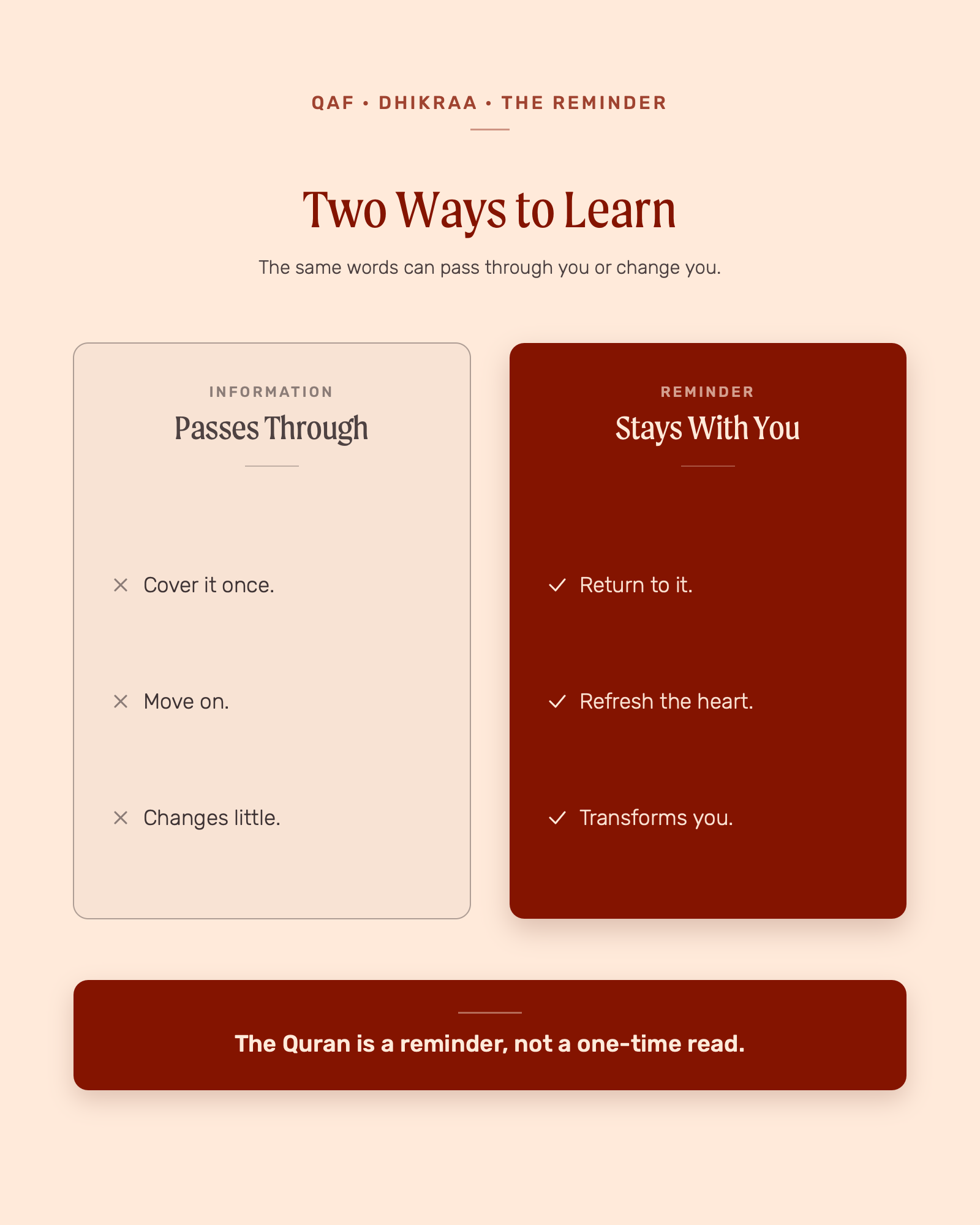
Reminder, Not Just Information
This points to something the modern mind easily misses. We tend to treat learning as the gathering of new information: once a chapter is covered, we move on, because reviewing it teaches us nothing new. The Quran works differently. Its purpose is not merely to inform you but to transform you. A reminder takes a truth you already know, one that has gone quiet or rusty inside you and makes it fresh again until it changes the way you think and live. That is why the prophets repeated themselves so often and why a child can ace a test on Islamic manners and still break every one of them. Information without internalization changes nothing. Reminder is how the Quran keeps working on the heart.
This is why the surah ends by naming exactly who it is for (50:37)2.
إِنَّ فِى ذَٰلِكَ لَذِكْرَىٰ لِمَن كَانَ لَهُۥ قَلْبٌ
“Indeed in that is a reminder for whoever has a heart.”
(50:37)
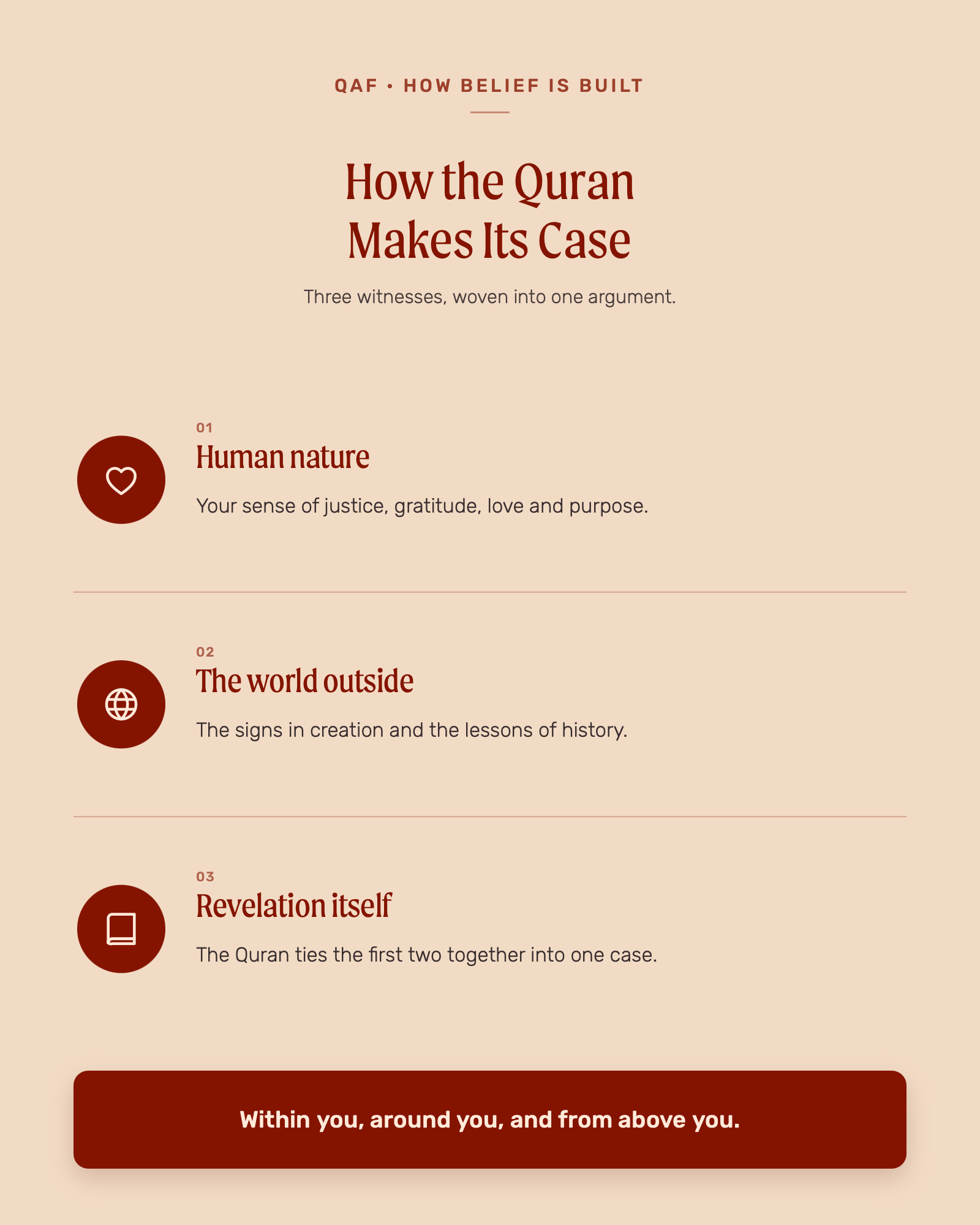
How the Quran Wins the Heart and the Mind
Surah Qaf is mostly about one of the three great beliefs the Quran keeps returning to: belief in Allah, belief in the afterlife and belief in revelation. This surah’s center is the afterlife and it makes its case the way the Quran always does, not by dry logic alone but through three lines of evidence. The first is human nature itself, the sense of justice, gratitude, love and purpose that every person is born with. The second is the world outside us: the order and beauty of creation and the lessons buried in the history of past nations. The third is revelation itself, which, once you give it a chance, fuses the first two together so seamlessly that the heart recognizes its source.
And each of these works on two levels at once. There is an intellectual side, the scientist studying the cosmos, the historian dating the ruins, the scholar parsing the grammar of a verse and a spiritual side, the person who simply smells a flower and says how perfect or weeps while reciting. The Quran refuses to let us pick one over the other. It speaks to the mind and the heart together, which is precisely why it can move a packed hall and satisfy a careful thinker at the same time.
A Surah You Are Meant to Feel
The surah opens with an oath by the Quran itself (50:1)3 and from there it presses gently on the listener’s heart: the wonder of creation, the fate of those who came before, the nearness of death, the certainty of return. It is not trying to win an argument so much as to wake something up. Read as the Prophet ﷺ used it, in a crowd that already believed, Surah Qaf is not new information at all. It is a reminder aimed straight at the heart, asking only that the heart be awake enough to receive it.
The Takeaway
The Prophet ﷺ recited Surah Qaf to crowds because crowds need reminding, not lecturing. The surah’s power is not in telling us something we have never heard; it is in taking what we already know about Allah, the afterlife and revelation and making it live again. That is the whole project of the Quran: not to fill the mind with facts, but to transform the person. And it will only reach those who come to it with a heart that is still listening.
There is far more to Surah Qaf than a single article can hold. You can explore the full Qaf: A Deeper Look series on Bayyinah TV, alongside the other surahs being opened up in the Deeper Look collection.
Related reading: The Hidden Symmetry of Surah Qaf (the companion post in this series).
Notes
[1] Sahih Muslim 891, https://sunnah.com/muslim:891 ↩
[2] Quran, 50:37, https://quran.com/50/37 ↩
[3] Quran, 50:1, https://quran.com/50/1 ↩

At Bayyinah, we are dedicated to helping you connect directly with the words of Allah beyond translation. Founded by Ustadh Nouman Ali Khan, our mission is to create transformative experiences that deepen your understanding and engagement with the Quran.
Study the Quran and Arabic in a systematic and personalized way through Bayyinah TV. Get started today for free.
Check out our newest articles, fresh off the press and ready for you to dive into!