
Successful subscription! Thank you for subscribing.
Successful subscription! Thank you for subscribing.

May 18, 2026
Muslim organizations are remarkably good at identifying problems. A 15-year-old education forum spends 80% of its sessions on the same unresolved curriculum question. Masajid websites list 85 links before you can find the prayer times. We know what is broken. We have known for decades. The challenge has never been diagnosis; it has been the willingness to focus.
The Quran, in a single phrase from Surah Al-Muzzammil, offers a diagnosis and a prescription. Most of us have read past it.
The Word and What It Actually Means
In Surah Al-Muzzammil, Allah says to the Prophet (SAW) (73:8):[1]
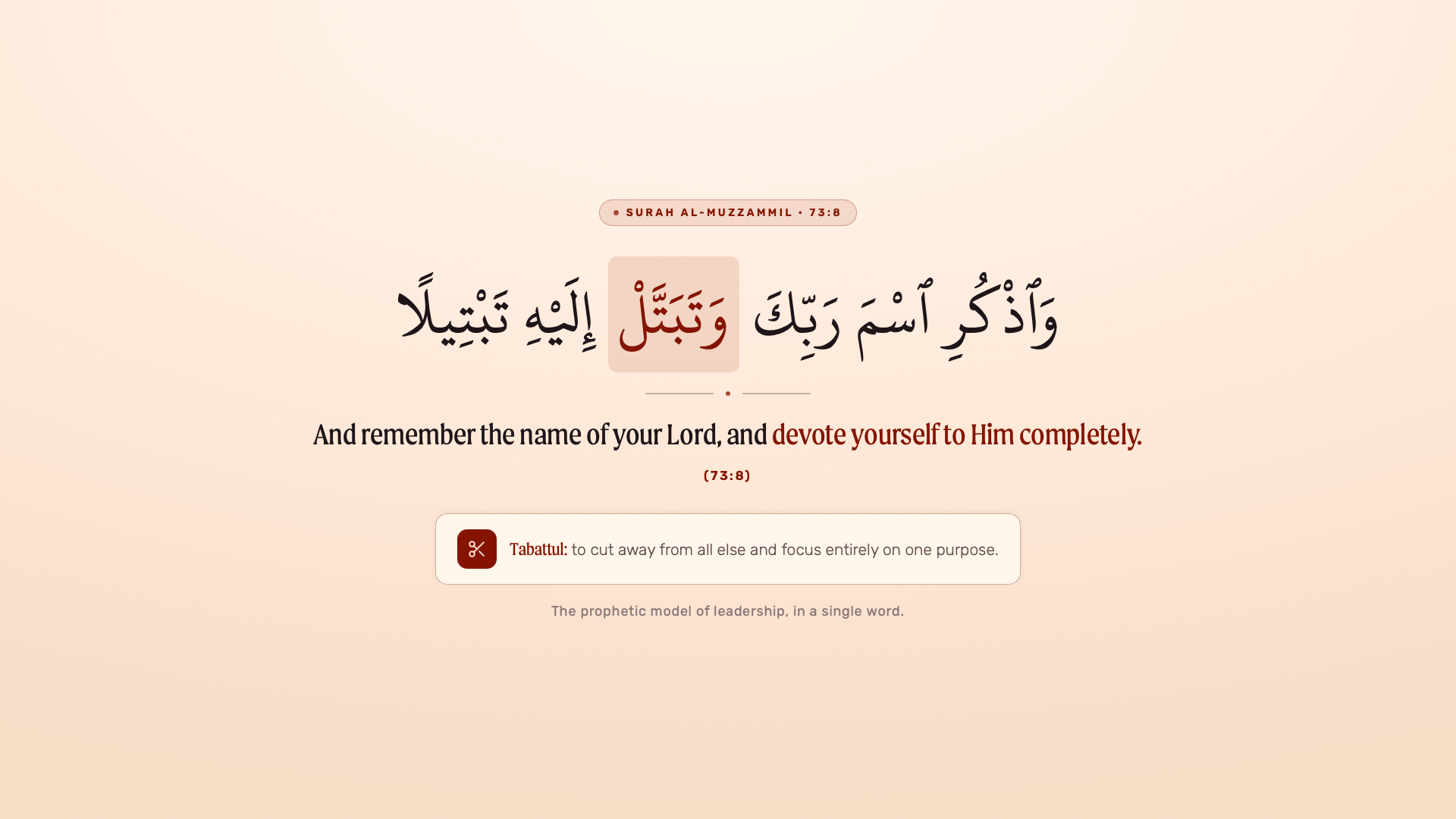
The word تَبَتَّل comes from the root meaning “to cut off”, specifically to be severed from all else and become distinct, singular in focus. The word is the same root as the Arabic name for a palm tree shoot that has been cleanly separated from its trunk: something that now stands alone, distinct, complete in itself. When Allah tells the Prophet ﷺ to do تَبَتَّل, He is telling him: separate yourself from everything else and direct yourself entirely toward this one purpose.
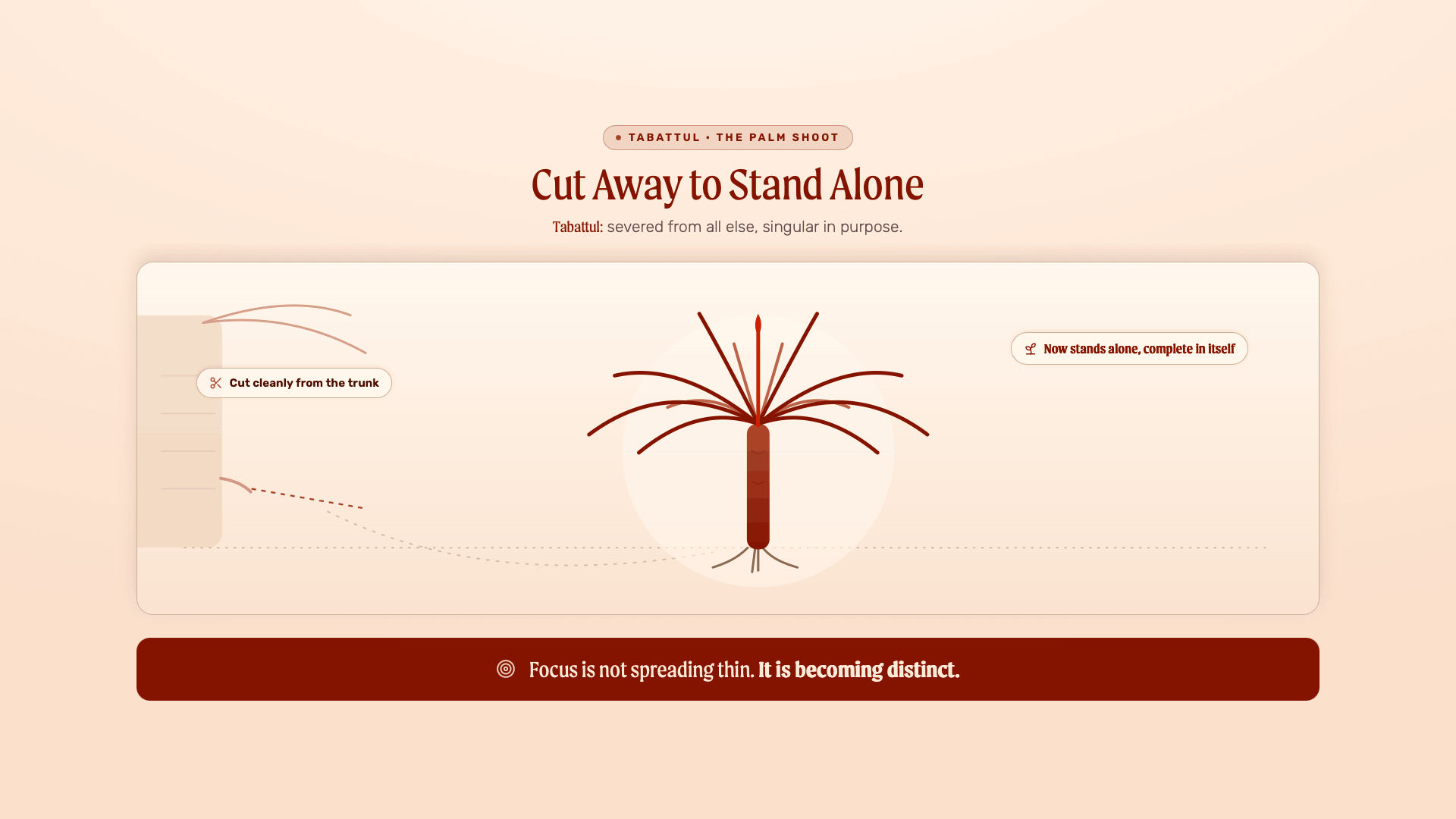
However, there is something stranger still in this Ayah; the word used for the noun form, تَبۡتِيلًا, is linguistically unusual. The expected word would have been تَبَتُّلًا, the word actually chosen belongs to a grammatical form that is used in Arabic for extremes, for something done at its most intense, most complete, most total degree. This is not just “focus.” It is focus at its absolute limit, the kind of focus that defines everything about the one who carries it.
This is the prophetic model of leadership in a single phrase.
Why Focus Is a Spiritual Principle, Not Just a Strategy
We tend to speak about organizational focus as a management concept. Pick your lane and don’t spread too thin. These are practical observations and they are not wrong but the Quran frames this differently. Focus is not a productivity strategy. It is a reflection of sincerity. Allah reminds us that He has not made for any man two hearts within his chest (33:4),[2] a Quranic image for the impossibility of true divided devotion. When a person or an institution is pulled in too many directions, the quality of intention deteriorates. You are no longer doing one thing for Allah. You are doing ten things for ten different reasons and the clarity that the Quran demands is gone. The believers are commanded to worship Allah with sincerity, devoting their religion to Him alone (98:5).[3]
The corresponding word, تَبۡتِيلًا, operates at the extreme end of its own grammatical form, the kind of word used in Arabic when something reaches its heights. The implication is layered: as your individual focus deepens, the expression of that focus intensifies. It is not enough to choose a lane. You have to drive it so completely that the lane becomes your identity.

What Happens When We Ignore This
An organization without singular focus communicates, at some level, that it is not yet sure what it is for. It asks people to support twenty causes simultaneously and wonders why nobody feels urgency about any of them. It struggles to recruit committed volunteers because there is nothing specific enough to commit to. It holds meetings about meetings and produces documents about strategy without executing a single initiative well. Allah warns the believers directly: why do you say what you do not do? It is gravely hated in His sight that you say what you do not do (61:2-3).[4]
Focus is not about ambition or the lack of it but rather about whether you have decided, seriously and publicly, what you are actually committed to. Once you have decided and you pursue it with the kind of intensity the Quran calls تَبۡتِيلًا, the results follow. Not because of a management technique but because of a spiritual principle.
This is the model the Prophet ﷺ lived, the model Bayyinah has tried to follow and the model every Muslim organization can learn from. Ustadh Nouman teaches it in full in his Leadership course on Bayyinah TV. Start exploring now.
Notes
[1] Al-Quran, 73:8 — https://quran.com/73/8
[2] Al-Quran, 33:4 — https://quran.com/33/4
[3] Al-Quran, 98:5 — https://quran.com/98/5
[4] Al-Quran, 61:2-3 — https://quran.com/61/2-3

At Bayyinah, we are dedicated to helping you connect directly with the words of Allah beyond translation. Founded by Ustadh Nouman Ali Khan, our mission is to create transformative experiences that deepen your understanding and engagement with the Quran.
Study the Quran and Arabic in a systematic and personalized way through Bayyinah TV. Get started today for free.
Check out our newest articles, fresh off the press and ready for you to dive into!