
Successful subscription! Thank you for subscribing.
Successful subscription! Thank you for subscribing.

July 23, 2026
We recite Surah Al-Fatihah more than any other passage in the Quran, yet few of us notice how exactly it is built. Look closely at the structure of Surah Al-Fatihah and a pattern emerges that is balanced in a way no human author could design.
This post traces that balance through the surah, from the way it splits between Allah and us, to the careful order of its words, to the way it mirrors the very last surah of the Quran. None of it is accidental. Each piece sits exactly where it belongs.
A Surah Split in Half
In a well-known hadith qudsi, Allah says:1
قَسَمْتُ الصَّلَاةَ بَيْنِي وَبَيْنَ عَبْدِي نِصْفَيْنِ
“I have divided the prayer between Myself and My servant into two halves.”
(Sahih Muslim)
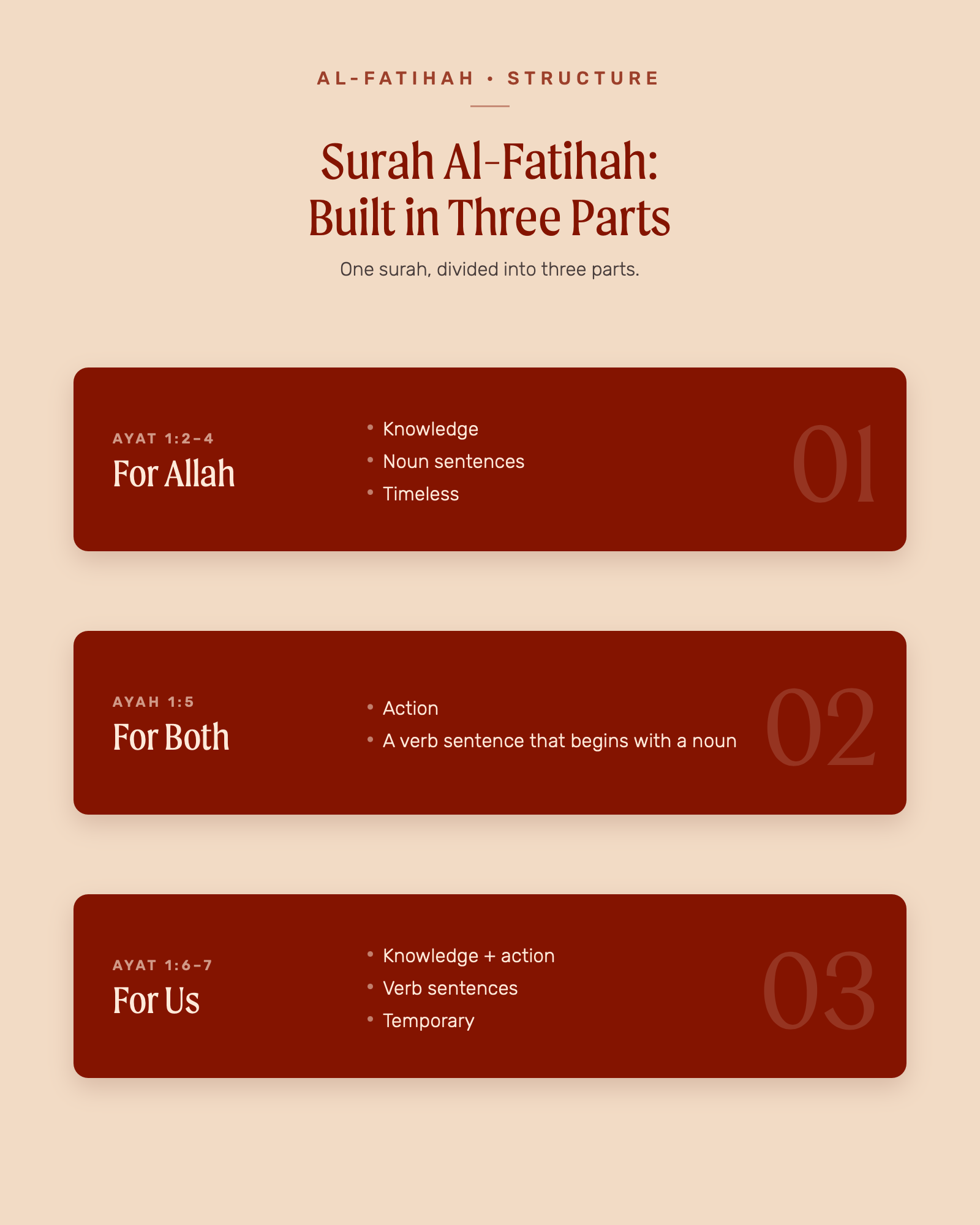
Surah Al-Fatihah is that division made visible. The first part belongs to Allah, the last part belongs to us and one verse sits in the middle holding both together.
The opening verses are entirely about Allah. Alhamdulillahi Rabbil-ʻalamin (1:2), Ar-Rahman ar-Rahim (1:3) and Maliki Yawmid-Din (1:4) introduce who He is.2 The closing verses are about us, our request for guidance and the kinds of people we hope to walk with or avoid. Between them stands iyyaka na’budu wa iyyaka nasta’in (1:5),3 the only verse that is about both us and Allah at the same time. The surah is arranged so that its shape matches its meaning.
You First, Then Your Need
That middle verse rewards a closer look. The word order in iyyaka na’budu places “You” before “we worship,” which is unusual in Arabic just as it would be in English. We do not normally say “a sandwich I ate.” By moving the object to the front, the meaning of “only You” comes forward. It is only to You that we give ourselves in worship and only Your help that we seek.
Notice the sequence. We commit ourselves as servants first and only then ask for help. This is deliberate. The purpose of our creation is to worship Allah (51:56),4 so we begin with what we owe Him before turning to what we need from Him. One half of the verse is for Allah and the other half is for us and even within a single line the order keeps that balance.
The word for seeking help here carries its own lesson. It describes the help you ask for after you have already put in your own effort, the way you call for a hand only once you have pushed the car as far as you can yourself. The Quran’s balance between effort and results runs through the whole surah. You give your best effort and the results remain in the hands of Allah. Asking for help while doing nothing is one extreme andcrediting yourself for everything is the other. Surah Al-Fatihah holds the middle.
Knowledge, Then Action, Then Both
The same balance shapes the surah’s themes. The opening verses about Allah are knowledge. They teach us who He is before we are asked to do anything. Then iyyaka na’budu is action, the commitment we make once we know Him. The final request, to be guided along the path of those Allah has favored (1:7),5 asks to walk with people who had both knowledge and action together, while being kept away from those who had one without the other. Knowledge and action are balanced from beginning to end.
This is also why the request is for guidance, asked again and again. Guidance is not like knowledge that you learn once and keep. It is closer to water, something you need continually, which is why even the most knowledgeable person still stands before Allah and asks for it. A straight path that rises upward takes constant effort, because the pull of this world never stops, so we keep asking to stay on it rather than treating it as a destination already reached.
Timeless Words for a Timeless Subject
The balance reaches down even into grammar. The first part of the surah, which is about Allah, is built from noun sentences and nouns in Arabic are timeless, just as Allah is timeless. The last part, which is about us, is built from verbs and verbs are bound to time, just as we are temporary. The middle verse, about both us and Allah, is a verb sentence that begins with a noun, a mixture of the two. The form of each part matches exactly what it describes.
The same precision appears in how the surah names three kinds of people. There are those Allah has favored, named in the past tense as completed examples we look back to, which is part of why the Quran is full of the stories of those who came before. There are those who received anger, described without naming who is angry, because anger comes at them from every direction. There are those who are lost, a different failing from the first. Every human being falls somewhere among these three, in every age, which is why the words for them are timeless too.
A Surah That Comes Full Circle
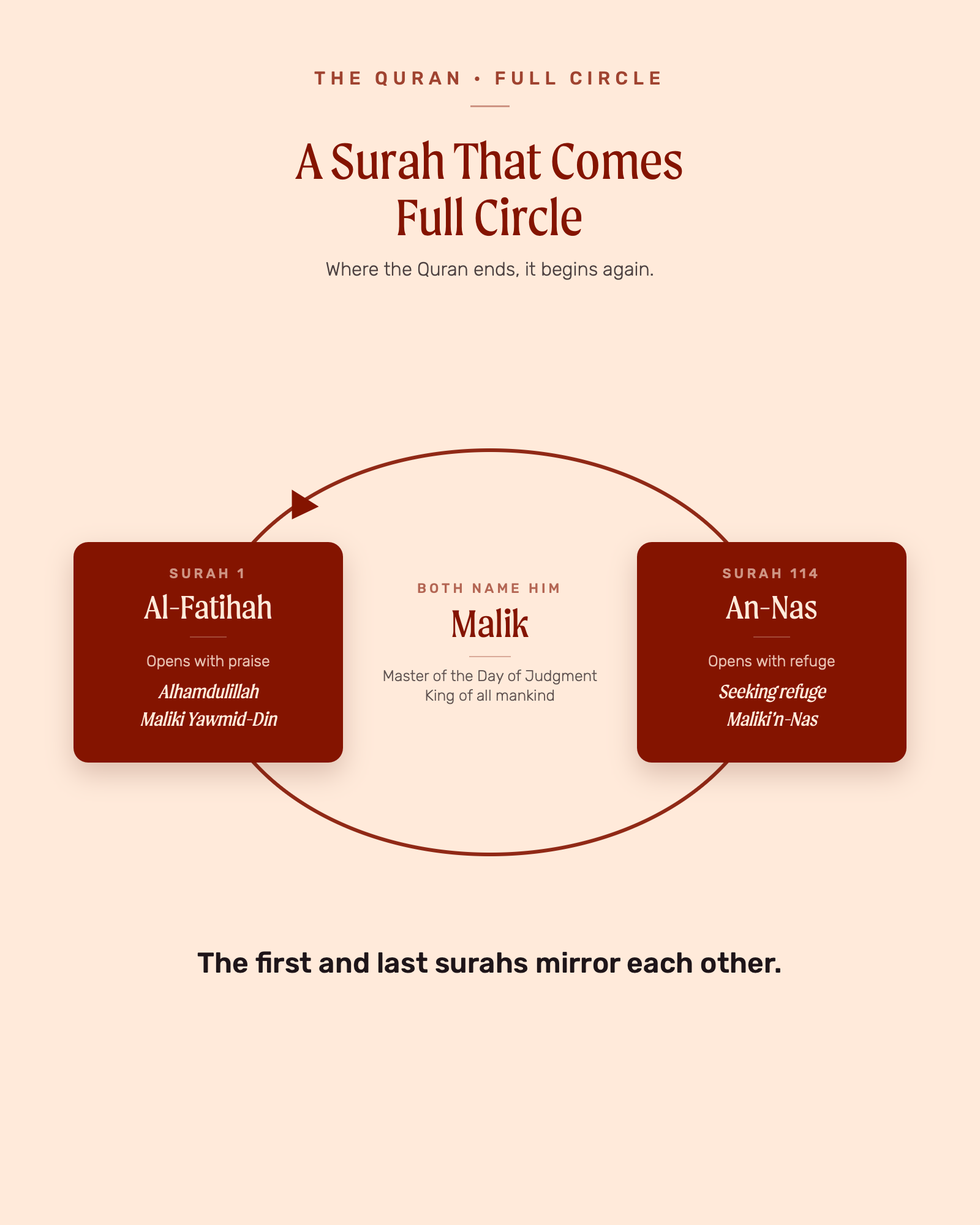
The most remarkable balance is the one you only see by stepping back to the whole Quran. Surah Al-Fatihah opens the Book on a positive note with Alhamdulillah. Surah An-Nas (114), the very last surah, opens on a protective, negative note with seeking refuge.6 Where Al-Fatihah declares Maliki Yawmid-Din, An-Nas speaks of Maliki’n-Nas (114:2), the same lordship from another angle. Reading the end sends you back to the beginning. The Quran flows in a circle and Al-Fatihah is balanced so completely that it points beyond itself to the design of the entire Book.
The Takeaway
The balance of Surah Al-Fatihah is not a clever pattern we read into the text. It is a balance of language, of theme, of knowledge and action, of our effort and Allah’s help, all held together at once in seven short verses. That kind of symmetry, sustained on every level at the same time, is humanly impossible to produce by design. The next time you stand and recite it, you are not repeating a routine. You are stepping into one of the most perfectly balanced passages ever revealed.
There is far more symmetry in Surah Al-Fatihah than a single article can hold. You can explore the full Al-Fatihah: A Deeper Look series on Bayyinah TV, alongside the other surahs being opened up in the Deeper Look collection.
Related reading: Why Surah Al-Fatihah Begins With Alhamdulillah (the companion post in this series).
Notes
[1] Sahih Muslim 395 (hadith qudsi: dividing the prayer), https://sunnah.com/muslim:395 ↩
[2] Quran, 1:2-4, https://quran.com/1/2-4 ↩
[3] Quran, 1:5, https://quran.com/1/5 ↩
[4] Quran, 51:56, https://quran.com/51/56 ↩
[5] Quran, 1:7, https://quran.com/1/7 ↩
[6] Quran, Surah An-Nas (114), https://quran.com/an-nas ↩

At Bayyinah, we are dedicated to helping you connect directly with the words of Allah beyond translation. Founded by Ustadh Nouman Ali Khan, our mission is to create transformative experiences that deepen your understanding and engagement with the Quran.
Study the Quran and Arabic in a systematic and personalized way through Bayyinah TV. Get started today for free.
Check out our newest articles, fresh off the press and ready for you to dive into!