
Successful subscription! Thank you for subscribing.
Successful subscription! Thank you for subscribing.

July 24, 2026
Surah Yasin is a Makki surah of 83 verses and it opens in a way that stops you before the argument even begins. There are no introductions, no easing in. Just two letters and then an oath sworn by the Quran itself. For an audience hearing it for the first time, the opening was meant to feel strange, to make them lean in and ask what was going on. This post follows that opening: the two letters, the oath and the single word the whole surah keeps coming back to, Hakeem.
Two Letters and a Question
The surah begins with two disconnected letters, Ya and Sin (36:1)1.
يس
“Ya-Sin.”
(36:1)
These broken letters appear only at the start of certain surahs and they are almost always followed by a mention of the Quran. They carry a quiet challenge. Letters are the building blocks of reading and writing and the Prophet ﷺ was unlettered, as unfamiliar with the alphabet as someone who had just learned to speak. So when these letters come out of his mouth, they sound like the speech of someone receiving an education. And that raises a question the surah wants in the listener’s mind from the very first breath: if he is learning letters, who is teaching him? The answer, every time, is the revelation. It is coming from beyond him.
An Oath That Becomes Evidence
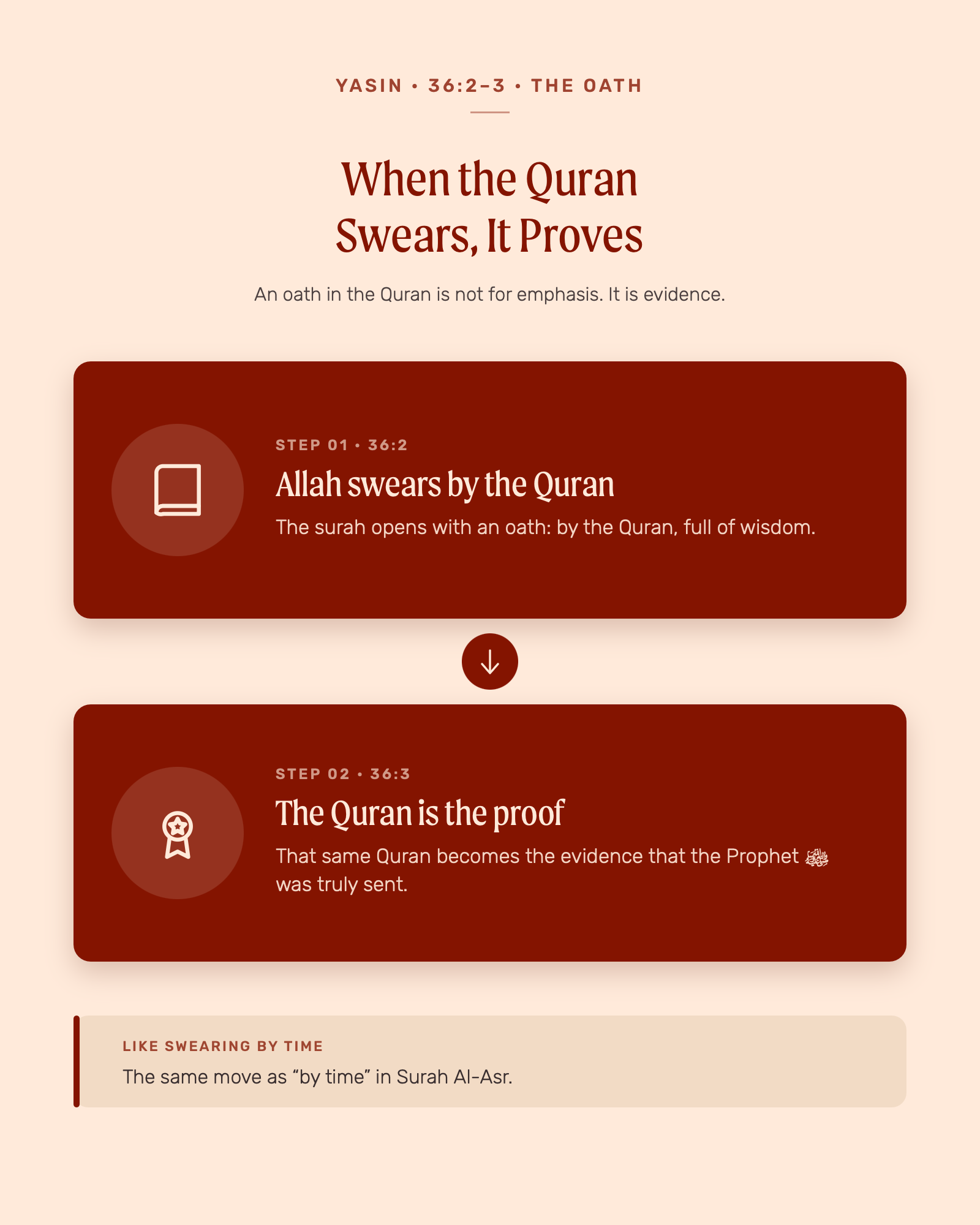
Right after the letters, Allah swears by the Quran (36:2)2.
وَالْقُرْآنِ الْحَكِيمِ
“By the Quran, full of wisdom.”
(36:2)
When the Quran takes an oath, it is doing something specific. It is not only grabbing your attention; it is turning whatever it swears by into evidence for the statement that follows. Elsewhere Allah swears by time (103:1-2)3 and time itself becomes the proof that the human being is in loss, because nothing exposes our losses like the passing of time. So here, when Allah swears by the Quran, the Quran is being placed on the table as evidence. The question is: evidence for what? And first, evidence of what kind, because everything hangs on what this word Hakeem actually means.
Three Meanings of One Word
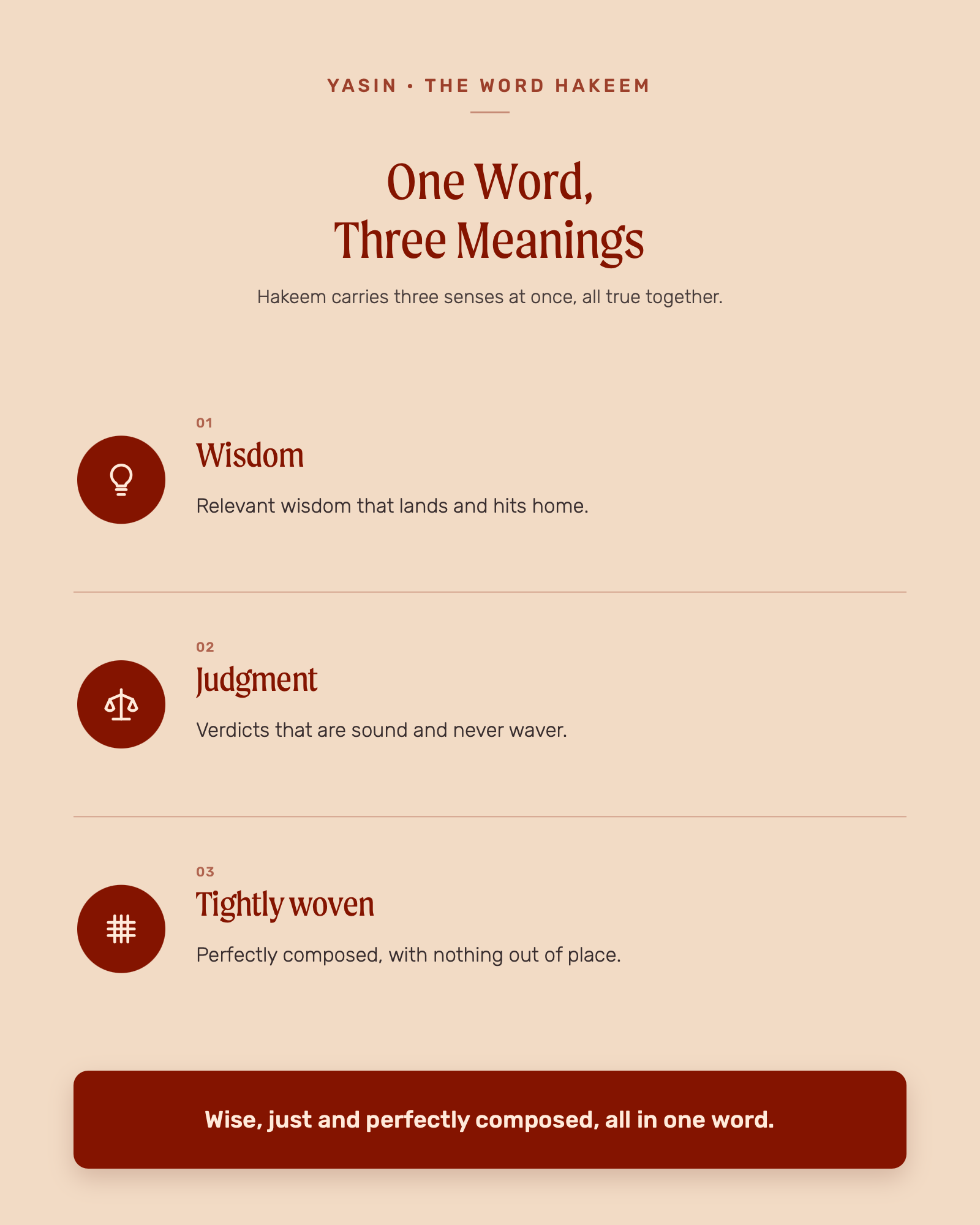
Hakeem carries at least three meanings in Arabic and all three are true of the Quran at once. The first is wisdom. The Quran is full of it, but wisdom is only recognized as wisdom when it is relevant to you. The remarkable thing about the Quran is that whenever it is recited, someone listening can be struck and feel that it is speaking directly to them, giving exactly the counsel they needed. That is far too much relevant wisdom to be one human being’s work.
The second meaning is authority, the power to pass judgment. The word shares its root with hukm, a verdict and hakim, a ruler. The Quran gives verdicts openly and never wavers. Over twenty-three years of revelation it never matured out of an old position or quietly walked one back. Ordinary people soften their tone when a statement gets them into trouble; they back off, change the subject, move to a different town. The Quran says the same thing again and again, to the same people, without apology. It speaks from a position of authority it was never, on the surface, in a position to claim.
The third meaning comes from ihkam, to make something tight and perfectly woven. A wall that is finished, square and seamless is called muhkam. The Quran is woven this tightly. Everything connects to everything elseand nothing can be pulled out and held against it. A politician can have one old line from a speech thrown back at him years later, but the Quran offers no loose thread to catch. It is simply too perfectly knit to be the unscripted speech of a man.
What the Quran Proves
All of this is building toward a verdict and it lands on the Prophet ﷺ himself (36:3)4.
إِنَّكَ لَمِنَ الْمُرْسَلِينَ
“You are indeed one of the messengers.”
(36:3)
The wisdom, the authority and the flawless weave are all offered as proof of one thing: that the man reciting this could not be its author. This is too wise, too bold and too tightly made to be his own. He must have been sent. Notice the care of the wording. Allah does not yet say sent by Allah; He says only that the Prophet ﷺ is from those who have been sent. The mystery is opened but not yet closed: sent by whom? The surah will answer that as it unfolds.
Notice, too, who is being addressed. Allah is not arguing with the deniers here; He is speaking to the Prophet ﷺ directly, reassuring him that he is no liar and no madman, whatever the propaganda says. And then comes the source: it is a revelation sent down by the Almighty, the Especially Merciful (36:5)5.
The Takeaway
Surah Yasin opens by putting the Quran’s own credibility on the line. Two letters raise the question of who is teaching an unlettered man; an oath turns the Quran into evidence; and the word Hakeem tells us what kind of evidence it is, wise, authoritative and perfectly woven. The conclusion is unavoidable: this is not the work of a human being and the one who carries it has been sent. Reading the surah with that frame, every section after this becomes part of the same argument, gently pressing the same question, who taught him this?
There is far more to Surah Yasin than a single article can hold. You can explore the full Yasin: A Deeper Look series on Bayyinah TV, alongside the other surahs being opened up in the Deeper Look collection.
Related reading: How Surah Yasin Ends by Folding Back on Itself (the companion post in this series).
Notes
[1] Quran, 36:1, https://quran.com/36/1 ↩
[2] Quran, 36:2, https://quran.com/36/2 ↩
[3] Quran, 103:1-2, https://quran.com/103/1 ↩
[4] Quran, 36:3, https://quran.com/36/3 ↩
[5] Quran, 36:5, https://quran.com/36/5 ↩

At Bayyinah, we are dedicated to helping you connect directly with the words of Allah beyond translation. Founded by Ustadh Nouman Ali Khan, our mission is to create transformative experiences that deepen your understanding and engagement with the Quran.
Study the Quran and Arabic in a systematic and personalized way through Bayyinah TV. Get started today for free.
Check out our newest articles, fresh off the press and ready for you to dive into!