Successful subscription! Thank you for subscribing.
Successful subscription! Thank you for subscribing.
June 24, 2025
When people talk about spirituality, they usually mean something quiet. Something internal. Something that makes them feel better.
But the Quran doesn’t just want you to feel better. It wants you to become better. For yourself and for others.
In Episode 14 of Deeper Look: Surah Al-Ma’arij, I reflect on two metaphors for spiritual development: the onion and the soil.
A lot of spiritual paths focus on the onion. You keep peeling—your past, your habits, your pain—hoping to reach your purest self at the core. It’s introspective, it’s personal and it never quite ends.
But the Quran gives us something entirely different.
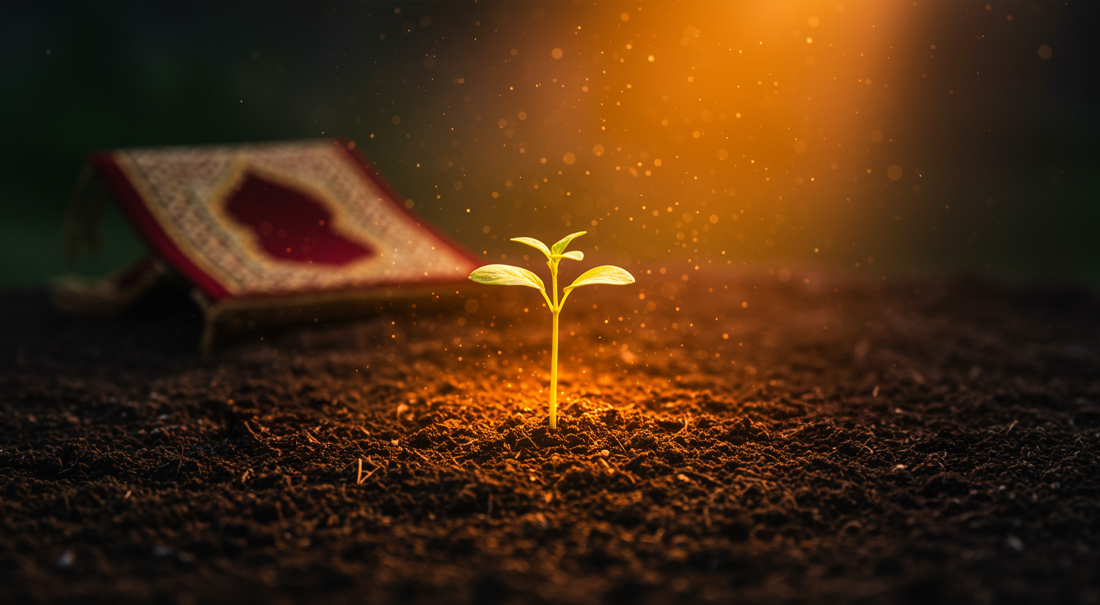
It’s not an onion. It’s soil.
And what’s the point of soil? Not to sit there, clean and purified. It’s meant to grow something. To nourish life. To give fruit. To change the environment around it.
That’s what salah is. It’s the beginning of a cleansing process, but the proof of that process is what happens outside the prayer mat.
Do you give more? Keep your word? Speak honestly? Live with trust?
If not, then something’s missing. Because real spirituality shows.
It doesn’t lock you away from the world. It trains you for the world.
Look at the early Muslims. They weren’t sent off to retreats or monasteries. They were raised in the chaos of Makkah, in the middle of a society full of injustice, arrogance and oppression.
And they weren’t told to escape it. They were told to withstand it. To live differently. To stand out.
The Quran started building a new kind of society—where the most honored people weren’t the wealthy or the well-connected, but the truthful, the trustworthy, the prayerful.
That’s the kind of strength salah is meant to build in us.
So the question isn’t: Are you praying?
The question is: Is your prayer growing anything?
Because if it’s working, you’ll see it. In your calm. Your generosity. Your reliability.
That’s how the Quran teaches us to measure growth—not by how we feel alone, but by how we show up for others.
And with the blessed 10 days of Dhul Hijjah almost here, it’s the perfect time to check in: Is my connection with Allah producing action? Is my soil ready to grow?
Watch Episode 14 of Deeper Look: Surah Al-Ma’arij now on Bayyinah TV.
Let these last days before Dhul Hijjah be your preparation ground.
Because real growth doesn’t end in stillness. It ends in service.
May Allah make our prayers a light for our hearts, a path to His pleasure and a means to grow in sincerity, strength and actions that benefit us in this life and the next.

Study the Quran and Arabic in a systematic and personalized way through Bayyinah TV. Get started today for free.
Check out our newest articles, fresh off the press and ready for you to dive into!