
Successful subscription! Thank you for subscribing.
Successful subscription! Thank you for subscribing.
July 29, 2026
Surah Al-Qiyamah is a Makki surah of forty verses, named after the Day of Resurrection. It is one of the most vivid descriptions of that Day anywhere in the Quran, but it opens in a surprising way, not with thunder, but by swearing simultaneously by the largest event in the universe and the smallest, quietest feeling inside a human being. This post introduces the surah and the remarkable connection it draws right at the start, between the Day everything ends and the conscience whispering inside you right now.
Two Oaths, Two Opposite Worlds
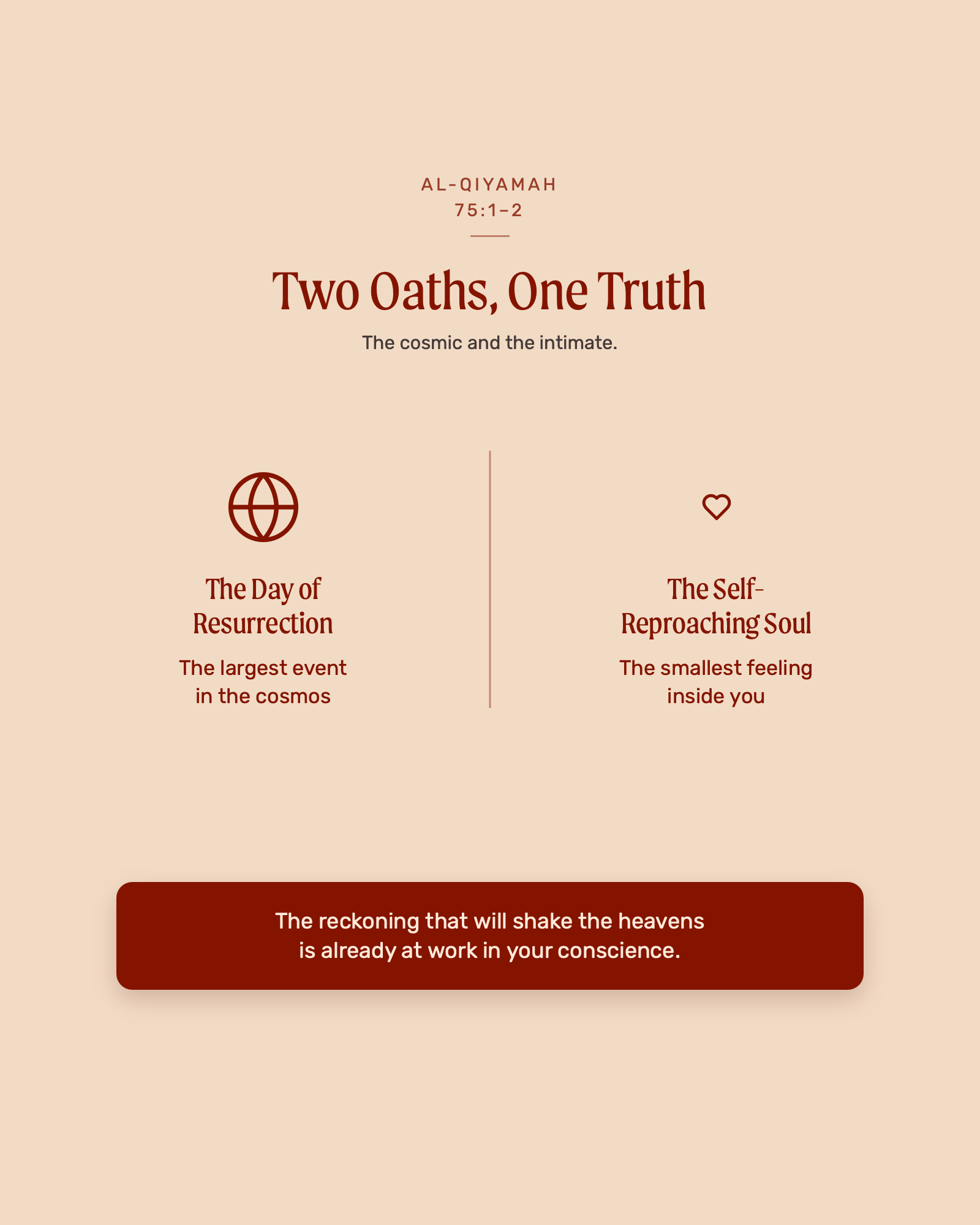
The surah begins with a striking double oath (75:1-2)1.
لَا أُقْسِمُ بِيَوْمِ الْقِيَامَةِ وَلَا أُقْسِمُ بِالنَّفْسِ اللَّوَّامَةِ
“I swear by the Day of Resurrection and I swear by the self-reproaching soul.”
(75:1-2)
Look at what is placed side by side here. The Day of Resurrection is the most colossal physical event imaginable, the sun and moon colliding, the sky tearing, the earth convulsing. And the self-reproaching soul, the nafsal-lawwamah, is the tiniest, most invisible thing in existence: that pang of conscience you feel when you have done wrong. No scanner can detect it; no one beside you can see it. Yet Allah swears by both in a single breath, deliberately connecting the grandest event in the cosmos with the smallest movement of your heart. The message is quietly profound: the same accountability that will one day shake the heavens is already at work, gently, inside your own conscience.
Your Conscience Is a Witness to the Day
Why pair these two? Because that twinge of guilt is itself a small proof of the Day. The conscience that blames you when you do wrong is evidence that you were made to be accountable, that right and wrong are realand that something in you already expects to answer for your choices. Resurrection Day is when that inner reckoning becomes a public, cosmic one. So the soul that reproaches itself in private is, in a sense, rehearsing for the Day everything is laid bare. The surah is telling us: do not wait for the heavens to split to take your conscience seriously; it is already pointing you toward the truth.
Even Your Fingertips
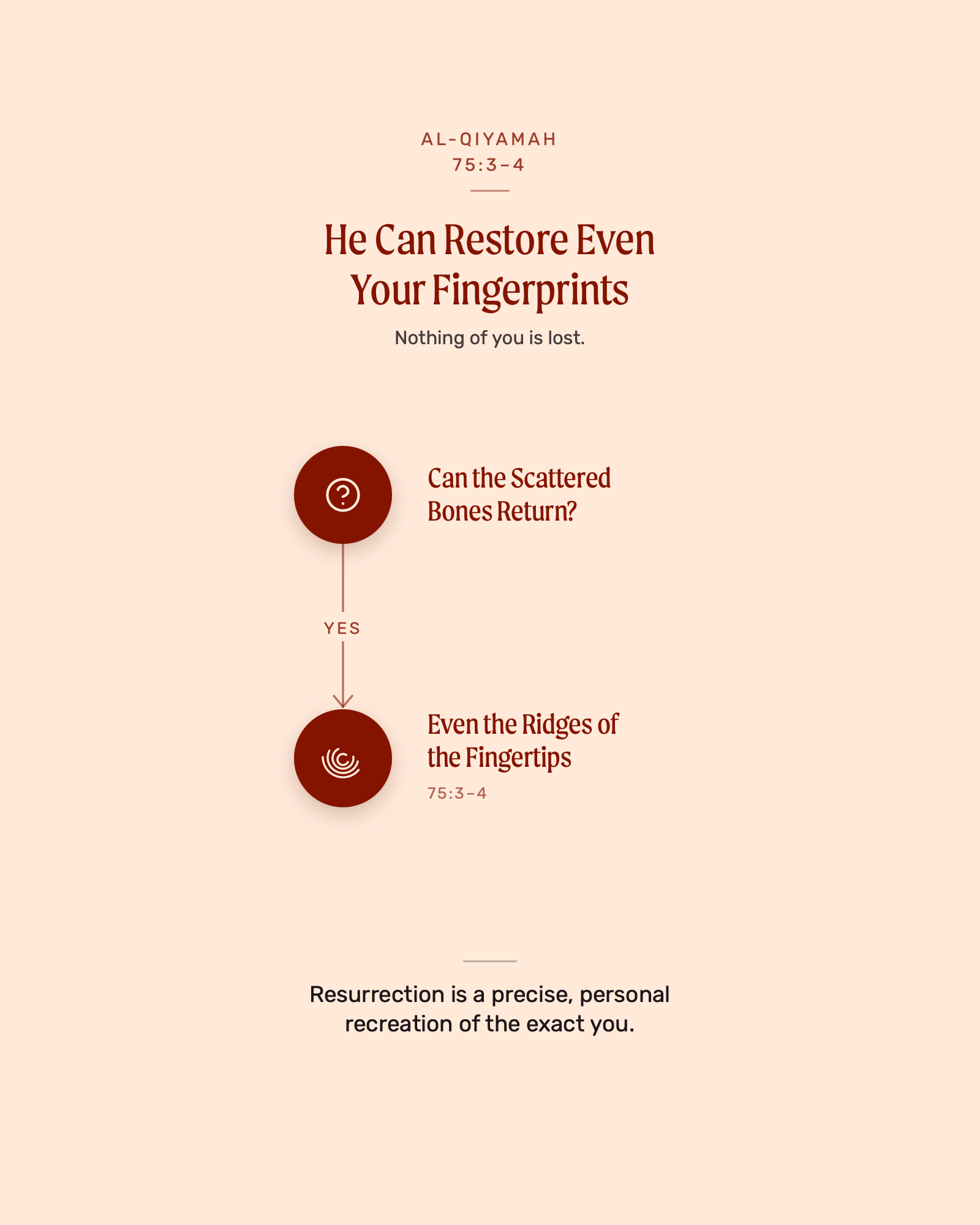
The surah then turns to the doubt at the heart of denial, that a decayed, scattered body could never be brought back (75:3-4)2.
أَيَحْسَبُ الْإِنسَانُ أَلَّن نَّجْمَعَ عِظَامَهُ بَلَىٰ قَادِرِينَ عَلَىٰ أَن نُّسَوِّيَ بَنَانَهُ
“Does man think We will never assemble his bones? Yes — We are able to restore even his fingertips.”
(75:3-4)
The answer is not merely that Allah can reassemble the bones, but that He can perfectly restore the fingertips, the bananah, the very ridges of the fingerprints. It is a stunning detail. Of everything that could have been named, the surah chooses the most intricate, individual signature on the human body, the thing we now use to prove a person’s unique identity. The God who can reprint your fingerprints down to their swirls is not going to struggle to bring you back. Resurrection is not a vague reassembly; it is a precise, personal recreation of the exact you.
A Witness Against Yourself
Later the surah makes the link between conscience and accountability explicit (75:14-15)3: on that Day the human being will be fully informed of everything he sent ahead and left behind and then it says that man will be a witness against his own self, even as he offers up his excuses. The court of the Day will not need to interrogate you; you already know. The same conscience that quietly accused you in this life will testify openly in the next. It is a sobering, clarifying thought and it turns the surah’s opening oath into a personal invitation: listen to that inner witness now, while listening still changes things.
The Takeaway
Surah Al-Qiyamah begins by tying the end of the world to the whisper of your conscience and then assures you that the God who notices the ridges of your fingertips will most certainly bring you back to account. The lesson lands close to home: you do not have to wait for the Day of Resurrection to feel its reality, because a piece of it already lives in you, in the soul that reproaches you when you slip. Honour that inner voice, let it pull you back to Allah and you will meet the Day having already made peace with the witness who knows you best, yourself.
There is far more to Surah Al-Qiyamah than a single article can hold. You can explore the full Al-Qiyamah: A Deeper Look series on Bayyinah TV, alongside the other surahs being opened up in the Deeper Look collection.
Related reading: A Mirror of Five Sections: The Structure of Surah Al-Qiyamah (the companion post in this series).
Notes
[1] Quran, 75:1-2, https://quran.com/75/1 ↩
[2] Quran, 75:3-4, https://quran.com/75/3 ↩
[3] Quran, 75:14-15, https://quran.com/75/14 ↩

At Bayyinah, we are dedicated to helping you connect directly with the words of Allah beyond translation. Founded by Ustadh Nouman Ali Khan, our mission is to create transformative experiences that deepen your understanding and engagement with the Quran.
Study the Quran and Arabic in a systematic and personalized way through Bayyinah TV. Get started today for free.
Check out our newest articles, fresh off the press and ready for you to dive into!