
Successful subscription! Thank you for subscribing.
Successful subscription! Thank you for subscribing.

July 29, 2026
Surah At-Tahrim is only twelve verses long, but those verses are arranged with stunning precision. Read closely, the surah divides into four parts and those four parts are not laid out in a straight line; they fold back on each other like a ring, the first part mirroring the last, the second mirroring the third. This post walks through that structure and asks what such careful design is meant to teach the heart that notices it.
Four Parts, Two Pairs
The simplest way to see the surah is as four passages arranged in two mirrored pairs. The outer pair, the first passage and the last, both open by addressing the Prophet ﷺ directly and then turn to lessons drawn from women. The inner pair, the second and third passages, both circle around the theme of repentance, framed by warnings and by the people, angels included, who stand on the side of obedience. Once you see the symmetry, the whole surah snaps into focus.
The Outer Ring: The Prophet, Then Women
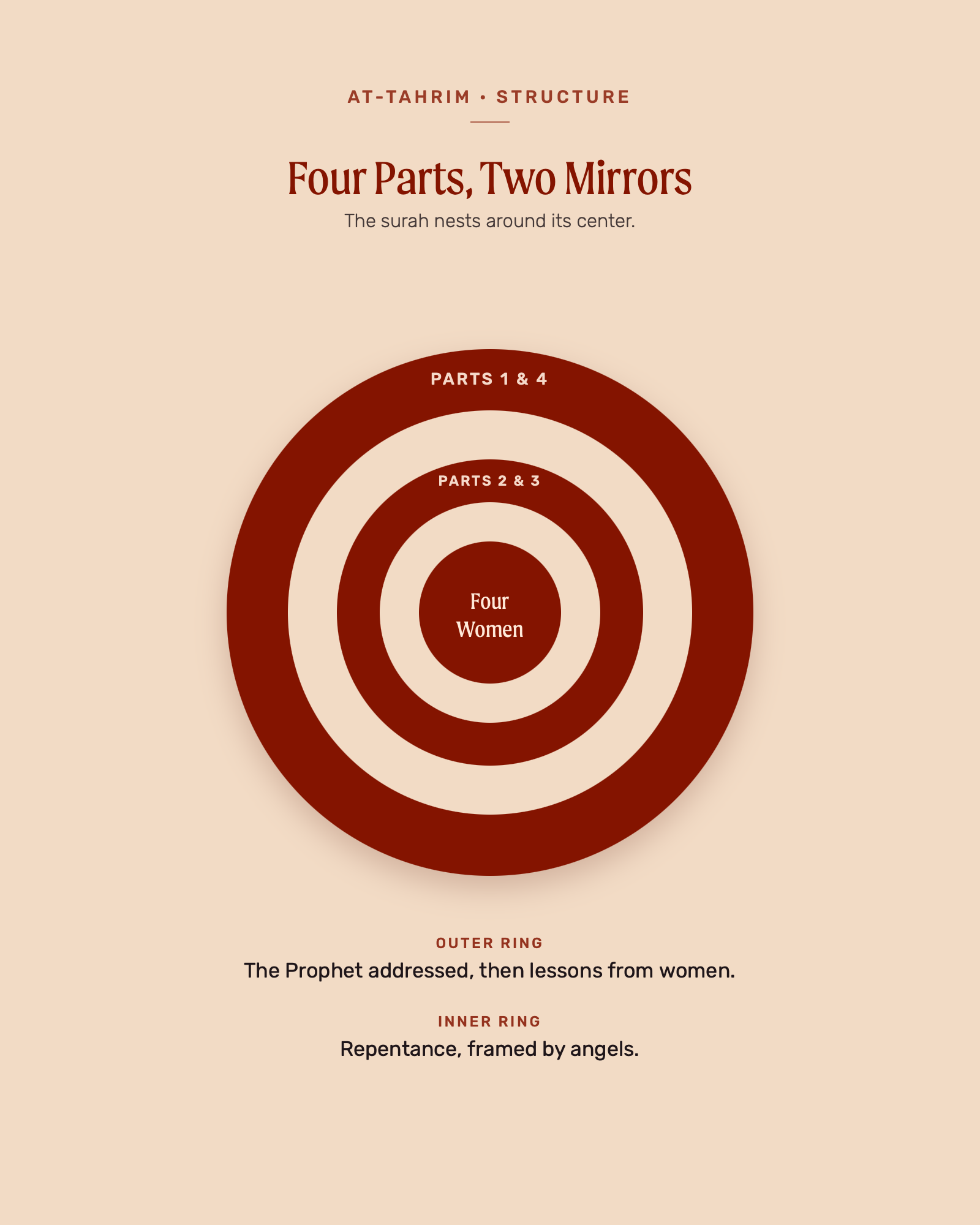
The first passage opens with a direct address to the Prophet ﷺ about not forbidding what is lawful, immediately followed by guidance for the believers and then a story involving two of his wives. The final passage mirrors it exactly. It also opens by addressing the Prophet ﷺ, this time calling him to stand firm against disbelief and hypocrisy (66:9)1 and is then followed by lessons drawn from women, four of them (66:10-12)2. Address to the Prophet, then lessons from women, at the start of the surah and again at its end. The two ends of the surah are built to echo each other.
The Inner Ring: Repentance and Reckoning
The two middle passages mirror each other just as tightly. The second passage begins by calling two hearts to repent and warns that if they persist, Allah Himself, along with Jibril, the righteous among the believers and the angels, stands behind His Messenger (66:4)3; it then promises that, if need be, they could be replaced with better wives, listing their beautiful qualities, devout, believing, obedient, repentant (66:5)4. The third passage opens with the famous command to protect your family from a Fire whose fuel is people and stones, guarded by stern angels (66:6)5 and closes by calling the believers to sincere repentance, tawbah nasuha (66:8)6. Notice the mirror: the second passage opens with repentance, the third closes with it; both are framed by angels; both move from warning to hope.
يَا أَيُّهَا الَّذِينَ آمَنُوا قُوا أَنفُسَكُمْ وَأَهْلِيكُمْ نَارًا
“O you who believe, protect yourselves and your families from a Fire.”
(66:6)
The Heart of the Surah: Four Women
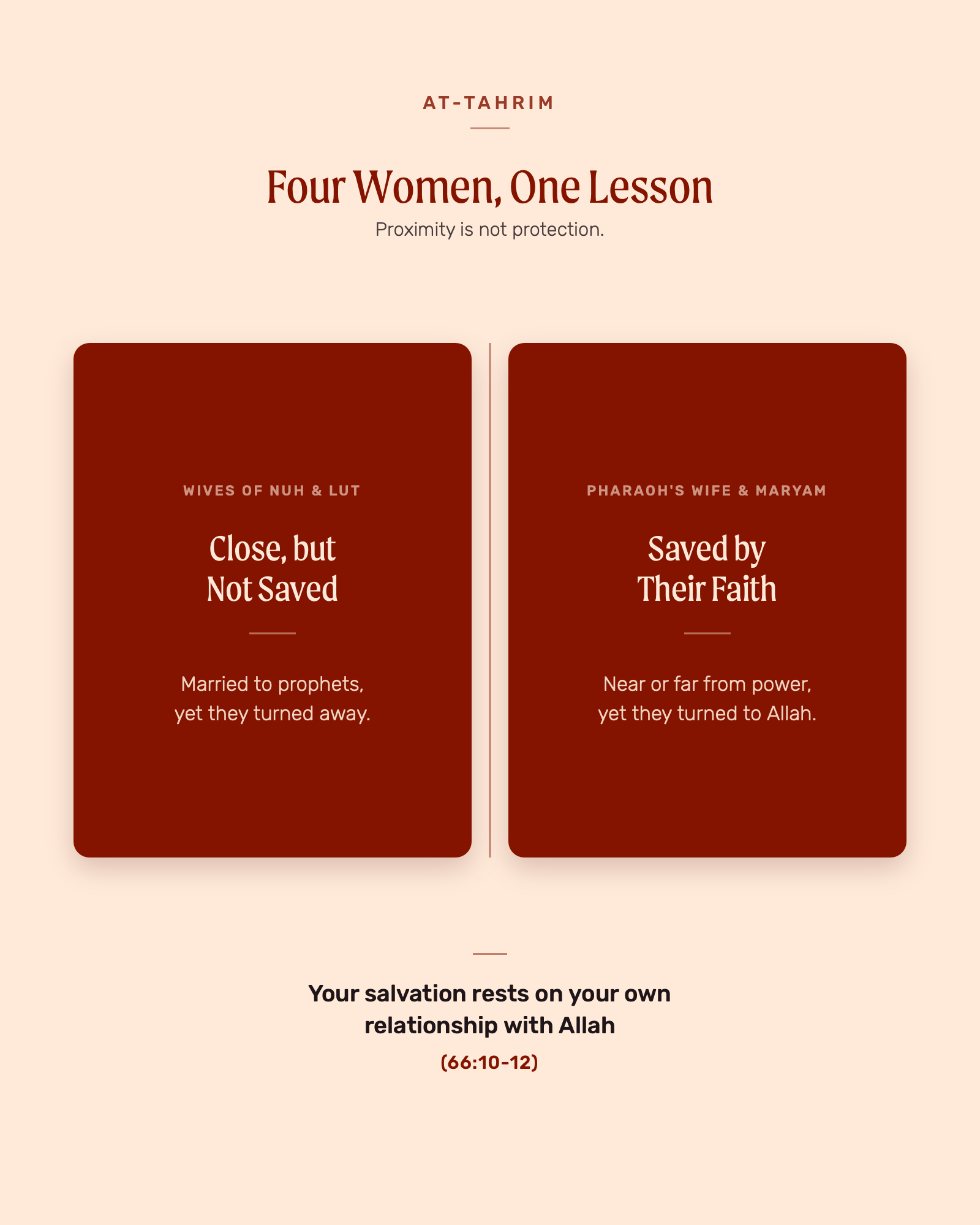
At the surah’s close stand four women given as examples for all believers. Two are warnings: the wives of Nuh and Lut, married to two great prophets, who still rejected faith and were not saved by their husbands’ closeness to Allah. Two are models: the wife of Pharaoh, who lived in the household of a tyrant and yet prayed to be rescued and Maryam, the woman of perfect devotion (66:10-12)2. Together they make one piercing point: no one is saved by their proximity to a righteous person and no one is doomed by being trapped near a wicked one. What counts is your own relationship with Allah. The prayer the Quran preserves on the lips of Pharaoh’s wife is the heart of the whole surah (66:11)7.
رَبِّ ابْنِ لِي عِندَكَ بَيْتًا فِي الْجَنَّةِ
“My Lord, build for me near You a house in Paradise.”
(66:11)
She does not ask for rescue from her palace; she asks for a house with Allah. In a surah that began with a household and the pull of human love, it ends with a woman choosing nearness to Allah over the most powerful home on earth. That is the destination the whole structure has been leading toward.
The Takeaway
The design of Surah At-Tahrim is not decoration; it is meaning. Its four parts fold into a ring so that the surah’s warnings and its mercy, its angels and its examples, all answer one another and the eye is drawn inward to the heart of it: protect your family, return to Allah sincerely and remember that your salvation rests on your own faith, not on who you are married to or who you are near. That a twelve-verse surah can carry a structure this precise is itself a quiet sign of where it came from. Read it slowly and let its symmetry pull your heart to its center.
There is far more to Surah At-Tahrim than a single article can hold. You can explore the full At-Tahrim: A Deeper Look series on Bayyinah TV, alongside the other surahs being opened up in the Deeper Look collection.
Related reading: When Love Goes Too Far: An Introduction to Surah At-Tahrim (the companion post in this series).
Notes
[1] Quran, 66:9, https://quran.com/66/9 ↩
[2] Quran, 66:10-12, https://quran.com/66/10 ↩
[3] Quran, 66:4, https://quran.com/66/4 ↩
[4] Quran, 66:5, https://quran.com/66/5 ↩
[5] Quran, 66:6, https://quran.com/66/6 ↩
[6] Quran, 66:8, https://quran.com/66/8 ↩
[7] Quran, 66:11, https://quran.com/66/11 ↩

At Bayyinah, we are dedicated to helping you connect directly with the words of Allah beyond translation. Founded by Ustadh Nouman Ali Khan, our mission is to create transformative experiences that deepen your understanding and engagement with the Quran.
Study the Quran and Arabic in a systematic and personalized way through Bayyinah TV. Get started today for free.
Check out our newest articles, fresh off the press and ready for you to dive into!