
Successful subscription! Thank you for subscribing.
Successful subscription! Thank you for subscribing.
July 29, 2026
Read once, Surah Al-Mulk feels like a sweeping tour, from the heavens to hell, from the flight of birds to the drying up of water. Read with its structure in view, something remarkable appears: the surah’s thirty verses fall into six sections and those sections mirror each other in pairs, the first answering the last, the second the fifth, the third the fourth. This post follows that design and asks what such deliberate symmetry is meant to do to the reader who notices it.
Six Sections, Three Mirrored Pairs
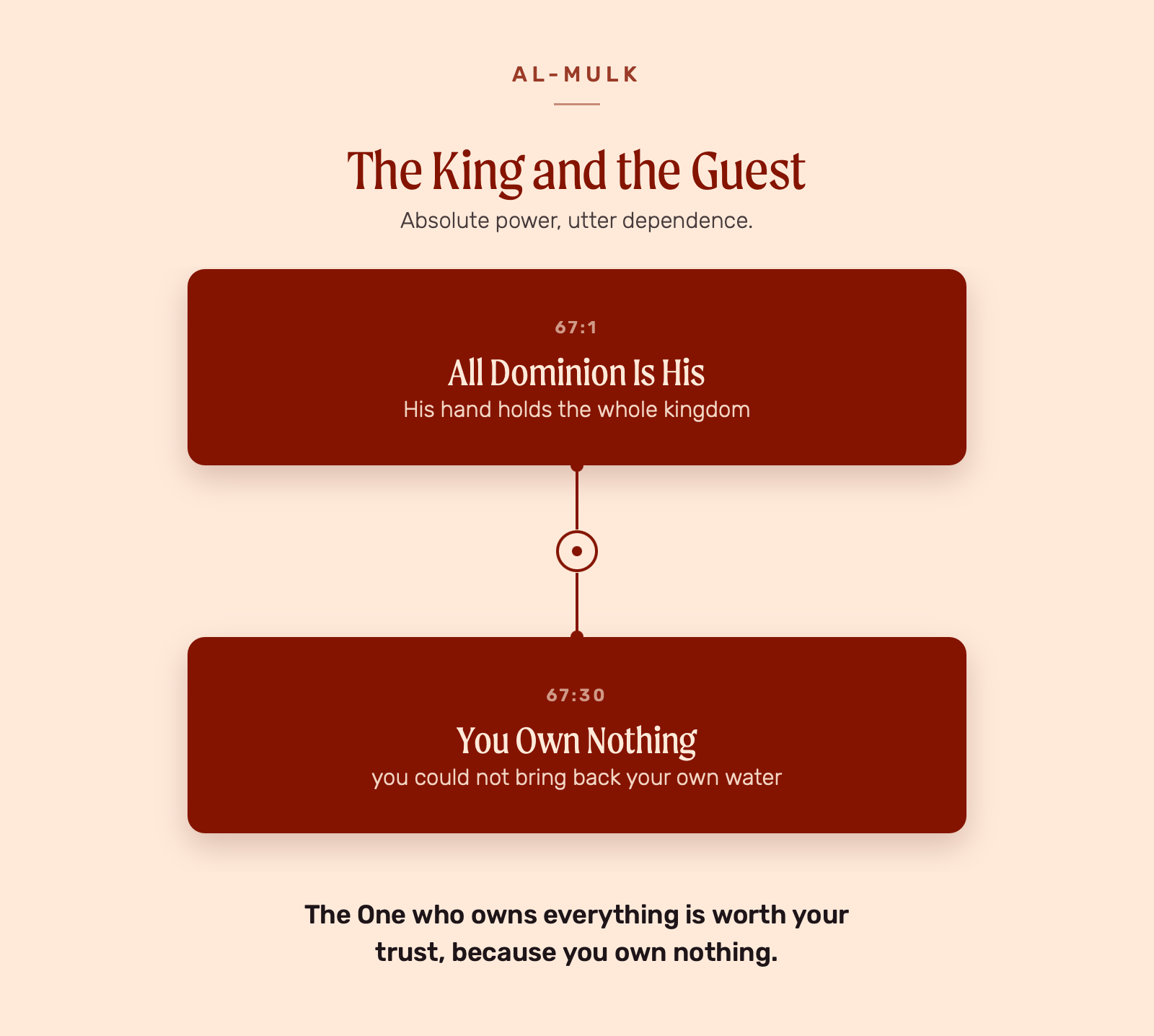
The surah moves through six passages. It opens with the sovereignty of Allah, then turns to heaven and hell, then to an immediate threat hanging over the deniers, then to the gifts of a short human life, then to their mocking question about when the promise will come and finally to a reminder of human helplessness. Laid out in a line, it reads as a progression. Folded in half, it reads as a mirror: section one pairs with section six, section two with section five, section three with section four. The surah is not just moving forward; it is folding inward.
His Power and Our Weakness
The outer pair sets the frame. The surah opens by establishing that all power belongs to Allah and closes by establishing how little belongs to us. In its final movement it asks the deniers to consider that they cannot even guarantee their own next breath and then leaves them with a single, devastating image (67:30)1.
قُلْ أَرَأَيْتُمْ إِنْ أَصْبَحَ مَاؤُكُمْ غَوْرًا فَمَن يَأْتِيكُم بِمَاءٍ مَّعِينٍ
“Say: Have you considered, if your water were to sink away, who then could bring you flowing water?”
(67:30)
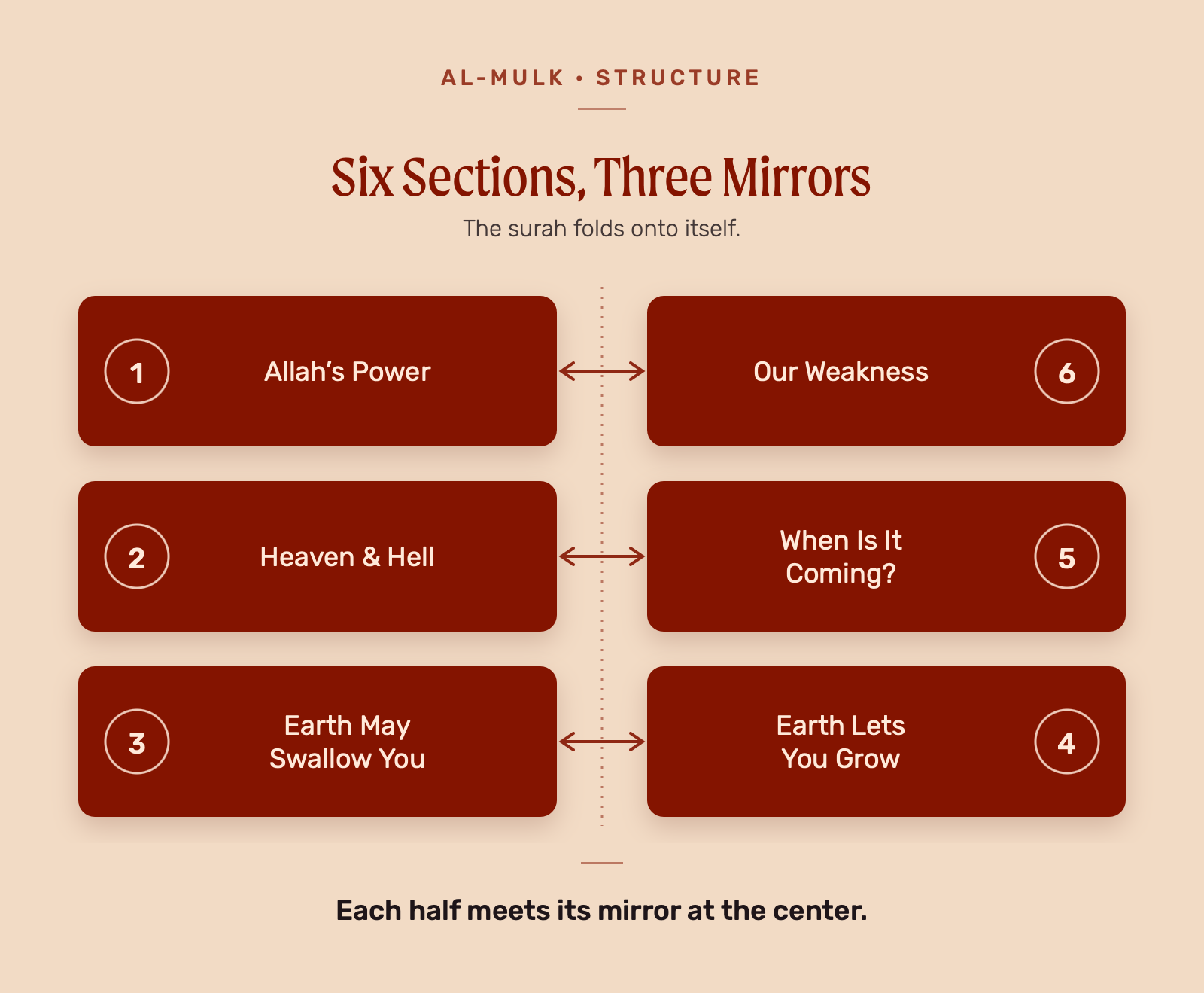
If the water beneath your feet simply drained into the earth, who could bring it back? The surah that began with a King whose hand holds all dominion ends with a creature who cannot summon a single cup of water on its own. Power and weakness face each other across the whole surah and the contrast is the argument: the One who owns everything is worth your trust precisely because you own nothing.
Heaven and Hell and the Mockers’ Question
The second pair works the same way. Early in the surah, Allah lays out the two destinations in vivid detail, far more space given to the fire than to the garden, because this is a surah of warning. Much later, the deniers answer that warning with a sneer, asking when this promised reckoning will actually arrive (67:25)2. The surah places their mockery directly opposite the destinations they are mocking. You asked when? the structure replies. Here is the heaven and the hell you are so casually dismissing. The question and its answer are set face to face.
The Earth That Holds You and the Earth That Takes You
The innermost pair is the most intimate. In the third section, Allah asks the deniers whether they feel safe that the earth will not be made to swallow them or the sky not rain down on them (67:16-17)3; in the fourth, He reminds them that He let them grow and spread across that same earth, gave them hearing, sight and feeling hearts and will one day return them to it (67:23-24)4. The same earth appears in both: in one, it lets you sprout and live; in the other, it opens to take you in. Between those two images sits the whole of a human life, brief, granted and easily withdrawn.
Why the Symmetry Matters
This design is not ornament. A surah of warning could simply pile threat upon threat; instead it builds an argument that closes on itself. His power is set against our weakness, the promised hereafter against our doubt of it, the earth that nurtures us against the earth that buries us. The threat is real and it is near, the surah says and the time you have to prepare is short, both as a nation and as a single soul. The very shape of the surah drives the point home: there is nowhere to look, forward or back, where you are not small and He is not in command.
The Takeaway
Surah Al-Mulk is built like a folded mirror, six sections that answer one another so that wherever you stand in it, you are looking at the same truth from a new angle: the kingdom is His and you are a brief, dependent guest within it. That is exactly why it humbles and steadies the heart and why the Prophet ﷺ held it so close. Read it slowly, feel the symmetry close around you and let it return you each night to the only stable ground there is, trust in the One whose hand holds the kingdom.
There is far more to Surah Al-Mulk than a single article can hold. You can explore the full Al-Mulk: A Deeper Look series on Bayyinah TV, alongside the other surahs being opened up in the Deeper Look collection.
Related reading: Blessed Is the One Who Holds the Kingdom: An Introduction to Surah Al-Mulk (the companion post in this series).
Notes
[1] Quran, 67:30, https://quran.com/67/30 ↩
[2] Quran, 67:25, https://quran.com/67/25 ↩
[3] Quran, 67:16-17, https://quran.com/67/16 ↩
[4] Quran, 67:23-24, https://quran.com/67/23 ↩

At Bayyinah, we are dedicated to helping you connect directly with the words of Allah beyond translation. Founded by Ustadh Nouman Ali Khan, our mission is to create transformative experiences that deepen your understanding and engagement with the Quran.
Study the Quran and Arabic in a systematic and personalized way through Bayyinah TV. Get started today for free.
Check out our newest articles, fresh off the press and ready for you to dive into!