
Successful subscription! Thank you for subscribing.
Successful subscription! Thank you for subscribing.

July 29, 2026
Most of Surah Al-Munafiqun is addressed to the Prophet ﷺ, warning him about the hypocrites. But in its final verses, the surah turns and speaks directly to the believers, the people listening with concern, half-afraid they might share some of the same flaws. To them it offers not another warning about hypocrisy but its remedy. This post follows that closing turn and the simple, searching antidote the surah prescribes.
A Word to the Believers
It helps to notice the surah’s three audiences. There is the Prophet ﷺ, who is being addressed throughout; the hypocrites, who are absent but described; and the believing community, who are listening, unsettled, wondering how to make sure they never drift into what they are hearing about. The closing verses are spoken to that third group. After laying bare the disease, the surah finally hands the believers the cure and it is not what you might expect. It is not a checklist for spotting hypocrites; it is a way of keeping your own heart alive.
Don’t Let Them Distract You
The instruction is gentle but pointed (63:9)1.
لَا تُلْهِكُمْ أَمْوَٰلُكُمْ وَلَآ أَوْلَٰدُكُمْ عَن ذِكْرِ ٱللَّهِ
“Let not your wealth or your children distract you from the remembrance of Allah.”
(63:9)
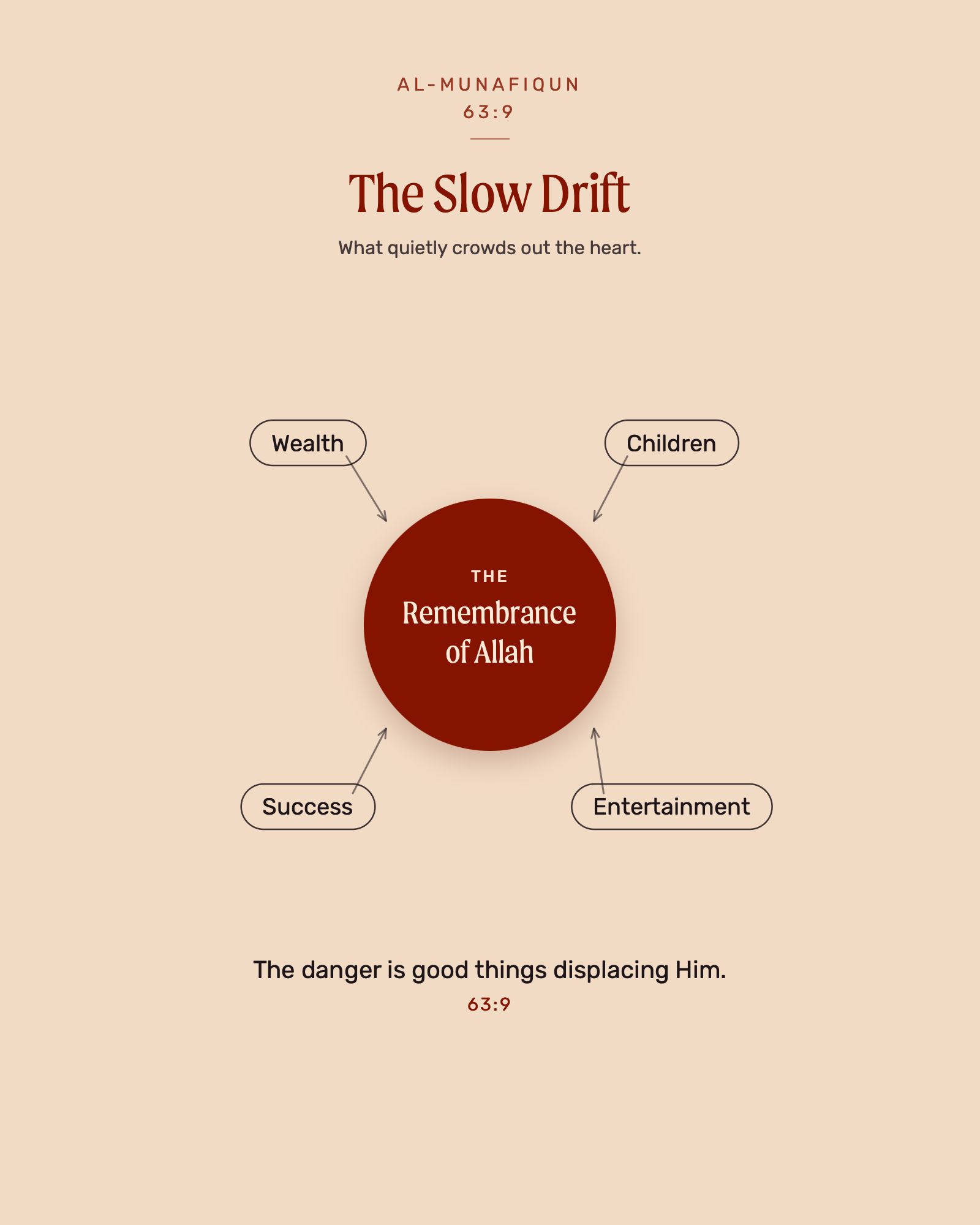
The word chosen for distraction is one used for things that pull you away from what truly matters toward what does not. And notice what does the pulling: not sins, but wealth and children, things that are good and beloved. That is the subtle danger. Hypocrisy rarely begins with an open rejection of Allah; it begins with a slow drift, where good and permissible things, money, family, success, entertainment, quietly crowd out the remembrance of Allah until the heart is full of everything except Him. The antidote to a hollow heart is to keep making room in it for Allah.
The Regret No One Escapes
To give that instruction urgency, the surah turns our eyes to the deathbed (63:10)2.
رَبِّ لَوْلَآ أَخَّرْتَنِىٓ إِلَىٰٓ أَجَلٍ قَرِيبٍ فَأَصَّدَّقَ وَأَكُن مِّنَ ٱلصَّٰلِحِينَ
“My Lord, if only You would delay me for a brief term, so I could give charity and be among the righteous.”
(63:10)
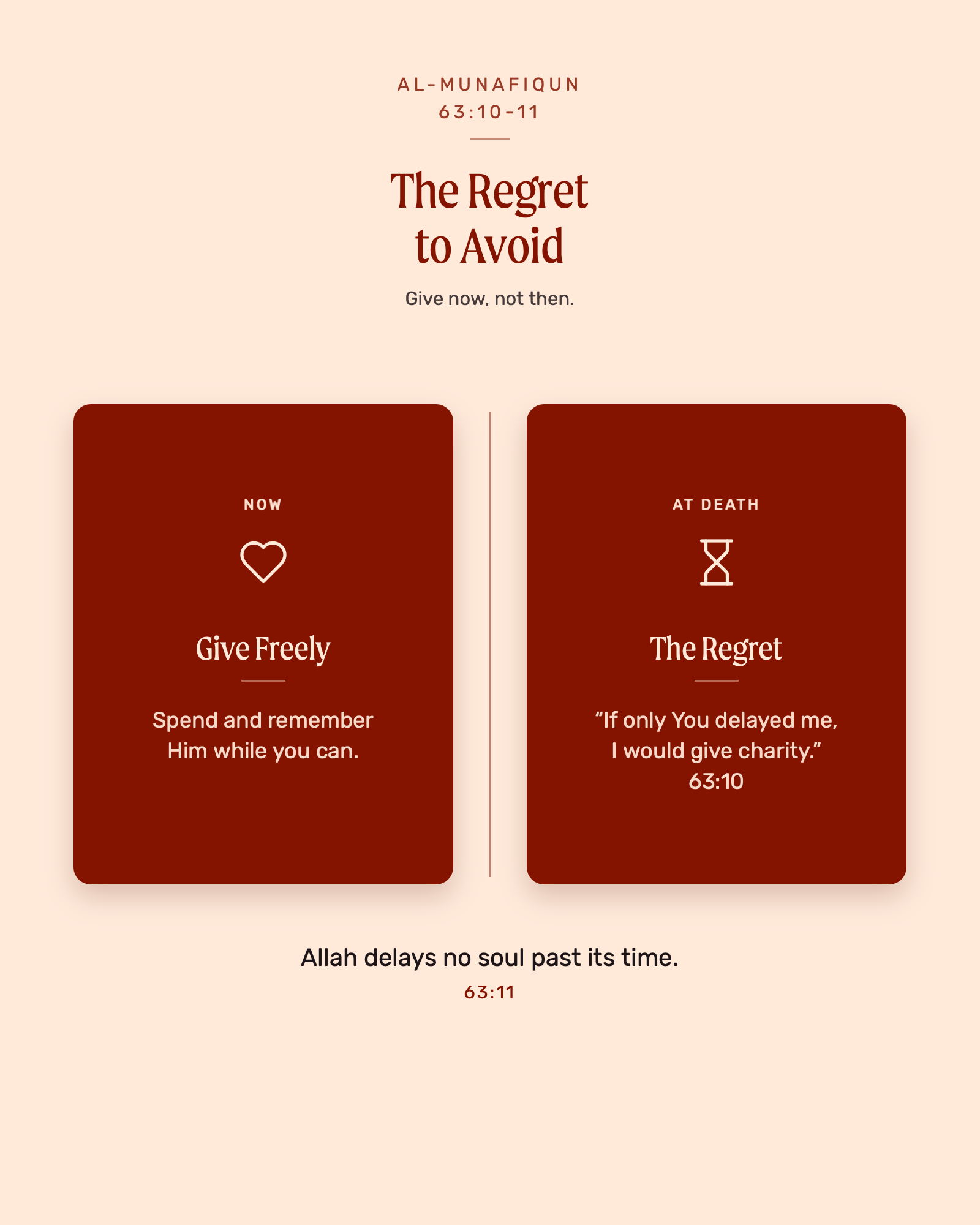
Spend from what We have given you, the surah says, before death comes to one of you and he pleads for just a little more time, to give in charity and finally become righteous. But the next verse is unflinching: Allah never delays a soul once its appointed time has come. It is the one regret no one escapes, the wish for more time to do the good we kept postponing. The surah places that future regret in front of us now, while there is still time to act on it, so that we give and remember today rather than beg for the chance tomorrow.
The Opposite of Hypocrisy
Put together, the cure the surah prescribes is the exact opposite of the disease it described. Hypocrisy was a tongue disconnected from the heart, a hollow shell, a love of status and wealth dressed up as faith. The remedy is a heart kept full of the remembrance of Allah, hands that give before they are forced to let go and a life ordered by what lasts rather than what distracts. You do not defeat hypocrisy mainly by exposing it in others; you defeat it by keeping your own inside and outside aligned, your wealth and family in their place and Allah at the center.
The Takeaway
Surah Al-Munafiqun ends by handing the worried believer something to do. Do not let even the good things, your money and your children, quietly displace the remembrance of Allah and give now, before the day you would give anything for a little more time. That is the antidote to a hollow heart: not vigilance against everyone else, but a heart deliberately kept alive with the remembrance of Allah and a hand that gives while it still can.
There is far more to Surah Al-Munafiqun than a single article can hold. You can explore the full Al-Munafiqun: A Deeper Look series on Bayyinah TV, alongside the other surahs being opened up in the Deeper Look collection.
Related reading: The Anatomy of Hypocrisy: An Introduction to Surah Al-Munafiqun (the companion post in this series).
Notes
[1] Quran, 63:9, https://quran.com/63/9 ↩
[2] Quran, 63:10-11, https://quran.com/63/10 ↩

At Bayyinah, we are dedicated to helping you connect directly with the words of Allah beyond translation. Founded by Ustadh Nouman Ali Khan, our mission is to create transformative experiences that deepen your understanding and engagement with the Quran.
Study the Quran and Arabic in a systematic and personalized way through Bayyinah TV. Get started today for free.
Check out our newest articles, fresh off the press and ready for you to dive into!