
Successful subscription! Thank you for subscribing.
Successful subscription! Thank you for subscribing.

May 12, 2026
Most of us have been told that the Quran is guidance for every area of life. We believe and say it but when it comes to how our masajid function, how our teams work together and how our communities are structured, we rarely turn to the Quran for a blueprint. Instead, we rely on corporate management models, personal instinct or the inherited culture of whoever happened to found the organization. The Quran’s framework for community life is not something most of us have ever been taught.
This significant gap sits at the heart of why so many well-intentioned Muslim organizations struggle, fracture or quietly fall apart.
The Quran Speaks to both Communities and Individuals
Most Islamic education focuses on the individual. How do I pray? How do I become a better Muslim? How do I connect with Allah? These are essential questions but the Quran’s guidance does not stop at the individual. The Quran speaks to believing communities and sets out principles for how they should organize, how leaders should behave and how members should interact.
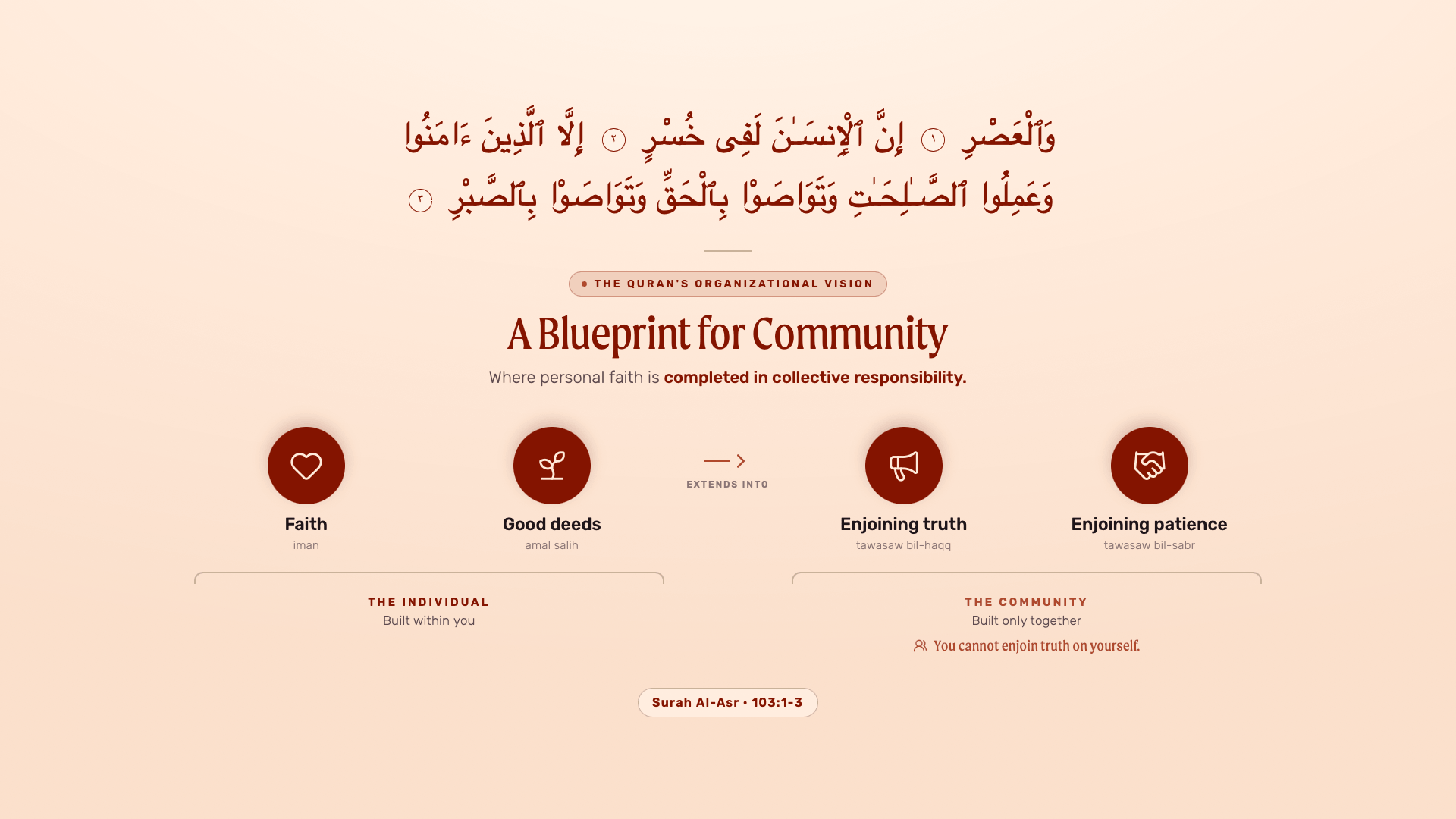
This is not a modern reading of the text. It is embedded in Surah Al-‘Asr, where the first half of the Surah speaks to the individual’s faith and good deeds and the second half, the enjoining of truth and patience, can only happen in community. [1] You cannot enjoin truth on yourself. That second half is a call for collective responsibility and it is one of the shortest, clearest proofs that the Quran has an organizational vision.
The Problem With How We Train Muslim Leaders
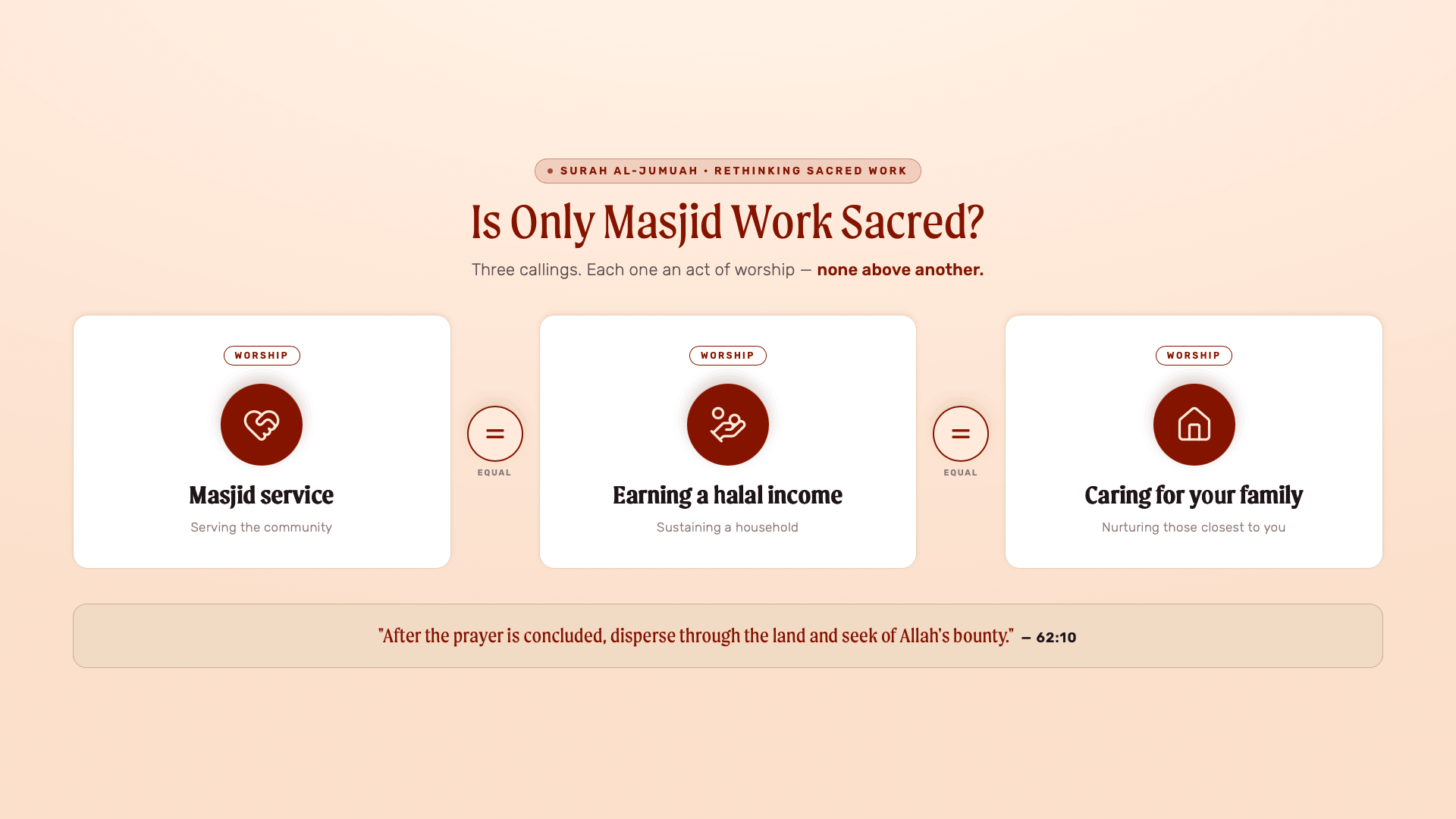
Walk into almost any masjid in America today and you will find people who care deeply, work hard and are exhausted. They volunteer long hours, sacrifice family time and burn out within a few years. We keep replacing people without examining the system that burns them out. The Quran has a framework that addresses this and it begins not with how to manage more efficiently but with a question of priority: is your livelihood sacred, or is only masjid work sacred? [2]
We have access to corporate training and nonprofit management frameworks and there is nothing wrong with those, but they do not account for the specific spiritual and communal dynamics of Muslim organizations. The Quran does.
What This Means in Practice
Approaching organizational work through a Quranic lens starts with one foundational shift: recognizing that serving the community is not more sacred than serving your family and that earning a halal income to sustain yourself is an act of worship. When that foundation is settled, volunteers stop apologizing for having boundaries and leaders stop expecting people to sacrifice everything for the cause.
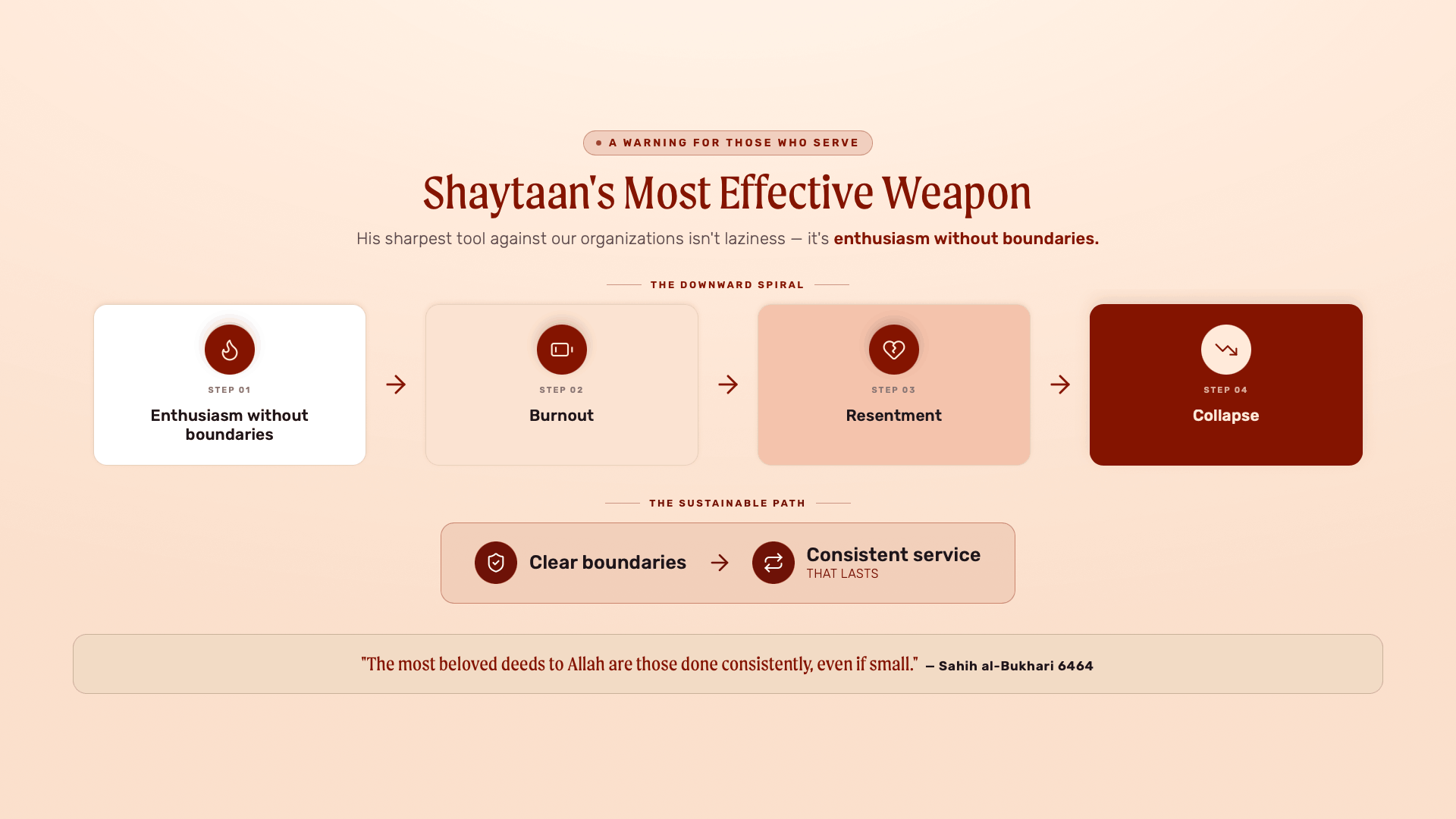
Once this is settled, everything else follows: learning to set clear limits, say no without guilt and do a few things well rather than many things poorly. Shaytaan’s most effective weapon against Muslim organizations is enthusiasm without boundaries because it leads directly to burnout, resentment and collapse.
The Quran has guidance for all of this; the question is whether we will take it seriously enough to actually build our organizations around it.
If you want to go deeper into these principles directly from Ustadh Nouman, his Leadership course on Bayyinah TV takes you through the Quranic foundation for how Muslims can work together with excellence and integrity. Start exploring now.
Notes
[1] Al-Quran, 103:1-3 — https://quran.com/al-asr
[2] Mishkat al-Masabih 2781 — https://sunnah.com/mishkat:2781

At Bayyinah, we are dedicated to helping you connect directly with the words of Allah beyond translation. Founded by Ustadh Nouman Ali Khan, our mission is to create transformative experiences that deepen your understanding and engagement with the Quran.
Study the Quran and Arabic in a systematic and personalized way through Bayyinah TV. Get started today for free.
Check out our newest articles, fresh off the press and ready for you to dive into!