
Successful subscription! Thank you for subscribing.
Successful subscription! Thank you for subscribing.

May 18, 2026
Most organizational advice given in Muslim spaces comes from outside sources; business books, nonprofit seminars, corporate training. There is a place for that but there are lessons that can only come from building something with Quranic principles at the center and learning, sometimes painfully, what works and what does not.
In his Leadership Workshop series, Ustadh Nouman Ali Khan draws on his experience building Bayyinah Institute to offer practical wisdom rooted in Quranic principles. Here are five of the most important institutional lessons from Bayyinah’s story.
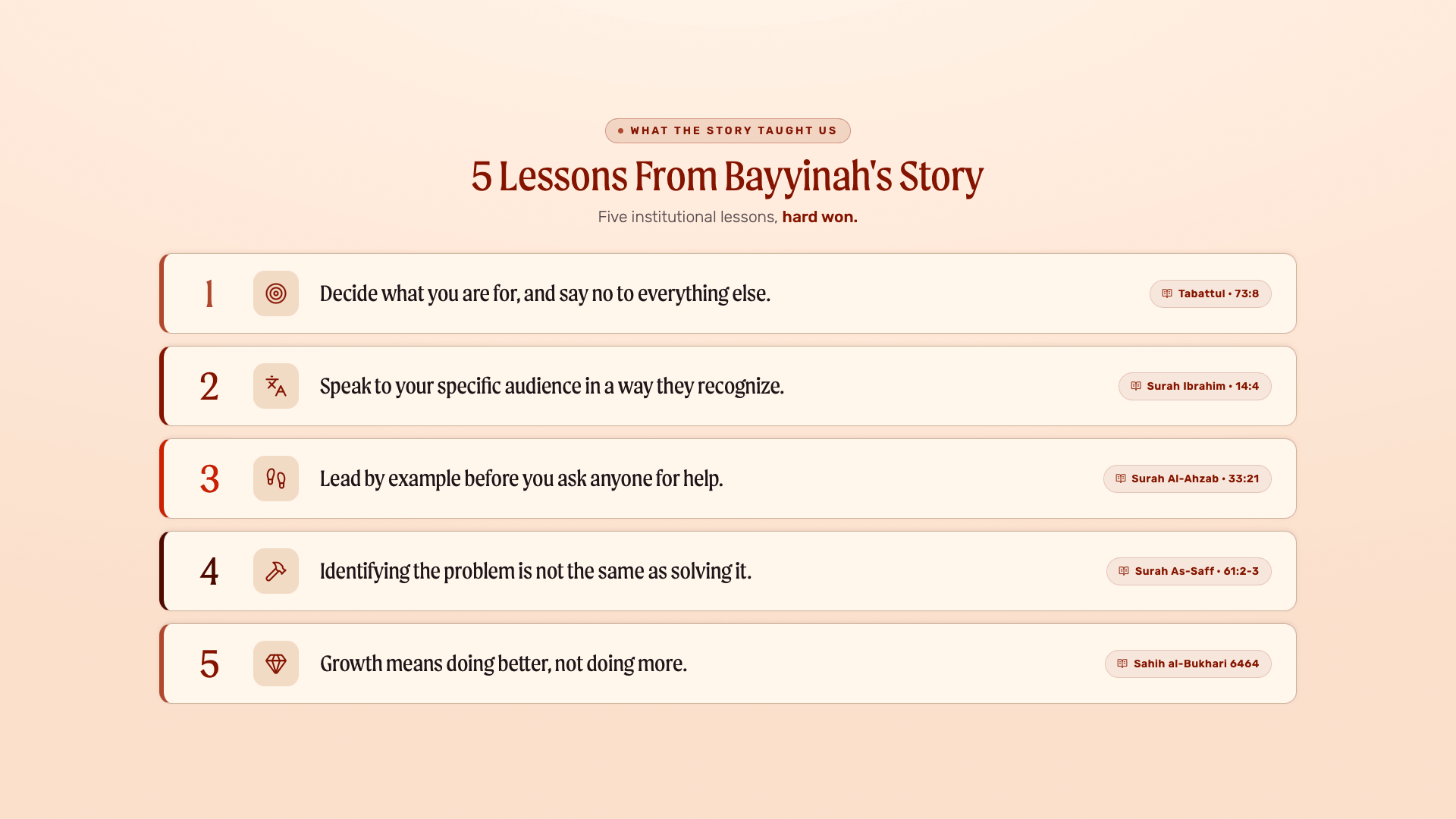
1. Decide What You Are For And Say No to Everything Else
When Bayyinah was taking shape, there were clear signals about what the institution would and would not do; Arabic and Quranic studies. Not fiqh, seerah or everything an Islamic school should ideally cover. The decision to say “this is what we do” was not easy and it meant disappointing people who wanted Bayyinah to be more. But it is the reason Bayyinah was able to build something excellent rather than something adequate. Focus is a Quranic principle: the word تَبَتَّل in Surah Al-Muzzammil (73:8)[1] literally means to cut away from everything else and devote yourself entirely to one direction.
2. The American Muslim Community Is a Specific Audience With Specific Needs
You can attend a general business seminar and learn universal principles but the American Muslim community is not a general audience, it has specific cultural dynamics, specific doubts and resistances and specific ways that people connect to the Quran. Allah Himself says that He did not send any messenger except in the language of his people, so that the message would be made clear to them (14:4).[2] Speaking to a specific audience in a way they recognize is a Quranic principle, not a marketing one. Bayyinah’s content was designed for this audience from day one. Ustadh Nouman did not import a curriculum from another context. He built something that spoke to the questions, assumptions and emotional realities of Muslims in America.
3. Lead by Example Before You Ask Anyone for Help
One of the most common complaints in Muslim institutions is the lack of volunteers, the absence of support, the difficulty of getting people to show up. Ustadh Nouman connects this to the Quranic principle that leadership is demonstrated, not declared. Allah reminds the believers that in the Messenger of Allah there is an excellent example for whoever hopes in Allah and the Last Day (33:21).[3] Before Bayyinah had a team, Ustadh Nouman was doing everything himself: teaching, recording, editing, answering questions. The credibility that built is not something you can manufacture. People follow because they saw you doing the work, not because you told them the work needed to be done.
4. Identifying the Problem Is Not the Same as Solving It
Ustadh Nouman shares a striking observation from an education forum he attended: for 15 consecutive years, 80% of the sessions were devoted to the same unresolved question about Arabic curriculum in Islamic schools. Everyone agreed it was important. Nobody had executed a solution. The lesson is that discussion without execution is not leadership; it is a distraction that feels productive. The Quran warns against saying what you do not do, telling the believers directly that it is gravely hated in the sight of Allah to say what you do not act on (61:2-3).[4]
5. Growth Does Not Mean Doing More, It Means Doing Better
Organizations that have existed for decades often face a particular temptation: they were built on one thing, they are known for that one thing, people come for that one thing and then they decide it is time to “expand.” Expansion for its own sake is one of the most reliable ways to destroy what made you effective. Bayyinah’s growth has come not from doing more things but from doing its core thing with greater depth and reach. The Prophet ﷺ taught that the most beloved deeds to Allah are those done consistently, even if small (Sahih al-Bukhari 6464).[5] The principle is the same as تَبۡتِيلًا: intensity, not breadth.

These are the kinds of lessons that are rarely discussed in Friday khutbahs or organizational trainings but they are exactly what our institutions need. Ustadh Nouman shares them in their full Quranic context in his Leadership course on Bayyinah TV.
Start exploring the course here.
Notes
[1] Al-Quran, 73:8 — https://quran.com/73/8
[2] Al-Quran, 14:4 — https://quran.com/14/4
[3] Al-Quran, 33:21 — https://quran.com/33/21
[4] Al-Quran, 61:2-3 — https://quran.com/61/2-3
[5] Sahih al-Bukhari 6464 — https://sunnah.com/bukhari:6464

At Bayyinah, we are dedicated to helping you connect directly with the words of Allah beyond translation. Founded by Ustadh Nouman Ali Khan, our mission is to create transformative experiences that deepen your understanding and engagement with the Quran.
Study the Quran and Arabic in a systematic and personalized way through Bayyinah TV. Get started today for free.
Check out our newest articles, fresh off the press and ready for you to dive into!