
Successful subscription! Thank you for subscribing.
Successful subscription! Thank you for subscribing.
June 4, 2026
In many cultures around the world, there is a persistent bias toward boys and against girls. Sons are celebrated as blessings while daughters are seen as burdens or obligations. This bias has caused immense suffering, from selective abortion to neglect to a failure to educate girls. Yet when we turn to the Quran, we find something radically different. The Quran itself criticizes this bias and affirms the blessing of both sons and daughters.
The Quranic Rejection of Bias
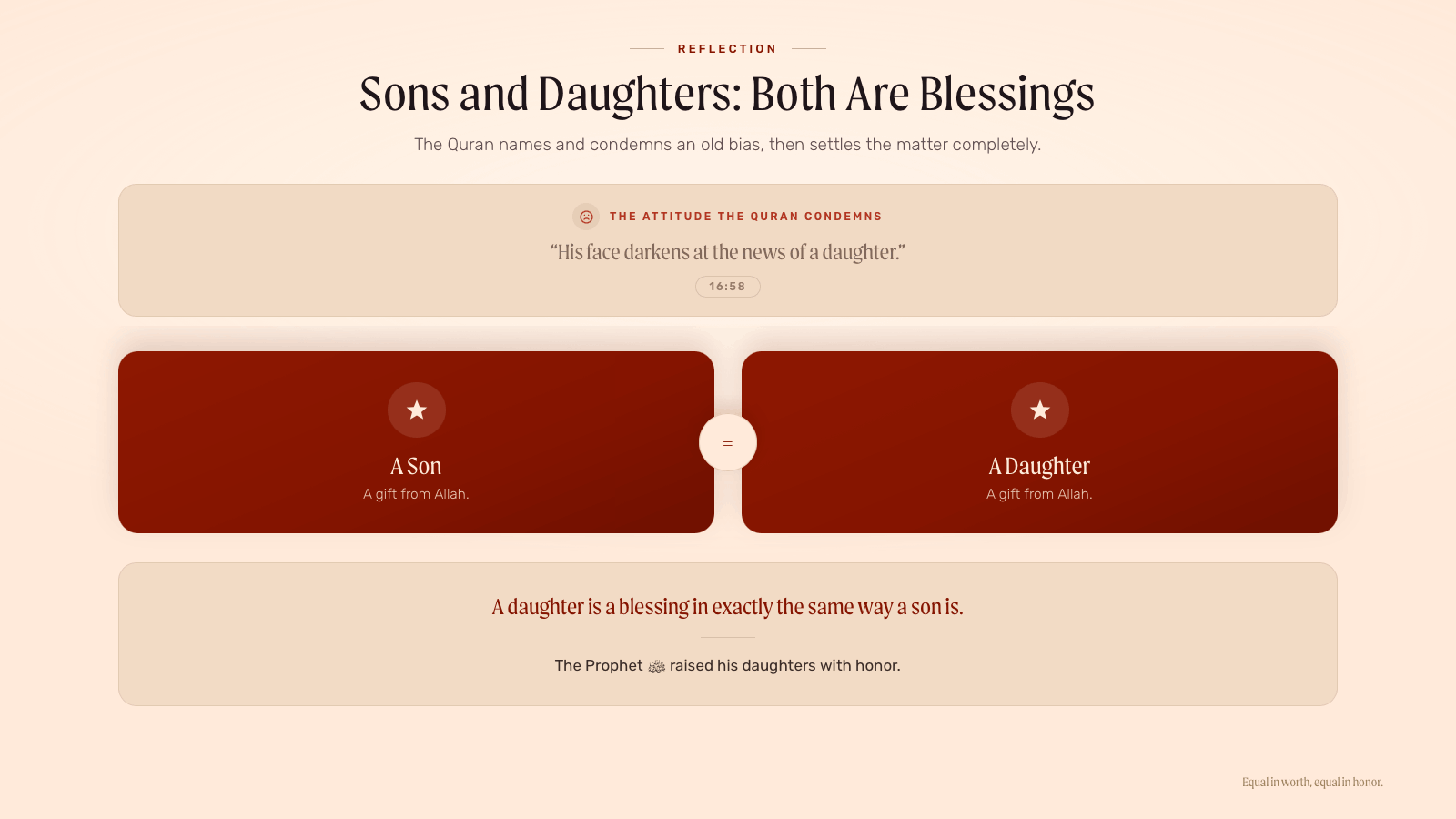
The Quran directly addresses people who were upset about having daughters. Allah says, “When one of them is given news of a daughter, his face becomes dark and he suppresses his anger” (16:58)1. The Quran is describing the reaction of those who see the birth of a girl as bad news. Moreover, how does Allah respond? With clear criticism and guidance, calling out this attitude as ignorance and injustice.
Later in the same passage, Allah points out the absurdity of the bias: “Do they assign to Allah those who create nothing, while they themselves are created? And they ascribe to Him daughters when they have no knowledge?” (16:17-18). 2 The Quran is highlighting the contradiction: people are ascribing something to Allah, daughters, as if it’s a defect, when they themselves are being given something they didn’t earn and couldn’t create.
This is crucial because the Quran is not being subtle here; it is directly condemning the cultural preference for boys and the dismissal of girls. If the Quran itself criticizes this bias, then for Muslims, this should be the end of the matter. A Muslim who continues to express a preference for boys over girls is contradicting the Quran itself.
Both Are Blessings
The Quran describes both sons and daughters as blessings from Allah, using the same word for both, which means a daughter is not a consolation prize if you wanted a boy. A daughter is not a trial or a test in the sense of something to be endured. A daughter is a blessing in exactly the same way a son is a blessing.
Yet in many Muslim cultures, we see a remnant of pre-Islamic attitudes toward daughters, which represents a major disconnect since Islam came to reshape this very perspective. The Prophet Muhammad ﷺ had daughters, raised them with honor and taught his followers to do the same. Yet somehow, across centuries and cultures, the pre-Islamic bias has persisted, sometimes even strengthened by misinterpretations of Islamic teachings.
The responsibility falls on parents to break this cycle. When you find yourself expressing a preference for a son, when you feel disappointed at the birth of a daughter, when you invest less in a daughter’s education because you assume she will be married off anyway, you are perpetuating something that the Quran itself condemns. You are teaching your children that the Quran is not the final word; cultural tradition is.
The Danger of Expressing Preference
Some parents justify their preference by saying it’s just a preference, just a private feeling. However, nothing is truly private in a family; children feel acutely when they are the “less preferred” child. They sense it through tone, through investment, through how much time and attention they receive. A daughter who grows up knowing that her parents would have preferred a son carries this wound throughout her life. She may become resentful or she may internalize the message that she is somehow less valuable.
Conversely, parents who genuinely celebrate the birth of their daughter, who invest in her development, who treat her as a full human being with the same potential as any son, are giving her an extraordinary gift. They are telling her, through action as much as words, that she is valued, that she matters and that her future is open to her. The daughter raised this way has a confidence and a sense of worth that the daughter who was the “less preferred” child simply cannot have.
Reframing Your Perspective
If you find yourself struggling with a preference for boys, the work is to reframe it. The Quran invites you to see daughters as blessings and challenges you to examine where this preference comes from, whether it is cultural, rooted in practical concerns about financial security or based on a misunderstanding of what daughters “should” do with their lives.
Once you identify the root, you can begin to change. You can consciously invest in your daughter’s education, in her confidence, in her relationship with Allah. You can support her dreams and ambitions, not as a mother or father supporting a “daughter,” but as a parent supporting a human being. You can break the cycle that has persisted far too long in Muslim cultures.
A Generation-Changing Decision
When a parent decides that they will fully, genuinely celebrate and invest in their daughters the way they do their sons, they are making a decision that will ripple through generations. The daughters raised this way will raise their own children differently, expecting better treatment and modeling confidence for their own daughters. They will teach their sons to respect women, not as a foreign concept, but as something they learned from their father’s respect for their mother and sisters.
The Quran has already made the statement clear: both sons and daughters are blessings. The only question that remains is whether you will align yourself with the Quran or with the remnants of pre-Islamic cultural bias. The choice is in your hands and the impact of that choice will be felt for generations.
Want to go deeper into Quranic parenting? Explore Ustadh Nouman’s full Parenting series on Bayyinah TV, designed to help Muslim families raise their children with intention, wisdom and faith. Start your journey today.
Notes
[1] Al-Quran, 16:58, https://quran.com/an-nahl/58 ↩
[2] Al-Quran, 16:17-18, https://quran.com/an-nahl/17-18 ↩

At Bayyinah, we are dedicated to helping you connect directly with the words of Allah beyond translation. Founded by Ustadh Nouman Ali Khan, our mission is to create transformative experiences that deepen your understanding and engagement with the Quran.
Study the Quran and Arabic in a systematic and personalized way through Bayyinah TV. Get started today for free.
Check out our newest articles, fresh off the press and ready for you to dive into!