
Successful subscription! Thank you for subscribing.
Successful subscription! Thank you for subscribing.

June 4, 2026
Every parent knows the feeling: your child is mid-tantrum, mid-lie or mid-fight with a sibling and you are not sure whether to intervene, ignore it or call for backup. Small behavioral issues have a way of becoming permanent character traits if they are left unaddressed and the window for shaping how your child handles anger, honesty and relationships is shorter than most of us realize.
Ustadh Nouman Ali Khan, drawing from Quranic principles and his own experience as a father of six, identifies four behavioral issues that deserve serious attention from Muslim parents and practical ways to address each one before it hardens into habit.
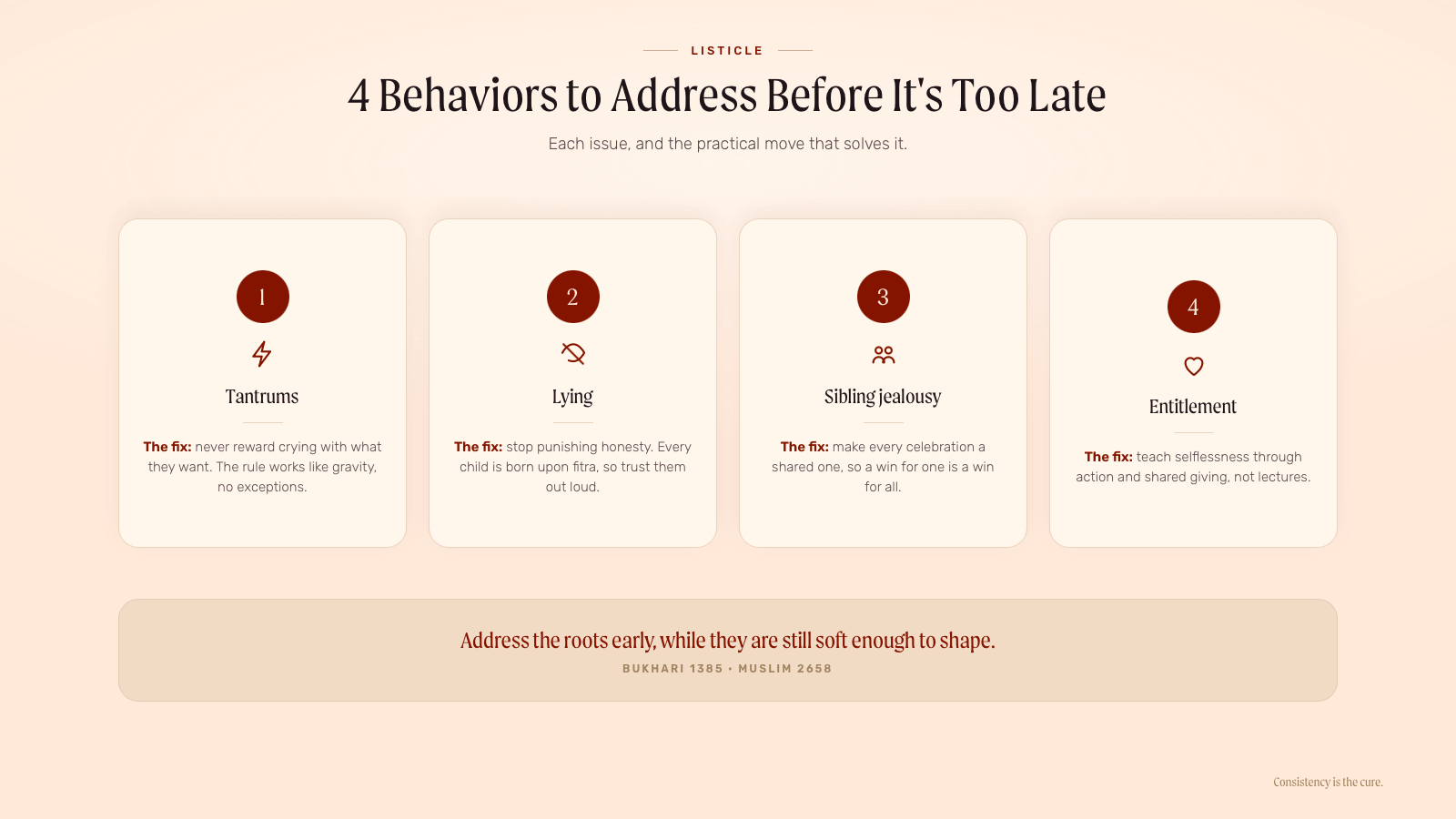
1. Tantrums: Do Not Reward Crying With What They Want
Every time a child cries and receives what they were crying for, a lesson has been taught: tears are currency. Tomorrow’s tantrum has just been guaranteed. The terrible twos are normal and developmentally expected, but how a parent responds during that stage sets the pattern for years to come.
Ustadh Nouman describes his own approach: when one of his children would not stop crying, he would calmly say, “I have something really fun for us to do, but I can not do it while you are crying. Once you stop and smile, we can play.” Then he would walk away. The child, mid-sob, would try to hold back tears, visibly wrestling between the habit and the incentive. It works not because of a single instance but because of repetition and the key is consistency. If you hold the line nine times and give in on the tenth, you have taught them that persistence pays off. The rule has to function like gravity: no exceptions, no negotiations and no guilt.
2. Lying: Stop Punishing Honesty
Children lie. It is not because they are morally corrupt; it is because they are calculating risk. When a child admits to something wrong and receives a severe punishment, they learn that honesty has worse consequences than deception. Next time, they dig in deeper. “I didn’t do it. I swear I didn’t do it.” They will deny it to your face, even with the evidence in plain sight, because admitting guilt has never worked in their favor.
The Quranic principle here is rooted in fitra: children are not inherently evil; they are inherently good. 1 When you do not punish them for a lie, something remarkable happens. Their conscience, which was being drowned out by fear, has room to speak. If the punishment does not come, the child sits with what they did and over time many of them come back on their own: “Mama, I want to tell you something. I did do it.”
Ustadh Nouman’s practical advice is direct: let them get away with it sometimes. Trust them out loud, even when you know the truth. Say, “I believe you, because I trust you. You promised me you would not lie, so I trust you.” When honesty is met with safety instead of fury, children stop fearing the truth and start choosing it.
3. Sibling Jealousy: Make Every Celebration a Shared One
One of the most common sources of sibling conflict is the feeling of being left out. A birthday party where one child blows out candles while another cries in the corner is not a celebration; it is a breeding ground for resentment. Ustadh Nouman argues that every family celebration should involve every child. If one child is being honored, let that child choose gifts for their siblings. Let every child blow out a candle. Make the moment about family rather than about one person being elevated above the rest.
This extends beyond birthdays. When a new baby enters the household, the older child often acts out, not because they dislike the baby, but because they feel replaced. The solution starts during pregnancy: involve the older child in preparations, let them help pick items for the baby and give them a role in the care from day one. If they feel like a participant rather than a bystander, the jealousy diminishes significantly.
The eldest child in any family deserves special attention here. They carry the most expectations (“You are the older one, act like it”) and often receive the least individual time. Ustadh Nouman emphasizes that higher expectations must be balanced with more love, more conversation and more one-on-one moments. If your older child never gets time alone with you, they will resent the younger ones for taking it.
4. Entitlement: Teach Selflessness Through Action, Not Lectures
The culture of “it is my birthday, what are you getting me?” breeds a child who measures love in material terms. When every occasion centers on receiving, the muscle of giving atrophies. Ustadh Nouman recommends a practical shift: instead of asking what the birthday child wants, take them to the store and ask, “What do you want to get for your brothers and sisters? What do they like?” When a child picks something for a sibling based on what they know that sibling loves, you have just created a moment of empathy, observation and generosity.
Similarly, toys and games should be chosen with cooperation in mind. Board games that require multiple players, races where siblings compete as a team against a parent, activities where winning is shared, all of these quietly build a culture of togetherness. Ustadh Nouman describes racing toy cars with his young sons and deliberately losing so they could celebrate together: “Brothers win, Abba loses.” The content of the game is less important than the dynamic it creates.
None of these behavioral issues resolve overnight. Consistency over weeks and months is what creates lasting change and the Quran’s framework for patience applies as much to parenting as it does to worship. The parent who stays calm, stays consistent and stays present is already doing the hard work that most children desperately need.
If you want to go deeper into Quranic principles for raising children, Ustadh Nouman’s Parenting course on Bayyinah TV covers these topics and many more. Start your journey today.
Want to go deeper into Quranic parenting? Explore Ustadh Nouman’s full Parenting series on Bayyinah TV, designed to help Muslim families raise their children with intention, wisdom and faith. Start your journey today.
Notes
[1] The concept of fitra (innate goodness) is grounded in the Prophet ︎ﷺ’s words: “Every child is born upon fitra.” Sahih al-Bukhari 1385; Sahih Muslim 2658, https://sunnah.com/bukhari:1385 ↩

At Bayyinah, we are dedicated to helping you connect directly with the words of Allah beyond translation. Founded by Ustadh Nouman Ali Khan, our mission is to create transformative experiences that deepen your understanding and engagement with the Quran.
Study the Quran and Arabic in a systematic and personalized way through Bayyinah TV. Get started today for free.
Check out our newest articles, fresh off the press and ready for you to dive into!