
Successful subscription! Thank you for subscribing.
Successful subscription! Thank you for subscribing.

June 4, 2026
Have you ever made an angry face at your toddler, just to see what would happen? Maybe their lip trembled, their eyes welled up and you quickly said, “I was kidding, I was kidding!” That moment, as small as it seems, reveals something important: children are extraordinarily sensitive to how we look at them, how we speak to them and what we call them. Most of us would never think of ourselves as verbally abusive parents, yet the Quran identifies forms of emotional harm that are so subtle we may be committing them every single day without realizing it.
Ustadh Nouman Ali Khan, drawing from Quranic principles, highlights five ways that parents unknowingly hurt their children and what we can do instead.
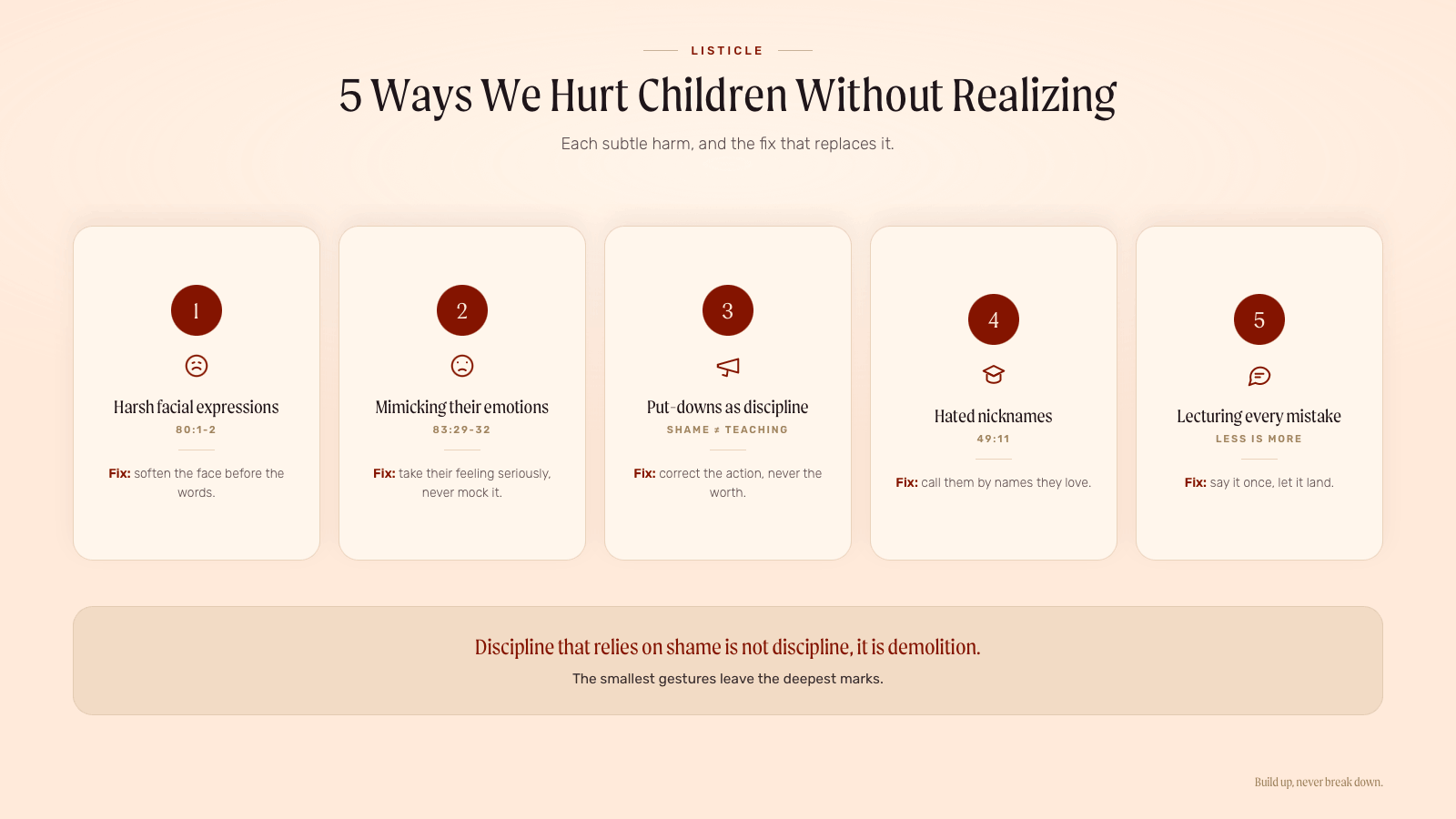
1. Your Facial Expressions Carry More Weight Than You Think
Allah corrected the Prophet ︎ﷺ for frowning in the presence of a companion who could not even see it. In Surah ‘Abasa, the opening verses address this directly: “He frowned and turned away, because the blind man came to him” (80:1-2). 1 If Allah held His Messenger to that standard in front of a man who was blind, what does that say about how seriously He takes our facial expressions in front of our children, who see everything?
Children read faces before they understand words. A look of frustration, disappointment or anger can communicate rejection in a way that no verbal reassurance fully erases. Controlling our expressions is not about being fake; it is about recognizing that we hold enormous emotional power over our children and that power demands care.
2. Mimicking Your Child’s Emotions Is a Form of Mockery
When a child is crying and a parent starts imitating them, exaggerating the sound or pulling faces, it may seem like harmless fun. It is not. The Quran describes the disbelievers mocking the Prophet ︎ﷺ and the early Muslims by winking, making condescending gestures and mimicking them as they passed by. 2 This behavior is condemned precisely because it belittles someone in a moment of vulnerability.
There is a difference between using humor to lighten a tense moment and using sarcasm to diminish a child’s feelings. If your child is upset and you start crying alongside them in a playful, empathetic way, that can actually help. If you are mocking the sound of their distress, you are teaching them that their emotions are ridiculous and that lesson stays with them far longer than you might expect.
3. Put-Downs Disguised as Discipline
Surah Al-Hujurat contains a series of direct instructions about how believers should treat one another: do not mock one another, do not insult one another, do not call each other by offensive nicknames (49:11). 3 These ayat are usually taught in the context of community relations, but Ustadh Nouman argues they apply with even greater force inside the home. When a parent says, “What’s wrong with you?” or “Why can’t you do anything right?” or “You’re just like your father,” they may think they are correcting behavior. What they are actually doing is attacking the child’s sense of self.
Discipline that relies on shame is not discipline. It is demolition and the Quran draws a clear line between correcting someone’s behavior and degrading their character and parents cross that line more often than they realize.
4. Nicknames They Hate Are Not Terms of Endearment
In the same passage of Surah Al-Hujurat, Allah says: “Do not call each other by offensive nicknames. How evil it is to be called by a bad name after having faith” (49:11). 3 If a child does not like a nickname, using it is not affection; it is a small but repeated act of disrespect. Worse, when a parent uses a nickname the child dislikes, siblings pick it up too. Suddenly the parent who says, “Only I can call you that,” has created a double standard that the child sees right through.
The practical rule is simple: call your children names you would be comfortable hearing their siblings, their classmates and eventually their spouses use. If a name would embarrass them in public, it should not be used in private either.
5. Responding to Every Mistake With a Lecture
Not every infraction requires a speech. One of the most important parenting instincts to develop is knowing which battles to fight. When a child snatches a toy, the instinct is to launch into a lecture about sharing, respect and why this behavior is unacceptable. The problem is that children under a certain age do not process lectures; they process consequences and patterns.
Ustadh Nouman describes a simpler approach: take the item back, return it to the other child and calmly ask, “How do you ask properly?” No yelling, no speech, just redirection. Repeat this consistently, every single time and within weeks the behavior changes. The key is consistency, not volume. When we respond to small infractions with the same intensity we reserve for serious ones, children stop distinguishing between the two and they stop listening altogether.
The harm we do to our children with words and expressions is rarely intentional. Most parents who frown, mock, label or lecture too harshly are doing so out of exhaustion, frustration or inherited habits they never examined. The Quran does not shame us for these tendencies; it names them clearly so we can recognize them and choose differently. The standard is not perfection. It is awareness, restraint and the willingness to keep trying.
If you want to explore more of Ustadh Nouman’s teachings on Quranic wisdom for parents, his Parenting course on Bayyinah TV walks through these principles in depth. Start your journey today.
Want to go deeper into Quranic parenting? Explore Ustadh Nouman’s full Parenting series on Bayyinah TV, designed to help Muslim families raise their children with intention, wisdom and faith. Start your journey today.
Notes
[1] Al-Quran, 80:1-2, https://quran.com/abasa/1-2 ↩
[2] Al-Quran, 83:29-32, https://quran.com/al-mutaffifin/29-32 ↩
[3] Al-Quran, 49:11, https://quran.com/al-hujurat/11 ↩

At Bayyinah, we are dedicated to helping you connect directly with the words of Allah beyond translation. Founded by Ustadh Nouman Ali Khan, our mission is to create transformative experiences that deepen your understanding and engagement with the Quran.
Study the Quran and Arabic in a systematic and personalized way through Bayyinah TV. Get started today for free.
Check out our newest articles, fresh off the press and ready for you to dive into!