
Successful subscription! Thank you for subscribing.
Successful subscription! Thank you for subscribing.

June 4, 2026
Some of us are already parenting teenagers, while others are parenting children who will be teenagers before we feel ready for it. Either way, one reality is unavoidable: there are qualities that need to become part of a young Muslim’s personality during the teenage years, because if they do not take root at that stage, they will be far harder to build later.
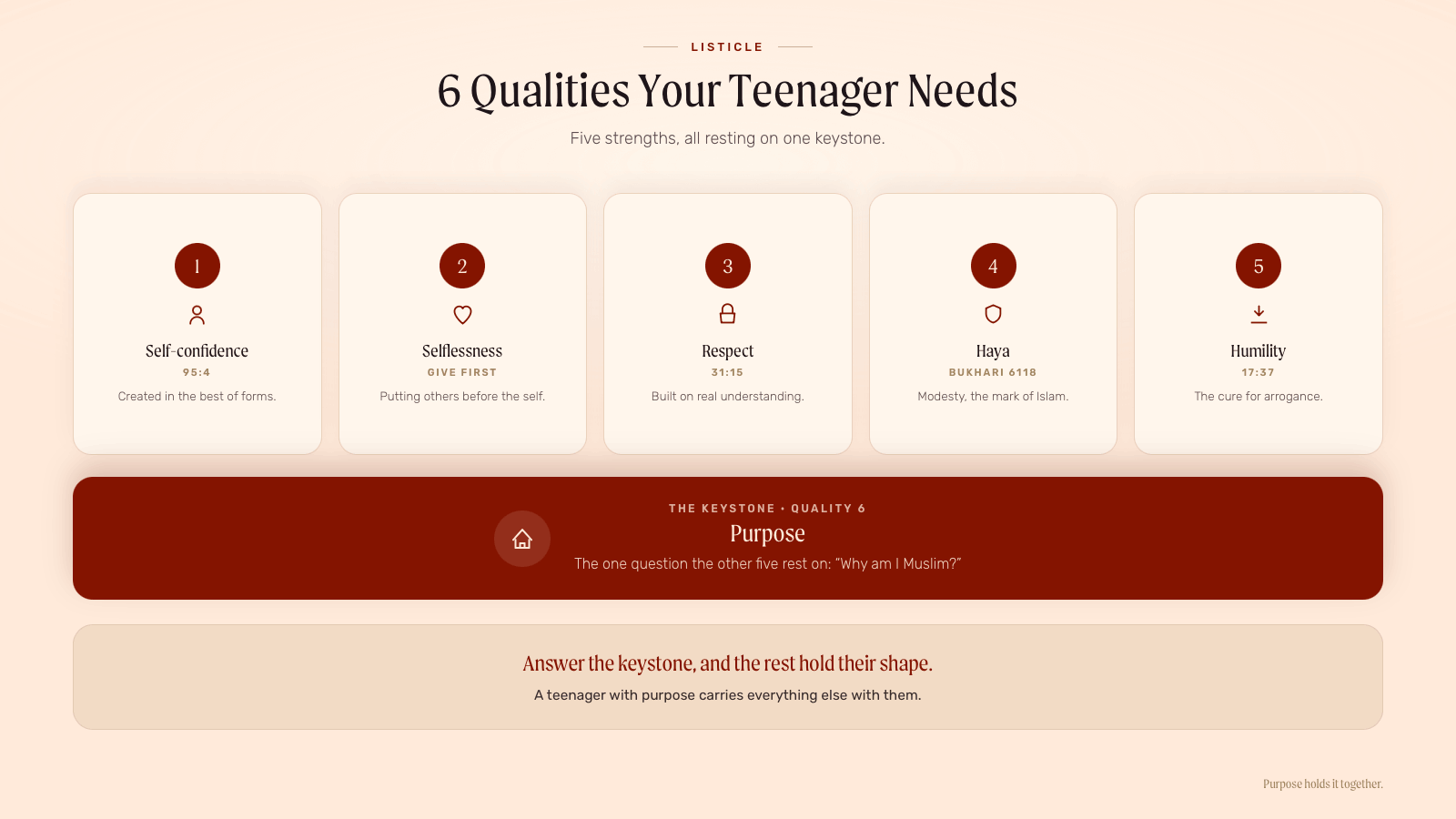
Ustadh Nouman Ali Khan identifies six qualities that, if instilled during adolescence, give a young person the foundation to lead a life that is successful in every sense, materially, morally and spiritually.
1. Self-Confidence: Being Okay With Who You Are
Self-confidence, in the simplest terms, means that a young person does not think less of themselves because of their weight, their skin color, their family’s income or any other external measure. This sounds basic, yet the statistics on teenage depression and low self-esteem are staggering.
The danger is particularly acute for girls. At a vulnerable age, a girl who does not feel pretty enough, special enough or valued enough is extraordinarily easy to manipulate. When someone outside the family offers the validation she never received at home, she becomes, as Ustadh Nouman puts it, “putty in their hands.” For boys, low self-confidence manifests differently: they avoid taking positions, they shrink from responsibility and they never develop the backbone needed to lead a household, let alone a community.
The Quran addresses this at its root. Allah declares that He created the human being “in the best of forms” (95:4). 1 When a child truly understands that their worth was assigned by Allah Himself and is not contingent on appearance, popularity or wealth, external pressures lose their grip.
2. Selflessness: Fighting the Culture of “Me”
The teenage years are, by nature, years of heightened self-absorption. Fashion, appearance, social validation and personal desires take center stage. The Quran names this tendency directly, calling it zeenah, beautification, the pull toward making yourself look good and feel important in the eyes of others (18:46). 2
Combating selfishness is not about shaming teenagers for caring about how they look; it is about building a counter-habit. Does your son worry about whether his mother has eaten before he eats? Does your daughter check on her younger sibling before worrying about her own plans? These small habits of putting others first do not emerge from a single lecture. They are built by modeling, by repetition and by making selflessness a visible, valued part of family life. A teenager who has never practiced thinking of others will struggle to do so as a spouse, a parent or a community member.
3. Respect: Building It on Understanding, Not Obedience
We live in a culture where nothing is above ridicule. Presidents, religious figures, sacred texts and parents are all fair game for a joke and children absorb this attitude through every screen and every hallway conversation at school. Then we come home and say, “You must have respect,” without explaining why.
Respect that is demanded without being earned will not survive the teenage years. Respect that is built on intellectual conviction will. The Quran commands respect for parents explicitly, even if those parents are not Muslim (31:15). 3 Teaching a teenager why respect matters, grounding it in their understanding of Allah’s commands rather than just cultural expectation, gives them a reason to hold the line when the world around them treats everything as a joke.
4. Shame: Protecting Modesty in an Immodest World
This is the age of hormones, curiosity and constant bombardment. Music videos, social media, the way peers dress in school and the casual display of intimacy in hallways and on screens all normalize what the Quran asks us to guard against. The Prophet ︎ﷺ said, “Every religion has a distinguishing quality and the distinguishing quality of Islam is haya (modesty).” 4
Ustadh Nouman does not sugarcoat what Muslim teenagers are exposed to daily. Eight hours a day in an environment where barely-dressed classmates and explicit language are standard is conditioning. Over four years of high school, what was once shocking becomes background noise. Parents cannot simply say “lower your gaze” and expect compliance. They need to build a foundation of faith strong enough that their teenager has internal reasons to protect themselves, not just external rules imposed from above.
5. Humility: Balancing Confidence With Groundedness
Arrogance is celebrated in youth culture. Speaking up, talking back and projecting an unshakable persona are treated as signs of strength, while humility, by contrast, is read as weakness. Teaching a teenager to be humble in an environment that rewards ego is one of the hardest things a Muslim parent will do.
The Quran repeatedly warns against pride and self-importance: “Do not walk upon the earth with arrogance. Indeed, you will never tear the earth apart and you will never reach the mountains in height” (17:37). 5 Humility does not mean being passive. It means recognizing that whatever talents, beauty or intelligence you have were given to you by Allah and that recognition should make you grateful rather than entitled.
6. Purpose: Answering the Most Important Question
Ustadh Nouman raises one question that he believes is the gateway to all other Islamic education for teenagers: Why am I Muslim? If a teenager’s answer is “because my parents are” or “I don’t know, I just am,” then every other lesson sits on a foundation of sand. Without a clear, confident and personally owned answer to that question, nothing else holds.
When a young person genuinely understands why they believe, self-confidence follows because their identity is anchored in something immovable. Selflessness follows because their purpose is bigger than themselves; respect follows because they understand what deserves reverence; shame follows because they have something they want to protect; and humility follows because they know who gave them everything they have.
The teenage years are not a crisis to survive; they are a window to build something lasting. These six qualities, self-confidence, selflessness, respect, shame, humility and purpose, are not luxuries. They are the foundation that determines whether a young Muslim enters adulthood ready to lead a meaningful life or spends years trying to find footing they should have had all along.
If you want to explore these principles in depth, Ustadh Nouman’s Parenting course on Bayyinah TV is designed to help Muslim families navigate exactly these challenges. Start your journey today.
Want to go deeper into Quranic parenting? Explore Ustadh Nouman’s full Parenting series on Bayyinah TV, designed to help Muslim families raise their children with intention, wisdom and faith. Start your journey today.
Notes
[1] Al-Quran, 95:4, https://quran.com/at-tin/4 ↩
[2] Al-Quran, 18:46, https://quran.com/al-kahf/46 ↩
[3] Al-Quran, 31:15, https://quran.com/luqman/15 ↩
[4] Sahih al-Bukhari, Hadith 6118, “Modesty is part of faith”, https://sunnah.com/bukhari:6118 ↩
[5] Al-Quran, 17:37, https://quran.com/al-isra/37 ↩

At Bayyinah, we are dedicated to helping you connect directly with the words of Allah beyond translation. Founded by Ustadh Nouman Ali Khan, our mission is to create transformative experiences that deepen your understanding and engagement with the Quran.
Study the Quran and Arabic in a systematic and personalized way through Bayyinah TV. Get started today for free.
Check out our newest articles, fresh off the press and ready for you to dive into!