
Successful subscription! Thank you for subscribing.
Successful subscription! Thank you for subscribing.

June 4, 2026
The Most Common Mistake Parents Make
One of the most universal parenting mistakes is comparing children to each other. “Why can’t you be more like your brother?” “She never gets angry like you do.” “He’s so much better at this than you are.” These comparisons feel innocent to parents, often used as motivation or as a way to highlight what we want to see more of. However, they carry significant damage.
The Quran addresses this directly. Allah tells us not to wish for what He has given others and not to compare ourselves based on what Allah has distributed differently1. The children of Ya’qub understood this principle too well. When they looked at how their father treated Yusuf (AS) and his brother differently, they immediately began comparing themselves: “Our father loves them more than he loves us”2. Whether Ya’qub (AS) intended to show favoritism or not, his children felt it through comparison.
This teaches us something critical: children will compare themselves to their siblings and measure their worth against their siblings’ worth. Moreover, if you do it first, you’re validating this comparison and intensifying its impact.
Why Comparison Is Psychologically Damaging
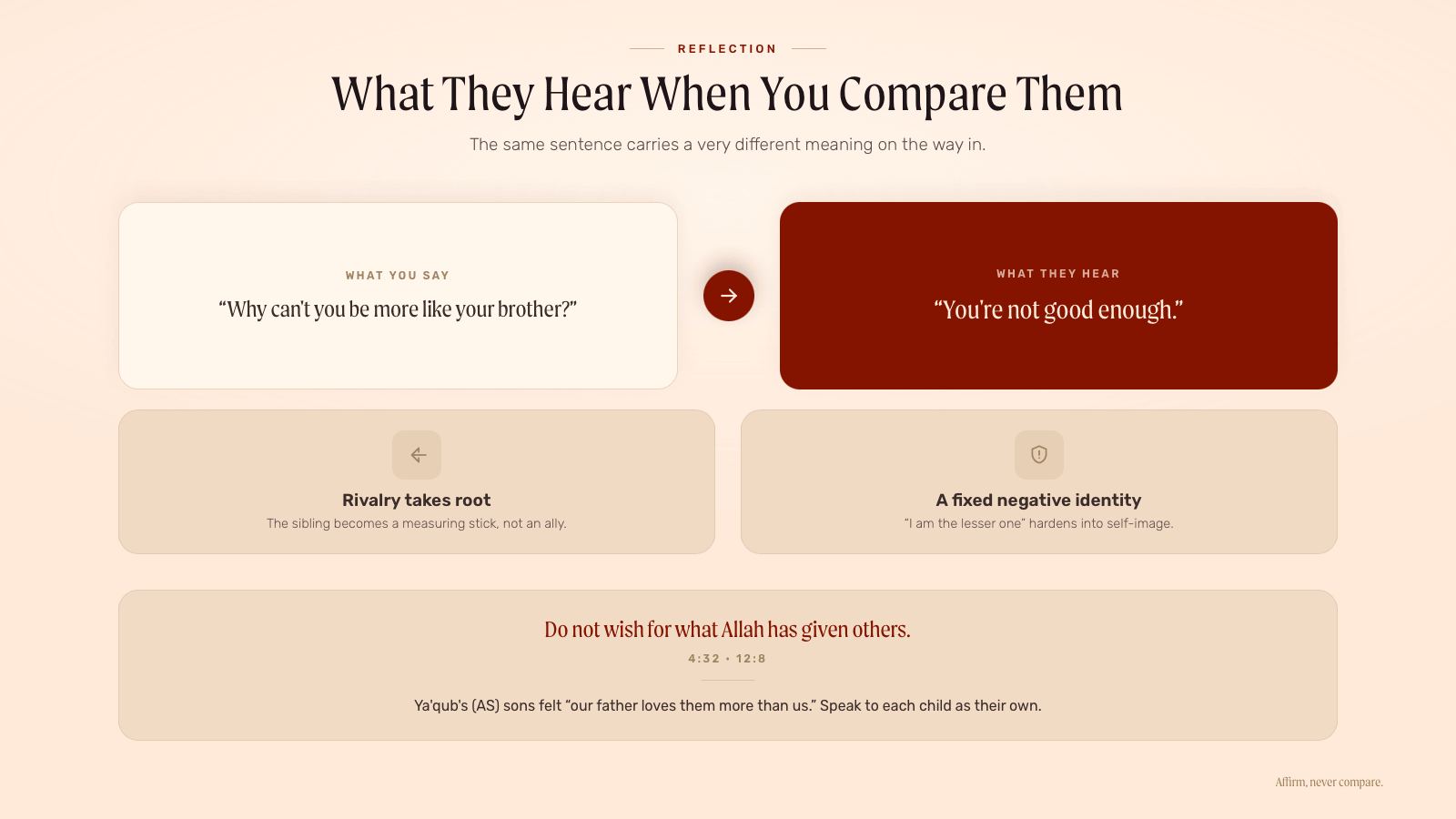
Comparison creates a zero-sum game in a child’s mind. If their sibling is better at something, that means they’re worse. If their sibling receives praise, that means they’re being judged as inferior. This sets up sibling rivalry and resentment. It also damages the child’s own self-image. A child who is constantly compared to a sibling begins to see themselves through the lens of that comparison.
Consider a child who hears repeatedly, “Your sister is so organized, why can’t you be?” Over time, this child develops an identity: “I’m the disorganized one.” They stop trying to be organized because that’s just not who they are. They’ve internalized the comparison as truth. Now you have a child who believes they’re fundamentally flawed in this area.
The Child’s Interpretation
When you compare children, they don’t hear “I want you to improve in this area.” They hear “You’re not good enough.” “Your sibling is better than you.” “I wish you were more like them.” Even if that’s not what you mean, that’s what they hear. Moreover, what they hear is what shapes their self-concept.
The comparison also damages the sibling relationship by creating resentment, as the compared-to child begins to feel like they’re being held up as the standard, which creates its own pressure. The child being compared unfavorably begins to resent their sibling, seeing them as competition rather than as a brother or sister.
The Reality of Individual Development
Children develop at different rates, with different learning styles, different strengths and different challenges. Some children are naturally organized; others need to develop that skill over time. Some children manage anger naturally; others need explicit teaching. Some children are academic; others are athletic. Comparing them ignores these fundamental differences.
Your job as a parent is to help each child develop their potential, not to make them identical to their siblings. Your goal isn’t to have all your children be the same kind of successful or the same kind of well-behaved. Your goal is to help each child become their best self.
What Ya’qub’s (AS) Example Teaches Us
Interestingly, Ya’qub (AS) seemingly didn’t compare his children explicitly. However, his children still felt that he loved Yusuf (AS) more. This suggests a few things: First, children are incredibly perceptive and pick up onsubtle differences in how they’re treated. Second, even without direct comparison, children will compare themselves to their siblings. Third, love has to be expressed visibly for children to feel secure in it.
The lesson isn’t that you have to treat every child identically. That’s impossible and unhealthy. The lesson is that you need to be intentional about how you love each child uniquely and you need to avoid direct comparisons that undermine their sense of worth.
Younger Children Need More
One practical reality: younger children naturally require more attention and care. A younger child’s needs are more intense. They need more supervision, more help, more emotional support. This isn’t favoritism; it’sreality. That said, a child who is older and more independent might perceive it as favoritism.
You need to acknowledge this openly. “I know it might seem like I’m spending more time with your sister and that’s because she’s younger and needs more help. However, that doesn’t mean I love you any less. You’remore independent, which is something I’m proud of. Moreover, I want to make sure we have time together too.” This acknowledges the reality while affirming each child’s worth.
Expressing Love Uniquely
Instead of comparing, express your love uniquely. Find something special about each child and highlight that. The Prophet ﷺ did this with his companions. He would find unique qualities in each person and recognize those. He didn’t say “Abu Bakr is kind, so everyone should be like Abu Bakr.” He recognized Abu Bakr’s specific qualities and honored them. He found different qualities in different people.
Do the same with your children. “I love your creativity.” “I love your loyalty to your friends.” “I love how thoughtfully you approach problems.” “I love your sense of humor.” These are specific recognitions of who your child actually is, not comparisons to anyone else.
Breaking the Comparison Habit
If you find yourself comparing your children, pause. Ask yourself why. If you are trying to motivate them, find a different way. If you are frustrated with one child’s behavior, address that behavior directly without reference to a sibling. If you are noticing a real strength in one child that you want to see in another, celebrate the strength in the one child without using it as a benchmark for the other.
Replace comparative language with individual language. Instead of “Why can’t you be more like your brother?” try “I see you struggling with this and I want to help you. What do you need from me?” Instead of “Your sister never does this,” try “I’ve noticed this is something that’s challenging for you. Let’s work on it together.”
The Long-Term Impact
The way you relate to your children now shapes how they see themselves as adults. A child who grew up being compared unfavorably to a sibling often struggles with self-worth as an adult. They may overcompensate by trying to prove they’re as good as their sibling or they may give up entirely, accepting the comparison as truth and resenting their sibling long into adulthood.
Conversely, a child who grew up feeling uniquely valued, who had their own strengths recognized without being compared to anyone else, develops genuine confidence. They can celebrate their siblings’ successes without feeling threatened. They can pursue their own path without needing to prove themselves against anyone.
This is the gift you give when you stop comparing and start seeing each child as a distinct individual worthy of love and recognition.
Want to go deeper into Quranic parenting? Explore Ustadh Nouman’s full Parenting series on Bayyinah TV, designed to help Muslim families raise their children with intention, wisdom and faith. Start your journey today.
Notes
[1] Al-Quran, Surah An-Nisa, 4:32, https://quran.com/an-nisa/32 ↩
[2] Al-Quran, Surah Yusuf, 12:8, https://quran.com/yusuf/8 ↩

At Bayyinah, we are dedicated to helping you connect directly with the words of Allah beyond translation. Founded by Ustadh Nouman Ali Khan, our mission is to create transformative experiences that deepen your understanding and engagement with the Quran.
Study the Quran and Arabic in a systematic and personalized way through Bayyinah TV. Get started today for free.
Check out our newest articles, fresh off the press and ready for you to dive into!