
Successful subscription! Thank you for subscribing.
Successful subscription! Thank you for subscribing.

June 4, 2026
The Problem With Generic Love
Many parents believe that if they love all their children equally, their children will feel that love. However, love isn’t just something you feel internally; it’s something that has to be communicated and demonstrated. A child can’t read your heart. They can only observe your actions, hear your words and feel the attention you give them.
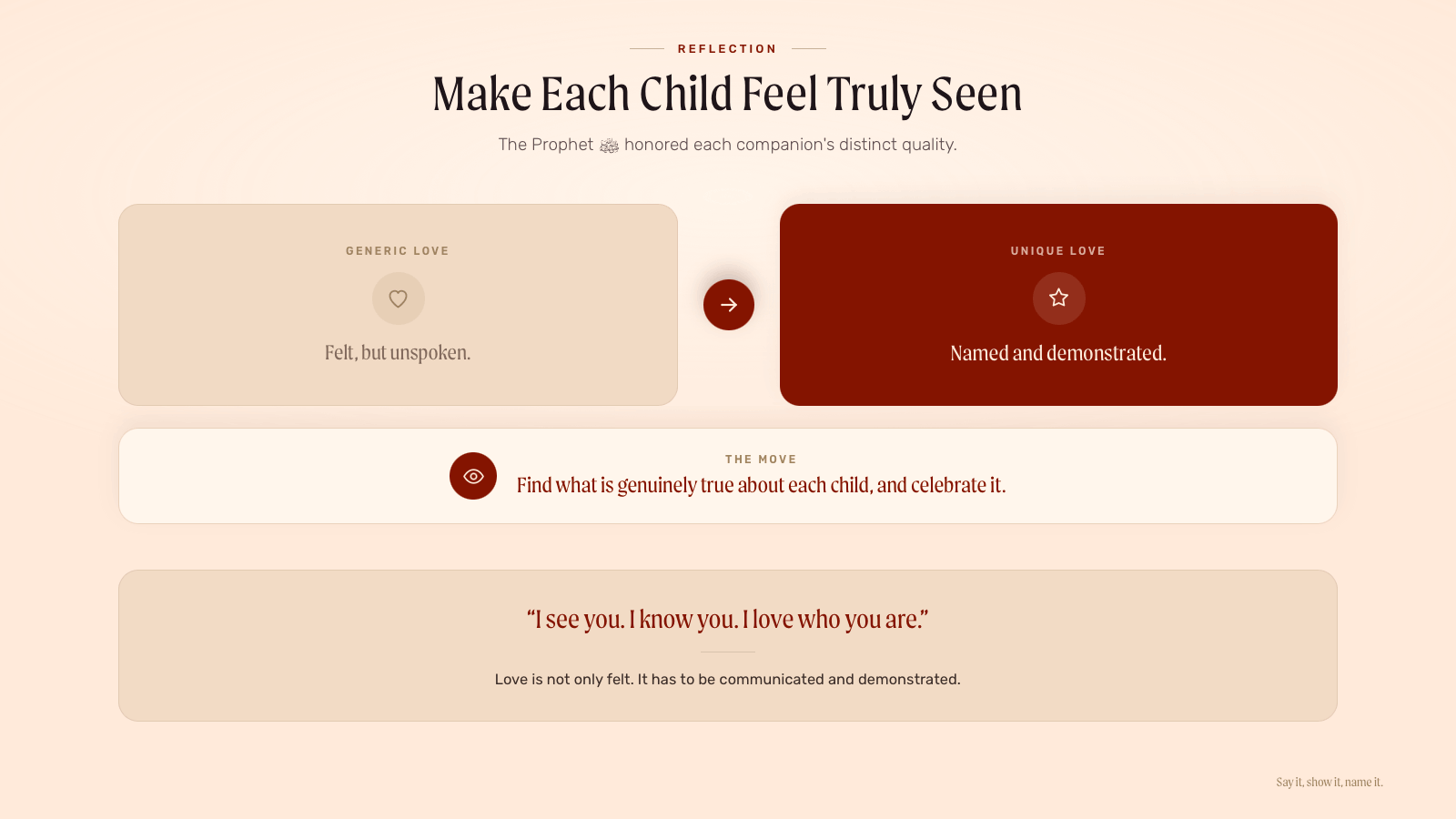
When parents try to love “equally,” they often end up loving generically. Every child gets the same gift, the same compliment and the same amount of attention. However, children are different. What makes one child feel loved might not register with another. One child needs words of affirmation; another needs quality time. One child needs physical touch; another needs acts of service. If you love them all the same way, some of them won’t feel loved at all.
The Model of the Prophet ﷺ
The Prophet ﷺ understood this deeply. He didn’t treat all his companions identically. Instead, he recognized and highlighted the unique qualities of each person. He would say things like “If you want to see the asceticism of Isa, look at Abu Dhar.” “If you want to see justice, look at Umar.” “If you want to see gentleness and compassion, look at Uthman.”1 He wasn’t comparing them to each other; he was honoring each person’s distinct quality.
This is the model for parenting. You find something unique about each of your children, something they’re genuinely good at or a quality they possess and you recognize it, celebrate it and hold it up as something valuable. Not in comparison to their siblings, but as something valuable in itself.
Finding Unique Qualities
Every child has qualities that are genuinely theirs. One child might be creative while another is loyal; one might have a great sense of humor while another is thoughtful and sensitive; one might be athletic while another is adventurous; one might be organized while another is easy-going. Look for these qualities. They might not be what you expected or what you value most, but they’re real.
The key is finding qualities that are actually true about your child, not trying to create a narrative that isn’t there. You’re not trying to convince yourself that your child is creative if they’re not. You’re observing who they actually are and celebrating that.
Sometimes these qualities come naturally, sometimes they come from how your child approaches the world and sometimes they’re still emerging and developing. Regardless, when you see them, recognize them by making a comment about it, letting your child know that you’ve noticed and that you value it.
Moving Beyond Parental Expectations
Many of us have expectations for our children based on our own values or our cultural background. We want all our children to be academically excellent or athletic or devout or creative. That said, your children aren’t clones of you or of each other. They’re individuals with their own natural tendencies and inclinations.
Part of loving your children uniquely is releasing your expectations and seeing who they actually are. Maybe one child will be academic and another will be artistic. Maybe one will be athletic and another will be intellectual. Maybe one will be very religious in their approach and another will be more practical. These differences aren’t failures. They’re expressions of individuality.
When you release the expectation that all your children should be the same and start celebrating who they actually are, you communicate meaningful love. You’re saying “I love you not because you meet my expectations, but because you’re you.”
Practical Expressions of Unique Love
How do you actually express this? First, through words. Specific, genuine compliments about who your child is. Not “You’re a good kid,” but “I really appreciate how thoughtfully you handle your friendships. You notice when people are struggling and you reach out to them.” Not “You’re smart,” but “I love how your mind works. You see connections that other people miss.”
Second, through specific actions. One child might feel most loved when you spend one-on-one time doing something they enjoy. Another might feel loved when you help them with something they care about. Another might feel loved through physical affection. Another might feel loved when you remember small details about what matters to them.
Third, through recognition in front of others. When you highlight your child’s unique quality to other family members or friends, you’re saying to that child “I’m proud of you for being you.” Be careful here not to embarrass them, but appropriate recognition in front of others carries weight.
Consistency Over Time
What matters is not one big gesture but consistent recognition of who your child is over time. Regular, genuine, specific affirmation that your child is seen and valued for who they actually are, not for how they compare to anyone else.
This doesn’t mean you never offer correction or challenge your child to grow. It means that your baseline relationship with them is rooted in acceptance and celebration of who they are. From that foundation of acceptance, you can help them develop in areas where they need growth.
When Love Doesn’t Feel Equal
One of the challenges parents face is that loving uniquely sometimes means different things to different children. One child might need more practical help. Another might need more emotional support. One might need you to advocate for them; another might need you to give them space. This can feel unequal if you’re not thinking about it carefully. However, this is actually the opposite of unequal. You’re giving each child what they actually need, not treating them the same. A parent who gives a struggling child more support and an independent child more space is loving equally, just expressing it differently.
The Gift of Knowing You’re Truly Seen
When your children grow up feeling that they are genuinely seen and loved for who they actually are, that their unique qualities are valued, that they don’t have to be like their siblings to be worthy of your love and pride, they develop genuine confidence. Not arrogance, but real confidence rooted in being known and accepted.
This is one of the greatest gifts a parent can give. In a world that constantly tries to make them fit into boxes, to compare them to others, to suggest they’re not enough, your child has a parent who says “I see you. I know you. I love who you are.”
Want to go deeper into Quranic parenting? Explore Ustadh Nouman’s full Parenting series on Bayyinah TV, designed to help Muslim families raise their children with intention, wisdom and faith. Start your journey today.
Notes
[1] At-Tirmidhi, Hadith 3802, The Prophet ﷺ recognized each companion’s unique qualities are found across the hadith collections, including Jami’ at-Tirmidhi, https://sunnah.com/tirmidhi:3802 ↩

At Bayyinah, we are dedicated to helping you connect directly with the words of Allah beyond translation. Founded by Ustadh Nouman Ali Khan, our mission is to create transformative experiences that deepen your understanding and engagement with the Quran.
Study the Quran and Arabic in a systematic and personalized way through Bayyinah TV. Get started today for free.
Check out our newest articles, fresh off the press and ready for you to dive into!