
Successful subscription! Thank you for subscribing.
Successful subscription! Thank you for subscribing.

June 4, 2026
Not All Misbehavior Is Equal
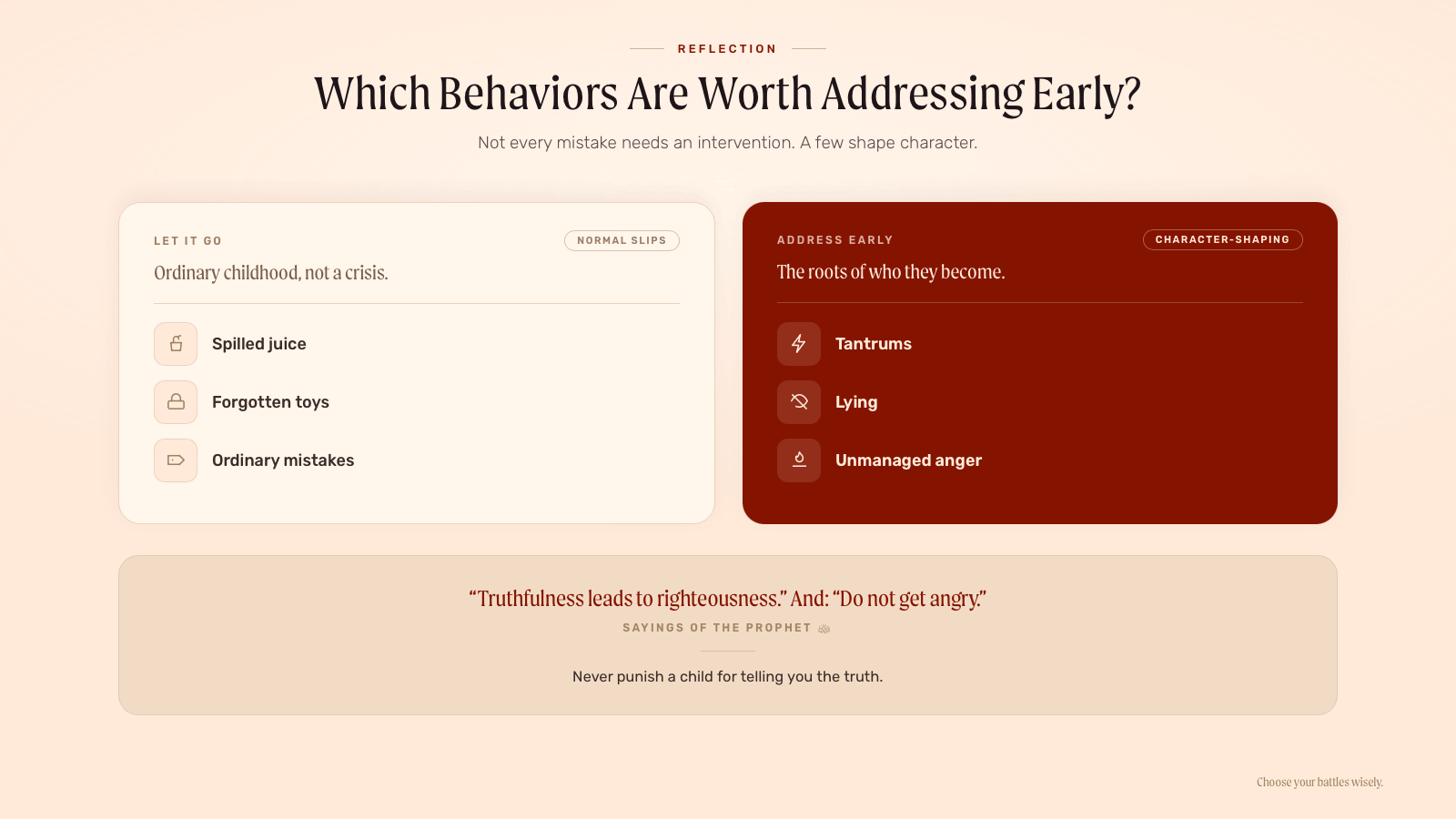
Not every mistake your child makes requires a serious intervention. Spilling juice, forgetting to put away toys, interrupting you while you’re talking,these are normal childhood behaviors that you address in the moment and move on from. However, there are other behaviors that are bigger, more significant, more damaging if they become patterns. These are the behaviors worth having serious conversations about early.
The most important of these are anger and temper, lying and the foundations of character that will affect how your child treats others and themselves. These aren’t just about obedience or immediate behavior. These are about shaping who your child becomes as a person.
Tantrums: Don’t Enable the Crying
Tantrums are one of the most common early childhood challenges. A two-year-old throwing a tantrum is normal because their brains aren’t developed enough to manage big emotions yet. However, that doesn’t mean you should enable the tantrum or give your child what they want because they’re crying. When you do that, you’re teaching them that crying is an effective strategy for getting what they want. You’re guaranteeing that they’llcry tomorrow and the day after, every time they want something.
The goal isn’t to suppress emotions. The goal is to teach your child that emotions are okay, but they need to be managed and they won’t get you what you want. A child who learns this early will have better emotional regulation throughout their life.
One approach is to acknowledge the emotion while maintaining the boundary. “I see you’re really upset. It’s okay to feel upset. That said, crying won’t change my answer.” Then stay calm and consistent. Don’t give in. Yes, it’s harder in the moment, but it’s much easier long-term when your child learns that tantrums don’t work.
Some parents use distraction or redirection with younger children. Offer an alternative that’s acceptable: “You can’t have candy now, but you can help me bake cookies and you can taste the dough.” This acknowledges what the child wants while offering a different acceptable outlet.
The Crying for Rewards Problem
As children get older, some learn to cry strategically to get rewards or to avoid consequences. A child cries and immediately parents give them something special, thinking they’re comforting them. What the child learns is that crying gets results. They’ll use this strategy forever if you reinforce it.
Instead, be consistent: “I love you very much. I’m here for you. However, I’m going to give you what you need, not what you’re asking for through crying.” If a child is genuinely upset, comfort them. However, if a child is using crying as a tool to manipulate, don’t reward the manipulation.
Lying: Address the Motivation, Not Just the Behavior
Lying is another big behavior worth addressing seriously. Every child lies sometimes. Still, if lying becomes a pattern, you need to understand why and address it directly. Is your child lying because they’re afraid of punishment, because they want to avoid disappointment, because they want to impress you or their peers or because they’re testing boundaries?
The motivation matters. A child who lies because they’re afraid of punishment is telling you that consequences in your home feel unsafe. They’d rather lie than face your reaction. This is serious because it means you need to change how you respond to mistakes and honesty.
If a child admits to a mistake, reward the honesty even if you still need to address the mistake. “I’m really glad you told me the truth, even though I’m disappointed about what happened. Let’s talk about what we can do differently next time.” A child who learns that honesty is safer than lying will become more honest.
Don’t Punish Honesty
This is critical: never punish your child for telling you the truth, even if the truth is about something they did wrong. Yes, you might need to address the wrong behavior. However, you should never make your child regret being honest with you.
Many children learn early that honesty leads to punishment, so they hide things. They become expert liars who hide their real thoughts, their real struggles and their real mistakes. All because parents responded to honesty with anger or harsh consequences.
If your child comes to you and admits they broke something, did something wrong or made a mistake, that’s the moment to reinforce honesty, not to come down hard on them. You can address the behavior, but do it in a way that says “I’m glad you told me.”
Anger and Temper: Teach Early Management
Anger is another big one. Some children are naturally more quick-tempered than others. However, all children need to learn to manage anger. A child who doesn’t learn to manage anger will have problems in relationships, in school, in work. They’ll hurt people they love. They’ll regret things they say or do in anger.
Start early teaching emotional awareness. Help your child identify the feeling before it explodes. “I notice you’re getting frustrated. What’s happening?” Help them develop strategies for managing anger before it gets out of control. Some children need to go to their room, some need to exercise, some need to talk it out and some need quiet time.
Importantly, don’t shame your child for feeling angry. Anger is a legitimate emotion. Teach them that the feeling is okay, but the expression of anger has boundaries. Hitting, screaming insults and destroying things aren’t acceptable, but feeling angry itself is simply human.
The Foundation of Character
These aren’t just behavioral issues. Tantrums, lying and unmanaged anger are about character. A child who learns to manage emotions will have better relationships, a child who learns that honesty is valued will be trustworthy1 and a child who learns to recognize and manage anger2 will be someone others can depend on.
When you take these behaviors seriously and address them with intention, you’re not trying to control your child. You’re helping them develop the character they’ll need to be successful and to treat others well.
The Window of Opportunity
The good news is that these patterns are easiest to address when children are young. A five-year-old who lies can be redirected. A ten-year-old who’s starting to develop dishonesty can be brought back. However, a teenager with deeply ingrained patterns is much harder to address. The time to take these big behaviors seriously is early, when patterns are still forming and when your influence is still strong.
Want to go deeper into Quranic parenting? Explore Ustadh Nouman’s full Parenting series on Bayyinah TV, designed to help Muslim families raise their children with intention, wisdom and faith. Start your journey today.
Notes
[1] The Prophet ﷺ said, “Truthfulness leads to righteousness and righteousness leads to Paradise”, Sahih al-Bukhari, 6094, https://sunnah.com/bukhari:6094 ↩
[2] The Prophet ﷺ advised, “Do not get angry,” repeating it several times, Sahih al-Bukhari, 6116, https://sunnah.com/bukhari:6116 ↩

At Bayyinah, we are dedicated to helping you connect directly with the words of Allah beyond translation. Founded by Ustadh Nouman Ali Khan, our mission is to create transformative experiences that deepen your understanding and engagement with the Quran.
Study the Quran and Arabic in a systematic and personalized way through Bayyinah TV. Get started today for free.
Check out our newest articles, fresh off the press and ready for you to dive into!