
Successful subscription! Thank you for subscribing.
Successful subscription! Thank you for subscribing.

June 4, 2026
The Real Question Isn’t About the Device
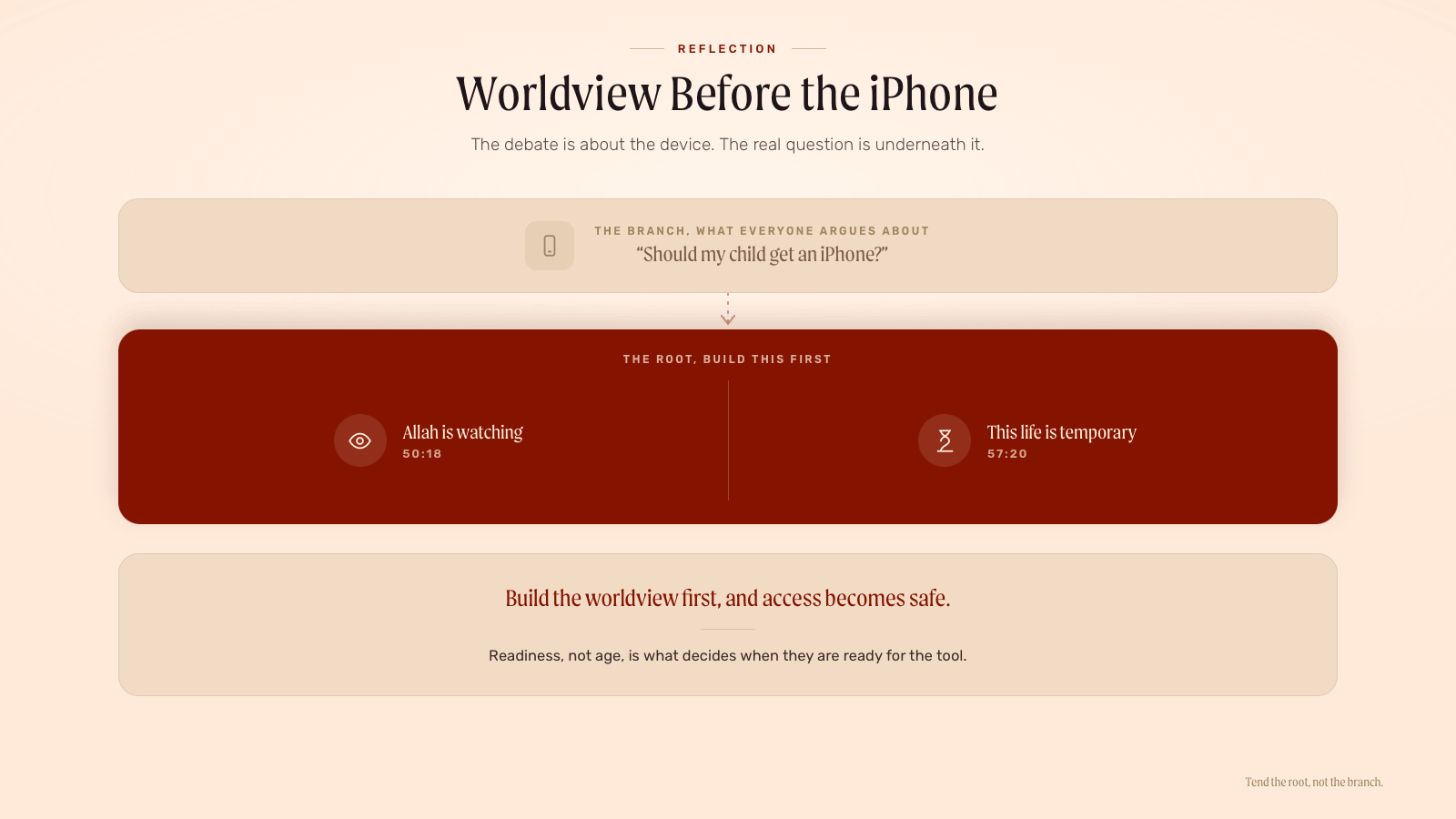
Every parent faces this eventually: “Can I have an iPhone?” or a smartphone or social media access or a video game. The knee-jerk parental response is often to focus on the object itself. “You’re too young,” “It’s bad for your brain,” “You don’t need it.” We try to set rules around the device. However, Ustadh Nouman’s insight cuts through all of this to the real issue. We’re discussing branches while ignoring the root. The real question isn’tabout the iPhone at all. The real question is about your child’s worldview. What does your child believe matters, what does your child believe is valuable and what does your child believe will make them happy or successful or worthy of love?
If your child’s worldview is identical to a non-Muslim child’s worldview,if they believe that status comes from having what everyone else has, if they believe their worth is determined by likes and followers, if they believe that access to entertainment and social validation is essential,then giving them an iPhone doesn’t suddenly change that. You’ve just given them a tool to pursue a faulty worldview more effectively.
The Worldview Problem
Most teenagers want an iPhone because everyone else has one. They want social media because their peers are on social media. They want to participate in the conversations that are happening on these platforms. When you look at it from their perspective, it makes sense. They want to belong and participate in their community. However, here’s the problem: the “community” they’re being drawn into is often built on values that contradict Islamic values. It’s built on comparison, on performative life and on the assumption that what you own, how you look and how many people validate you online is what matters.
If your child has internalized these values before they get access to the tools that amplify them, they’ll be trapped. They’ll make decisions not based on what’s right or what’s good for them, but based on what will get them validation from their peers.
The Foundation First
The Islamic approach is different. Before you give your child access to tools that will test their values, you need to build a different foundation. You need your child to have a worldview based on Imaan, on the understanding that Allah is watching, that this life is temporary1, that true success is measured not by followers but by character and obedience to Allah.
This isn’t theoretical; it’s entirely practical. A teenager who understands that Allah matters more than peer approval can have an iPhone and not be destroyed by it, can participate in social media and not be defined by it and can see their peers engaging in destructive behavior and choose differently. That said, a teenager without that foundation? They’re vulnerable. They’ll make decisions based on validation, hide things from you because their peer community doesn’t approve and internalize harmful messages because they’re repeated by the people who matter to them.
How to Build a Different Worldview
Building a worldview grounded in Imaan isn’t something you do once in a serious talk. It’s something you build over years through consistent messages and example. You help your child understand that Allah created them with purpose. You help them see that their character matters more than their appearance. You help them understand that true friends are those who support them in good things, not those who push them toward harm.
You do this through conversation, through example, through the choices you make and explain to your child. You do this by being intentional about what you expose your child to and what you don’t. You do this by celebrating character and values while not celebrating superficial things.
You do this by having your child involved in community that reinforces these values. Maybe it’s a masjid youth group, maybe it’s a volunteer program or maybe it’s a family culture where these things are just the air you breathe.
The Practical Approach
Once your child has internalized a worldview where Imaan matters, where character matters, where obedience to Allah matters more than peer approval, then you can give them tools. Moreover, here’s the remarkable thing: once they have that foundation, you can actually give them more freedom.
A parent might say “Okay, you can have an iPhone. You can use social media. Here’s why I’m comfortable with this: you understand that Allah is watching2. You understand that the things that are haram are haram whether or not your friends are doing them. You understand that your worth doesn’t come from how many people like your posts. So yes, have access. I trust your judgment because I’ve built your judgment.”
This isn’t naive. It’s not pretending your child won’t face pressure. However, it’s giving your child tools, spiritual tools, mental tools, a clear set of values, to navigate that pressure.
What Changes When the Foundation Exists
Compare this to a child without that foundation. “Everyone has Instagram, I’m the only one without it. I can’t participate in our group chat. I don’t know what’s happening at school.” For a child without a strong internal foundation, this feels like isolation. They want access for legitimate social reasons, but they don’t have the values to protect them from the harm that access can bring.
The parent then faces a dilemma. Either don’t give access and risk your child resenting you and feeling isolated or give access and worry constantly about what they’re being exposed to. However, a child with a strong foundation based on Imaan? They might want access for social reasons, but they also understand that if giving them access would harm their Deen, they shouldn’t have it. They might decide themselves that they don’t need it. Or they might have access but use it in a healthy way because they’re not using it to replace real community or to chase validation.
The Change in Your Child’s Worldview
The key shift is helping your child move from “Everyone has one, so I should have one” to “Does this align with my values and my goals?” It’s helping them move from external validation to internal values. It’s helping them understand that making decisions based on peer pressure is weak, while making decisions based on what’s right is strong.
This happens through years of parenting that emphasizes values over status, character over appearance, Imaan over material things. It happens through consistent messages. It happens through your own example. It happens through community that reinforces these values.
The Timeline
Is there a right age? That depends on your child and your assessment of their worldview. Some twelve-year-olds have a clear enough understanding of their values to handle access responsibly. Some seventeen-year-olds don’t. Look at your child. Not their age but their actual understanding and maturity and not their desire for access but their readiness to have access while maintaining their values. Moreover, understand that this isn’tabout whether they have the device. It’s about whether they have the foundation. That foundation is what matters.
Want to go deeper into Quranic parenting? Explore Ustadh Nouman’s full Parenting series on Bayyinah TV, designed to help Muslim families raise their children with intention, wisdom and faith. Start your journey today.
Notes
[1] Al-Quran, Surah Al-Hadid, 57:20, https://quran.com/al-hadid/20 ↩
[2] Al-Quran, Surah Qaf, 50:18, https://quran.com/qaf/18 ↩

At Bayyinah, we are dedicated to helping you connect directly with the words of Allah beyond translation. Founded by Ustadh Nouman Ali Khan, our mission is to create transformative experiences that deepen your understanding and engagement with the Quran.
Study the Quran and Arabic in a systematic and personalized way through Bayyinah TV. Get started today for free.
Check out our newest articles, fresh off the press and ready for you to dive into!