
Successful subscription! Thank you for subscribing.
Successful subscription! Thank you for subscribing.

November 19, 2026
Ustadh Nouman was once stopped at a restaurant in Irving by a man who had exactly one question for him, which was whether taking his Arabic program came with a guarantee of understanding the whole Quran. His response was a question of his own, asking whether the man had sat down with his professors before university and asked them to guarantee that he would graduate as the top accountant in his class.
The point is not that the question was a foolish one. The point is that it reveals something about how we have come to approach knowledge in general, and it is worth naming plainly, because it is probably the single biggest obstacle standing between most of us and the Quran.
You are not buying a product
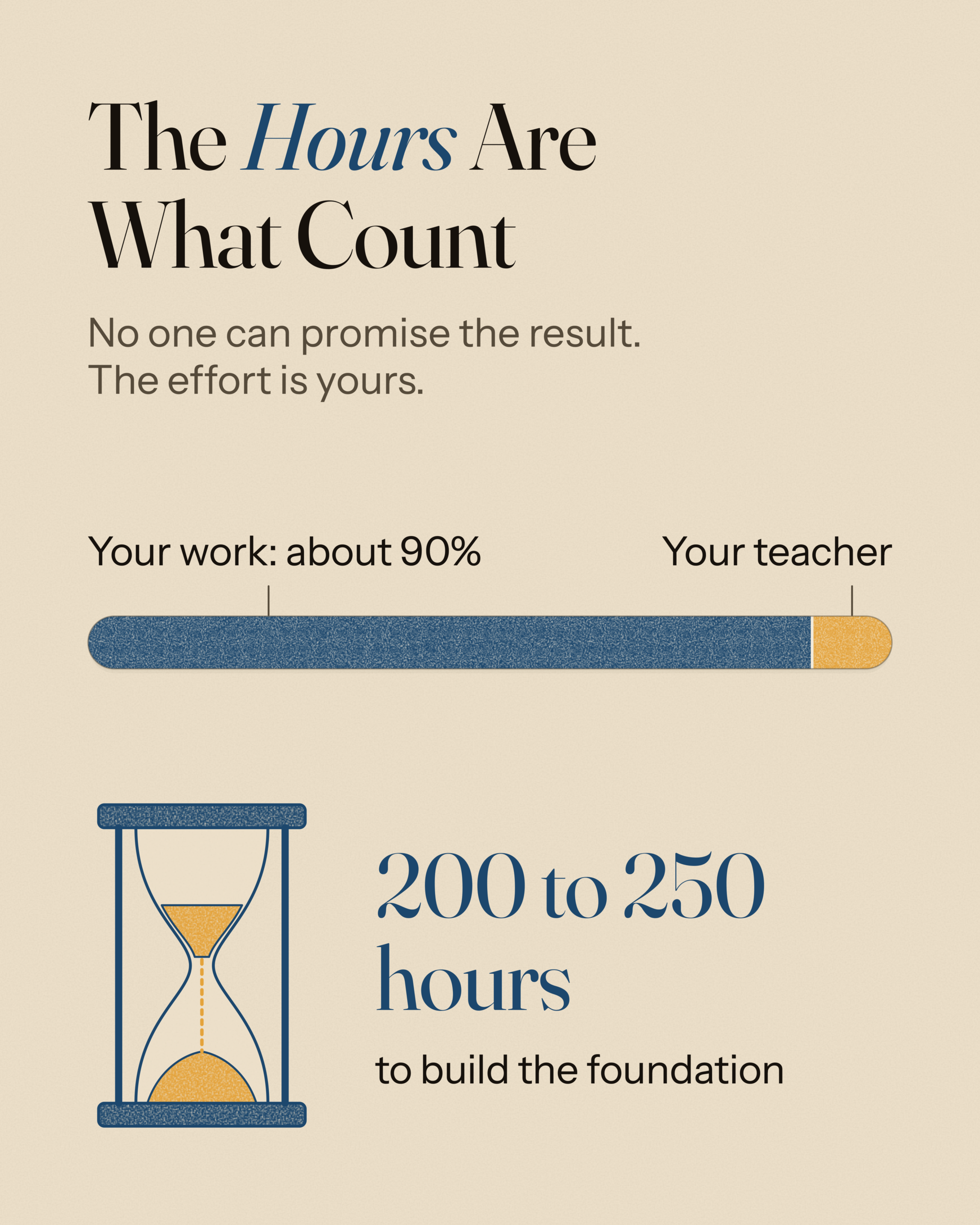
We are fluent consumers by now. We compare, we read reviews, we expect a result proportionate to what we paid and we expect it reasonably soon, which is an instinct that serves us well for almost every purchase and poorly for every education that has ever existed. In any real course of study roughly ninety percent of the work belongs to the student, while the teacher points, explains, corrects and keeps you from spending years going in the wrong direction. The lifting is yours, and nobody in history has been educated by purchasing access to something.
This is why the promises that circulate around Arabic should make you suspicious rather than hopeful, since learn Arabic in four hours sits in precisely the same category as lose ten pounds in five days, and both are selling you the removal of the only part that actually produces the result. There is something strange about our moment here, because scholars once crossed deserts and gave up years of their lives to sit with a teacher and collect a handful of narrations, whereas we have more access to knowledge than any generation in human history and considerably less patience with it. A video runs two hours and we go looking for a shorter one.
What can honestly be promised
If nobody can guarantee the outcome, it is fair to ask what is actually on offer, and the answer is that the effort can be named precisely even when the result cannot. The foundation of Quranic Arabic is a defined body of material rather than an endless ocean, and it takes most students somewhere in the region of two hundred to two hundred and fifty hours of real work, which some people fit into a couple of months and others spread across three years. The calendar is not the variable that matters; the hours are.
That is a demand rather than a promise, and it is a fair exchange to offer, because if you bring the hours then a teacher who has spent twenty-five years refining how this material is taught will meet you with his side of it. What cannot be promised is what happens inside you, since that was never in anybody’s gift to give.
The part that makes it worth doing badly
Here is the question worth sitting with for a moment. Suppose you give this nine months, struggle the entire way through and come out one percent better than you started, so was it worth doing?
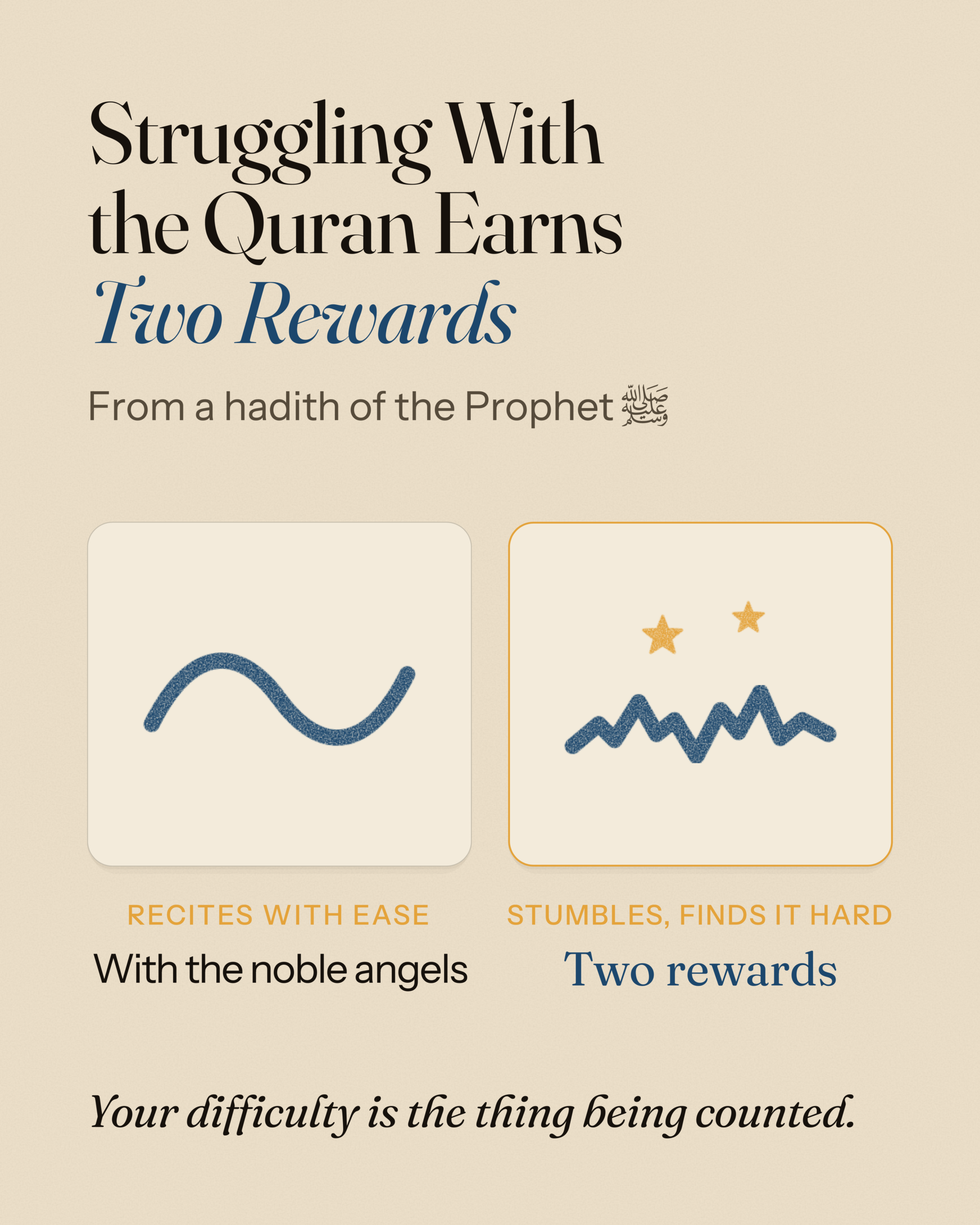
Consider what the Prophet ﷺ taught us about the person who finds the Quran difficult, which is that the one who recites it with ease is with the noble and obedient angels, while the one who recites it and stumbles over it, finding it hard, has two rewards. That is worth reading twice, because it inverts the way we normally think about effort: your difficulty is not evidence that this is not for you, it is the thing being counted. The same tradition tells us that when people gather to study the Book of Allah, tranquility descends upon them, mercy covers them, angels surround them and Allah mentions them to those who are with Him.
So picture the student who sat down four evenings a week for nine months, found most of it hard and finished barely further along than she started. By the measure she is using, she failed, and by the measure that is actually being kept she spent hundreds of hours inside something Allah describes in those terms, every one of which was recorded. That ought to change what you are afraid of, because the risk in this study was never that you might find it difficult.
The question is still addressed to you
Allah says in Surah Al-Qamar:
وَلَقَدْ يَسَّرْنَا الْقُرْآنَ لِلذِّكْرِ فَهَلْ مِن مُّدَّكِرٍ
“And We have certainly made the Quran easy for remembrance, so is there any who will remember?”
(54:17)
Allah states that the ease has already been given, then asks whether anybody will take Him up on it, and the fact that this ayah repeats four times across the Surah suggests the question is not merely rhetorical. It is also not addressed to scholars, but to people with jobs, children, commutes, tired evenings and a quiet sense that they have been reciting something for years without knowing what it says. You are not being asked to guarantee anything either, only to put in the hours and then to let the outcome be Allah’s business rather than yours.
May Allah make what we learn of His Book benefit us and everyone we go on to teach.
Begin with the first lesson. Explore the Bayyinah Arabic app.

At Bayyinah, we are dedicated to helping you connect directly with the words of Allah beyond translation. Founded by Ustadh Nouman Ali Khan, our mission is to create transformative experiences that deepen your understanding and engagement with the Quran.
Study the Quran and Arabic in a systematic and personalized way through Bayyinah TV. Get started today for free.
Check out our newest articles, fresh off the press and ready for you to dive into!