
Successful subscription! Thank you for subscribing.
Successful subscription! Thank you for subscribing.

November 19, 2026
We recently asked our community a single question: what stopped you from learning Quranic Arabic? More than a hundred people answered, and the pattern running through those answers is worth sitting with, because dozens of them did not describe a hard subject or a badly taught course. They described a personal failing, in their own words, as inconsistency, laziness, not forcing themselves enough, or losing motivation after the first few lessons.
These are people who bought the book, signed up for the class, learned the alphabet again and then watched the whole thing quietly stop somewhere around week three, and every one of them has concluded that the problem was their own character. For most of them that conclusion is simply wrong, and it is worth explaining exactly why.
Every language has four skills, and two of them are not what you need
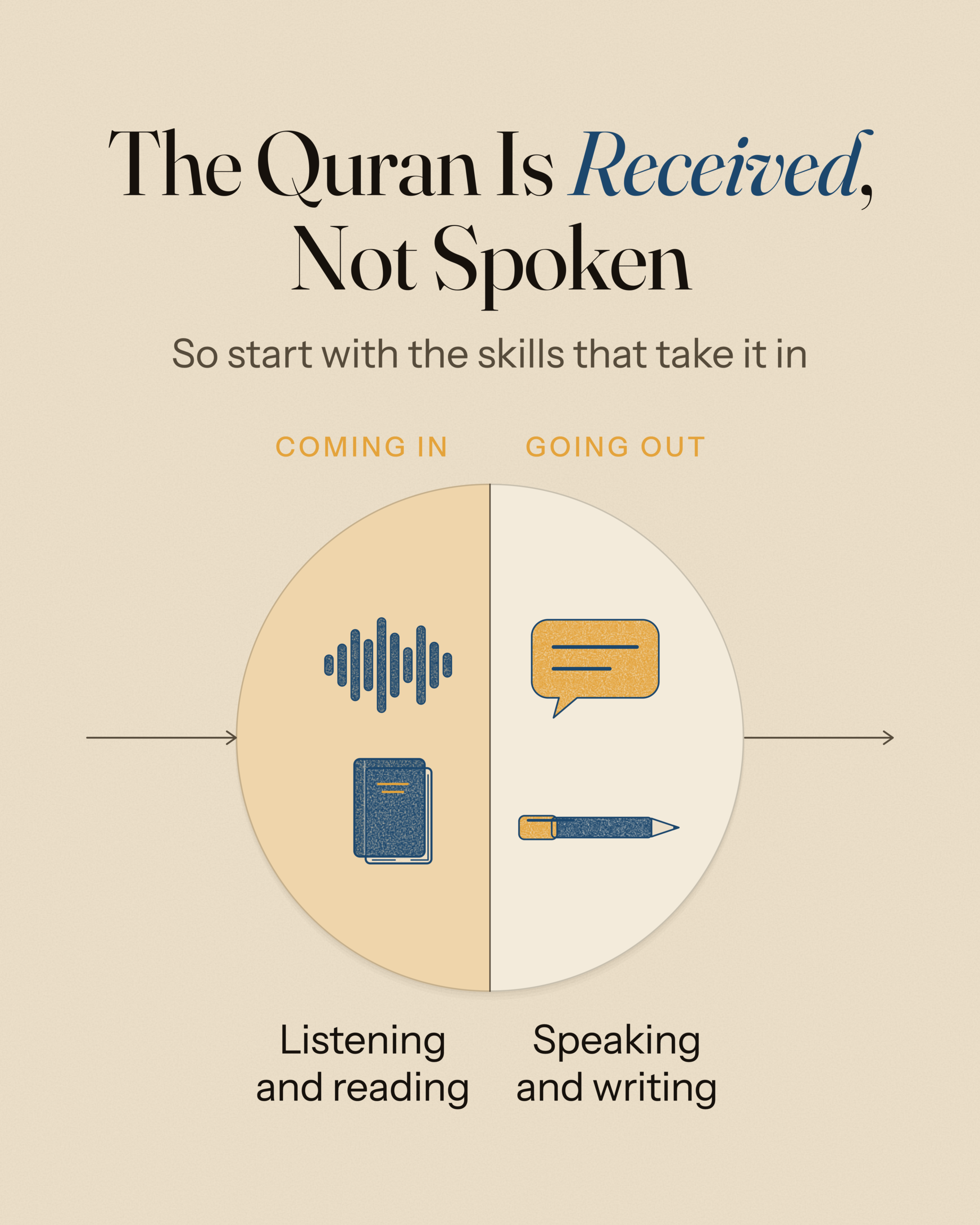
Any language in the world is learned through four skills: listening with comprehension, reading with comprehension, speaking properly and writing properly. Look at those four again and you will notice they split cleanly into two pairs, because listening and reading are information coming in, while speaking and writing are information going out.
Now think about how nearly every language program you have ever encountered begins, which is with my name is, I am from, I would like the chicken, what is your name. Those are all output skills, and programs start there for a perfectly good reason, since producing a sentence in a new language feels wonderful. You said a thing, somebody understood it, and you have visible proof that you are learning.
The problem is that if your reason for studying Arabic is the Quran, the two skills that connect you to it are the two that nobody worked on. You will not be speaking to the Quran; you will be receiving it, which is reading and listening. So you study for a year, you can introduce yourself, and then you open the Mushaf and feel exactly what you felt before you started, because nothing has changed and the thing you actually wanted was never what you were being trained in. That is not a discipline problem but a design problem, and you had no way of knowing about it.
Start with reading, not listening
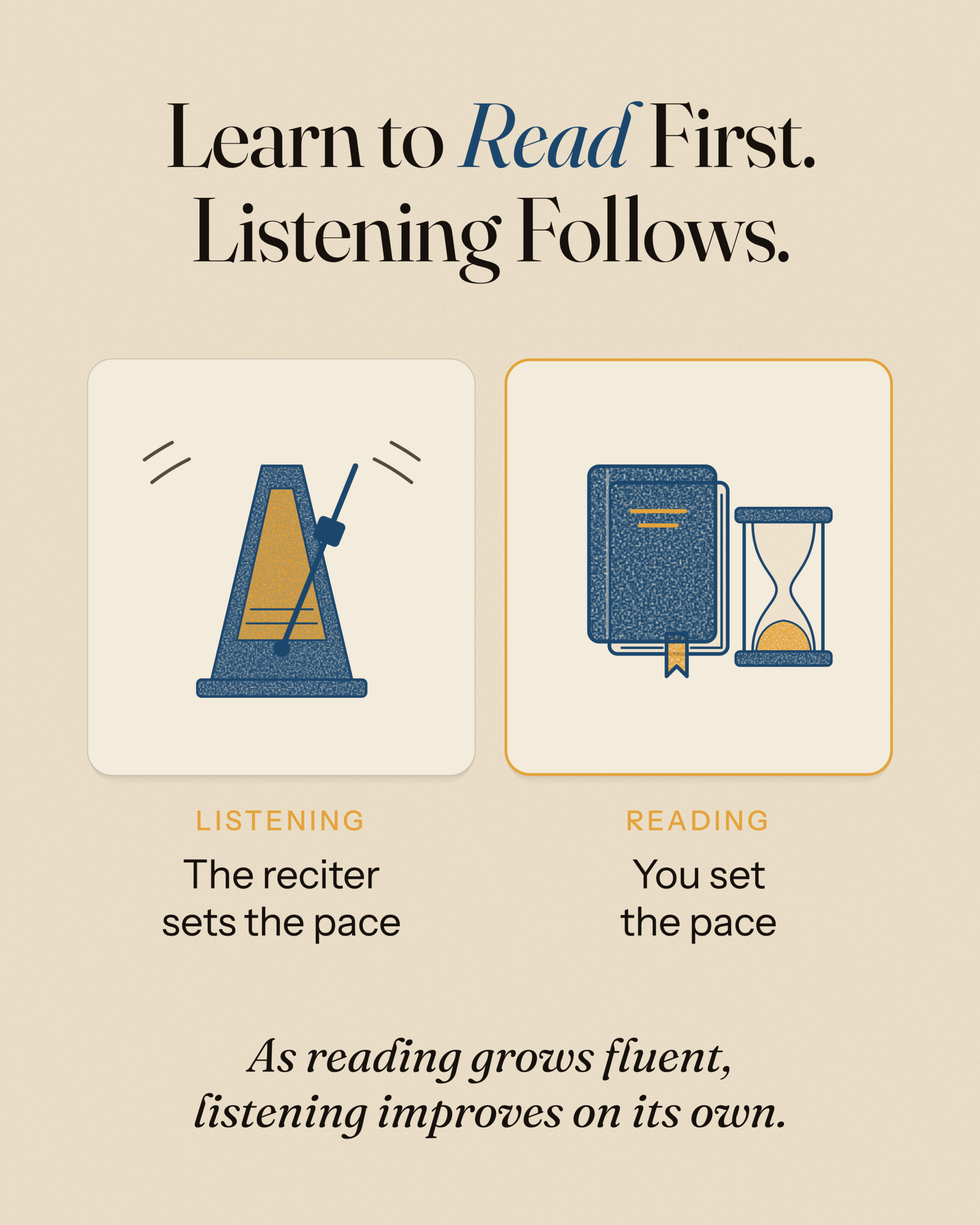
Between the two skills that actually matter there is also an order, and it is not the one most people assume. Nearly all of us want to understand the Quran as we hear it, standing behind an imam in taraweeh, which is the dream and also the harder of the two skills, because when you are listening the reciter sets the pace. He moves at his speed, and if your processing is still slow you fall behind within the first few words and spend the rest of the ayah trying to catch up.
When you read, by contrast, you set the pace entirely. You can sit on a single word for as long as you need, you can go back, and if taraweeh finishes while you are still working through the first ayah you studied that evening then nothing has gone wrong at all. The useful part is what happens next, because as reading becomes fluent, listening starts improving on its own without ever being studied directly. Build the skill you control and the one you do not control follows after it.
The second reason people quit, which is harder to say
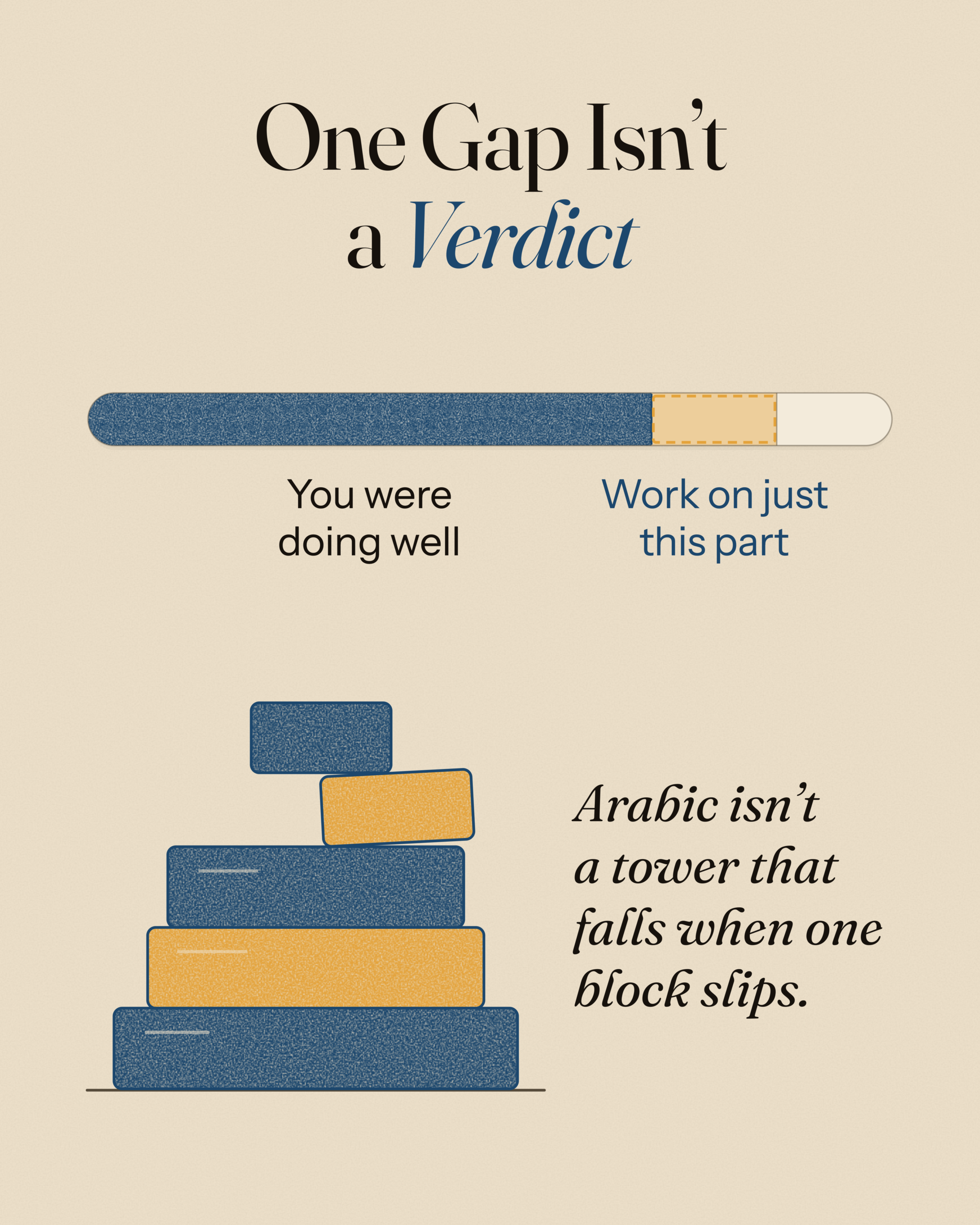
There is another pattern underneath the first one, and Ustadh Nouman names it directly with his students, which is that students are dramatic. You get one concept wrong, and within about thirty seconds you have decided that you do not understand any of this, so that a single confusion becomes a verdict on the entire subject and on your own capability.
But nothing actually collapsed. Arabic is not a tower of blocks where pulling the wrong one brings the whole structure down, and you were doing perfectly well at seventy percent before hitting something between seventy-one and seventy-five that did not land, which means the correct response is to go and work on seventy-one to seventy-five.
Anyone who has played a sport understands this instinctively, since every serious team employs a sports psychologist precisely because performance has as much to do with the head as the body, and getting inside an opponent’s mind makes their normal ability quietly disappear. Gamers know the same thing from the other direction, because when you are afraid of a particular boss you hesitate, so you never commit to the attack, so you lose every single time, when the fight was never that hard and the fear was doing all the work. This is what negative self-talk does in a classroom: it takes a small gap, turns it into an identity, and then the identity makes you stop.
Stop comparing, including to your teacher
One more thing, because it comes up constantly. A student once told Ustadh Nouman that a friend had studied a fraction of what she had and remembered more of it, and asked what was wrong with her, and his answer was to stop comparing, not only to classmates but to him as well. The more anxiety you carry about forgetting, the more you will forget, because anxiety takes up exactly the room that learning needs.
He also pointed out something students rarely hear, which is that forgetting a great deal in the early years is not a sign of failure but a stage you pass through. At some point the fundamentals stop leaving, and the thing you were terrified of losing simply stays.
What this means for you
Allah tells us that He does not burden a soul beyond its capacity (2:286), and that is worth taking seriously when you are deciding what you are capable of, because the verdict you passed on yourself after your last attempt may not be true. You did not fail at Arabic; you were taught in an order that was never going to get you to the Quran, and when a small gap appeared you treated it as proof of something much larger. Most people who try again, with the input skills first and without the catastrophizing, find that they get further than they expected and sooner than they expected.
If you stopped before, this is a good time to start again. Explore the Bayyinah Arabic app and begin from the beginning.

At Bayyinah, we are dedicated to helping you connect directly with the words of Allah beyond translation. Founded by Ustadh Nouman Ali Khan, our mission is to create transformative experiences that deepen your understanding and engagement with the Quran.
Study the Quran and Arabic in a systematic and personalized way through Bayyinah TV. Get started today for free.
Check out our newest articles, fresh off the press and ready for you to dive into!