
Successful subscription! Thank you for subscribing.
Successful subscription! Thank you for subscribing.

November 19, 2026
There is a moment most of us know well. The imam is reciting, something in the sound moves you, and you still do not know what was just said. You catch a word you recognize, then wait for the next one, and the rest passes by while you stand there hoping the feeling will be enough.
Allah did not describe His book that way. He said:
وَلَقَدْ يَسَّرْنَا ٱلْقُرْءَانَ لِلذِّكْرِ فَهَلْ مِن مُّدَّكِرٍ
“And We have certainly made the Quran easy for remembrance, so is there any who will remember?”
(54:17)
The ease is promised. The question at the end of the ayah is the part that waits on us. Most people who want to answer it have already tried once, with a book, a class or a video series, and stopped somewhere in the first month. That is usually a method problem rather than a sincerity problem, which is why the Bayyinah Arabic app was built the way it was. Here is what is actually inside it, and what each part is there to do for you.
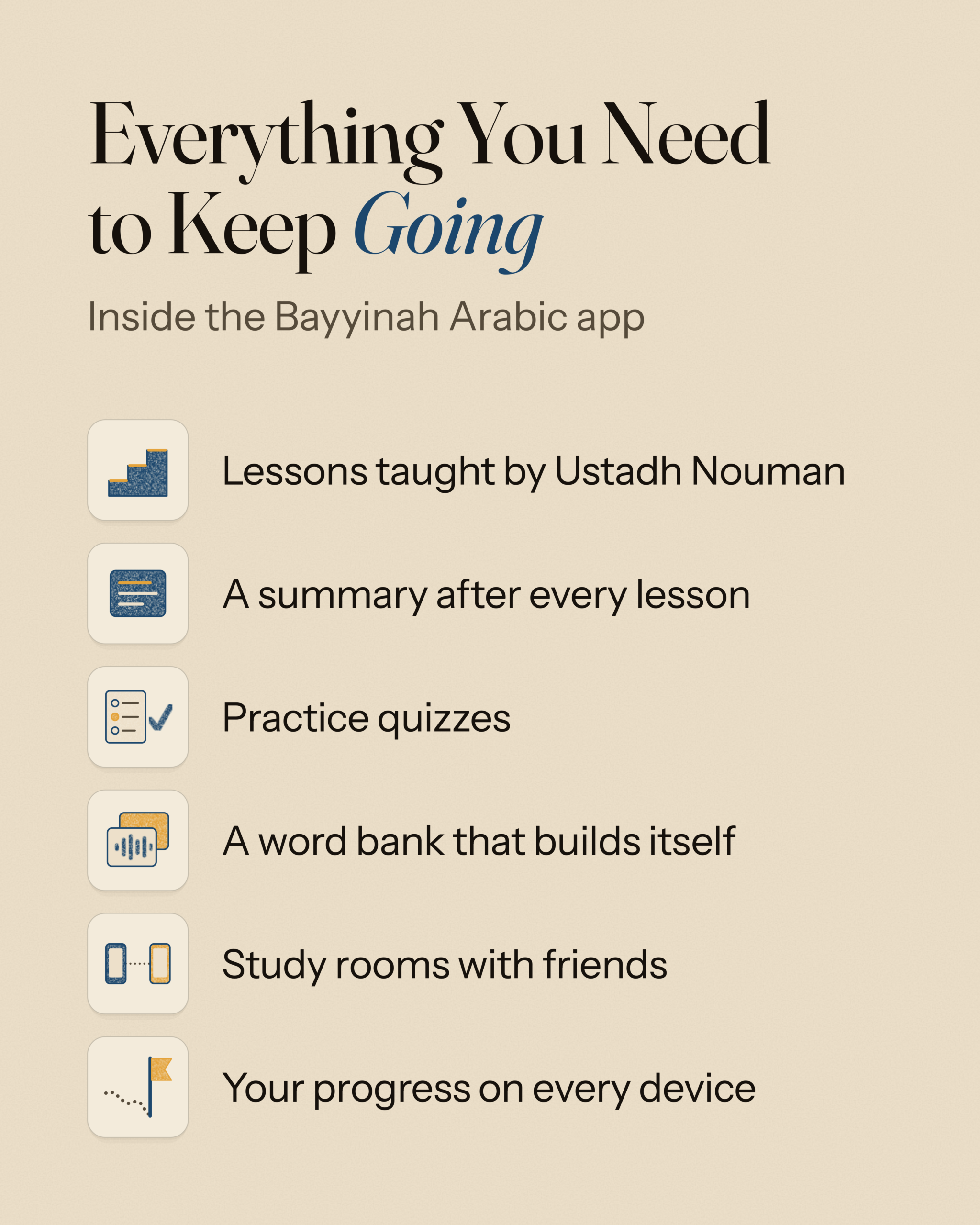
Lessons taught the way they would be taught in a classroom
The course runs in stages, each one built on the one before it, so nothing is assumed and nothing is skipped. Ustadh Nouman teaches every lesson himself, in the same voice and with the same examples he uses in front of a room. The lessons are short enough to fit into a real day, which matters more than it sounds, because the reason most attempts end is not a loss of interest but a week where there was no obvious half hour to give.
You are not reading a textbook alone and hoping you understood it correctly. You are being taught, and the next lesson assumes only what the last one gave you.
A summary of the key points after every lesson
When a lesson ends, the main points are written out in front of you. This sounds small until you have sat through an explanation, felt it land, then gone back two days later and found that none of it stayed.
Having the summary there means your memory is not the only place the lesson lives. It also means you can review a week of study in a few minutes before you start something new, which is how material becomes yours rather than something you once watched.
Practice that tells you the truth
After each lesson there are exercises and quizzes on exactly what you just learned, with feedback as you go. You can take them as many times as you want.
This is the part people skip when they study on their own, and it is the part that decides everything. Watching a lesson tells you it made sense while someone was explaining it. Practice tells you whether you can do it yourself, which is a different question with a different answer. Getting something wrong here is useful rather than discouraging, because a mistake shows you precisely where the gap is, and the gap is almost always smaller than it feels.
A word bank that builds itself
Every word you meet in the course goes into your own word bank automatically. You can open it whenever you like, hear the word pronounced, see it used in a sentence and review the whole collection as flashcards.
The Quran repeats its vocabulary far more than people expect, so the words you gather early keep returning to you in new places. This is the feature that quietly turns study into recognition. One day you are in Salah and a word arrives that you learned on a Tuesday, and you understand it before you have decided to think about it.
You do not have to study alone
You can open a room, send it to a friend, your spouse or your children, and work through a round of questions together at the same time while you see each other’s scores.
People have always learned this language in a group, sitting with someone who would argue a point back with them. Studying with another person is one of the strongest predictors that you will still be going in three months, and it does not need everyone to be in the same city anymore. For families this is often the easiest way in, since a parent and a child can be in the same material on different devices without either one waiting on the other.
A path you can see, and a place that is kept for you
The app holds your place, keeps your streak and shows you the lessons ahead of you and behind you, so you always know how far in you are. One lesson opens the next. You can stop on your phone and pick up in your browser later without hunting for where you were, and it runs on iPhone, Android and the web.
Progress you can see is worth more than motivation you have to manufacture. On the days when you are not especially inspired, a visible path and an unfinished lesson will carry you further than a good intention will.
What you need before you begin
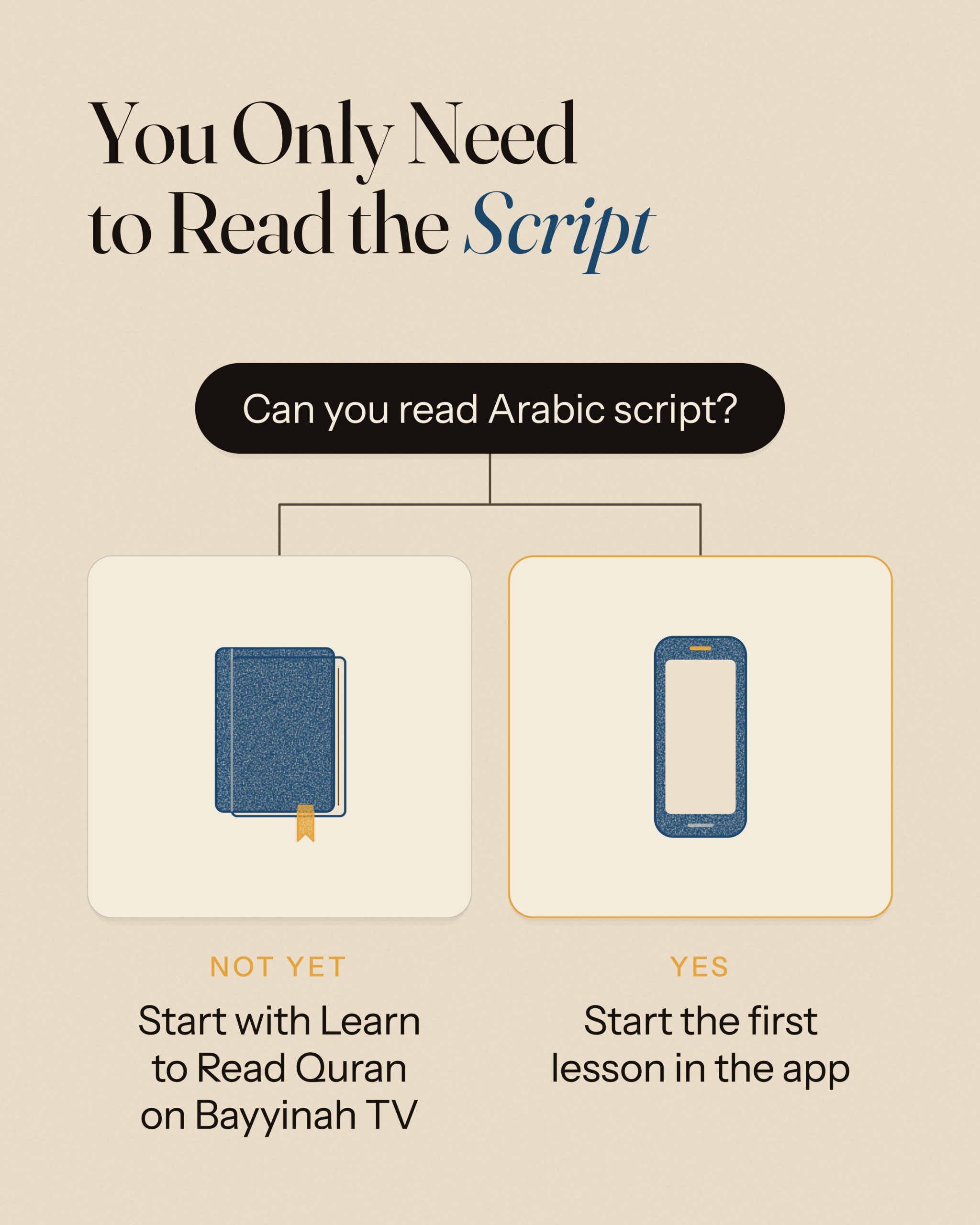
One thing only, which is the ability to read the Arabic script. You do not need to understand it, and you do not need any background in grammar or any study of the language at all. If you cannot read the script yet, start with Learn to Read Quran on Bayyinah TV and come back to this when you are ready.
None of these features are the point. The point is the next time you are standing in Salah, or behind an imam in Taraweeh, and the words being recited are words you understand rather than sounds you are waiting to recognize. Everything above exists to get you there and to keep you going long enough to arrive.
May Allah make the study of His book easy for you and keep you consistent in it.
Ready to begin? Download the Bayyinah Arabic app and start with your first lesson today.

At Bayyinah, we are dedicated to helping you connect directly with the words of Allah beyond translation. Founded by Ustadh Nouman Ali Khan, our mission is to create transformative experiences that deepen your understanding and engagement with the Quran.
Study the Quran and Arabic in a systematic and personalized way through Bayyinah TV. Get started today for free.
Check out our newest articles, fresh off the press and ready for you to dive into!