
Successful subscription! Thank you for subscribing.
Successful subscription! Thank you for subscribing.

November 19, 2026
Ask a teacher who has taught Arabic for twenty-five years what separates the students who finish from the students who quietly disappear, and the answer is rarely intelligence. It is almost always method. The rules below are the ones Ustadh Nouman gives his students before a single word of Arabic is taught, and several of them sound wrong the first time you hear them, which is exactly why they are worth reading before you begin rather than after you have stopped.
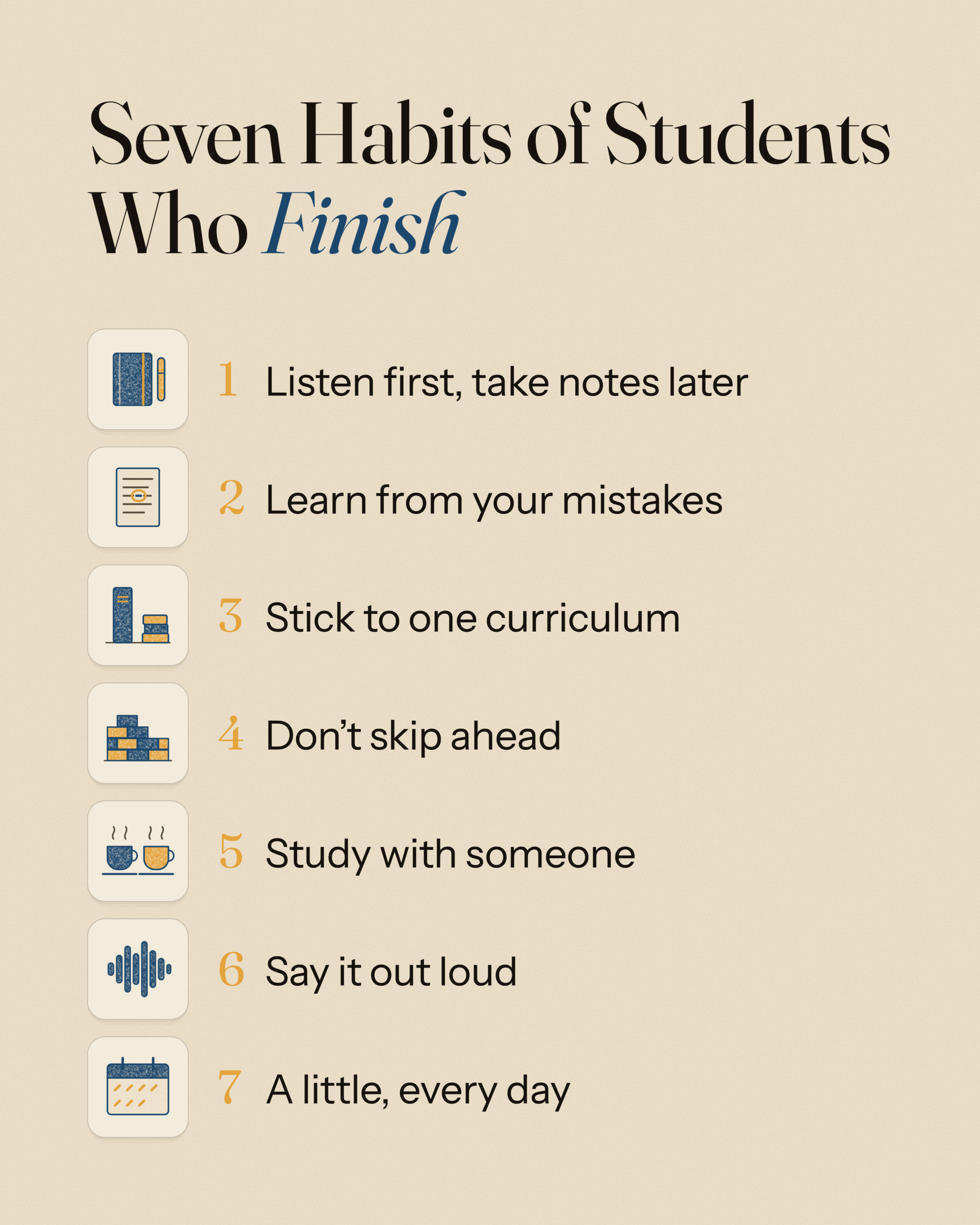
1. Do not take notes until you are told to
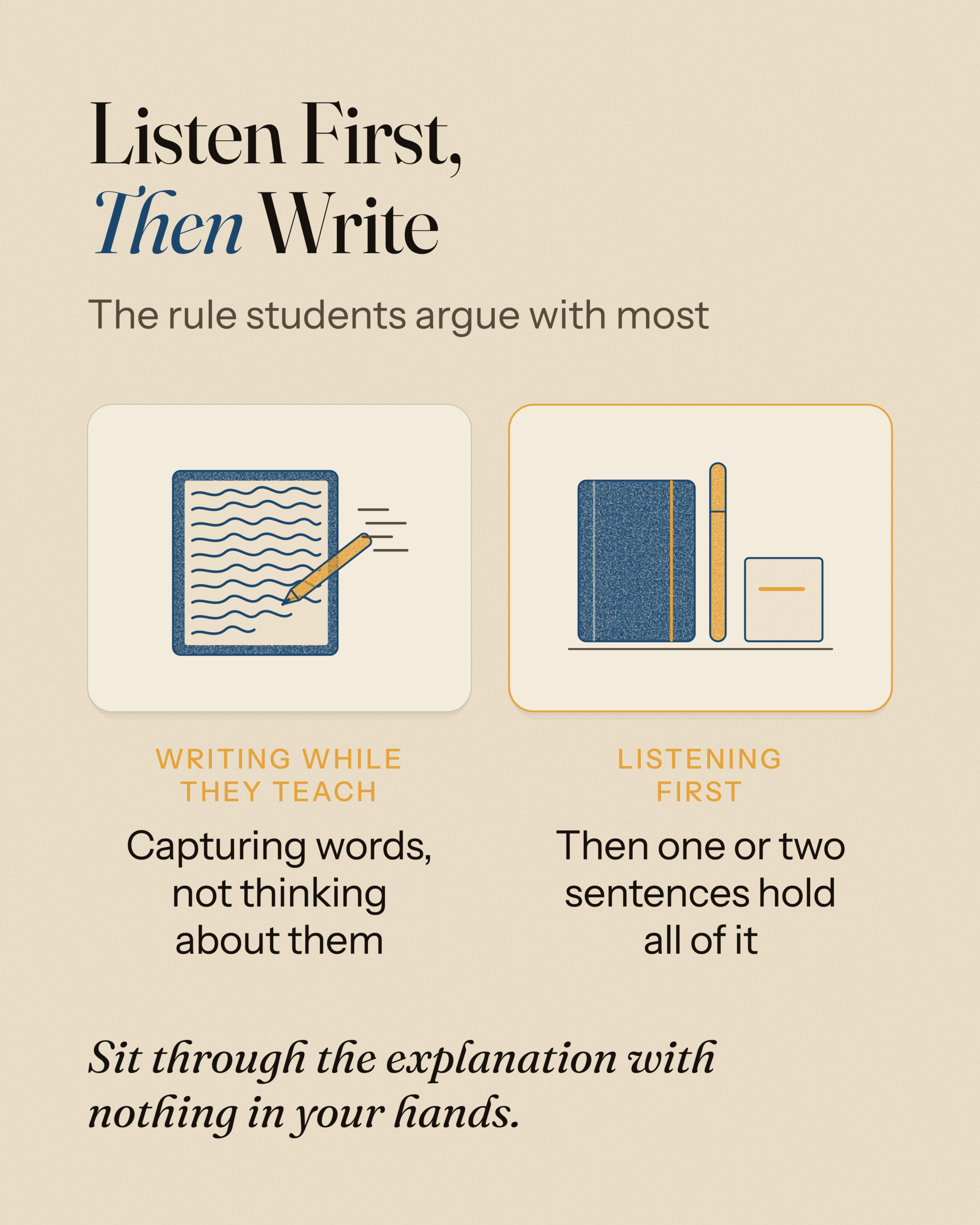
This is the rule students argue with most, and it is also the one that matters most. When you write while somebody is teaching, your brain switches into dictation mode, so that you are capturing words rather than thinking about them, with part of your attention spent on keeping up and the rest on the anxiety that you will have forgotten all of this by tomorrow.
A good teacher removes that anxiety instead of feeding it, which is why you should sit through the ten minutes of explanation with nothing in your hands. At the end of it you will be told the one or two sentences worth writing down, and because you heard the full explanation those two sentences will hold all of it, whereas handed to you at the start they would have meant nothing at all.
2. Make mistakes on purpose, then examine them
Most of us were trained to hide our errors, but in language study the error is the most useful thing you will produce all day. A wrong answer shows your teacher exactly how you were thinking, and thinking is the thing actually being corrected, so fixing the reasoning behind one mistake quietly prevents a hundred more that would have come from the same place. When you get something wrong, resist the urge to glance at the correct answer and move on, and work out instead why you believed what you believed, because that is where the learning is.
3. Close the other tabs
There have never been more ways to learn Arabic, which sounds like good news and usually is not. Two teachers explaining the same concept in different words will leave you stranded somewhere between them, and you will mistake that confusion for the difficulty of the subject itself. Pick one curriculum and ignore every other PDF, channel and app until you have finished it, and if you would rather study somewhere else then that is a perfectly reasonable choice, so make it once and then commit to it.
4. Stop asking about the roof
Students at the foundation always want to know about the windows. You learn one piece, then the piece beside it, then you have a wall, then four walls, then eventually a house, and partway through that first wall you will want to understand how the entire structure works, at which point a good teacher will decline to tell you. That is not information being hidden from you, because teaching is not giving students everything at once but giving them the right thing at the right time, and most of your questions about later material are better answered by simply arriving there.
5. Do not do this alone
When we asked our community what stopped them from learning Arabic, one answer kept recurring that had nothing to do with the language itself. People told us they had no teacher, no group and nobody who noticed when they skipped a day. The fix for this is unglamorous: get your spouse, a sibling, a cousin or a friend to do it alongside you, because students absorb one level of understanding from a teacher and a noticeably deeper one from arguing it out with each other afterwards. There is a further benefit too, since explaining a concept to somebody else is the point at which you stop being a learner and start becoming a teacher, and it is the fastest way to discover which parts you only thought you understood.
6. Study out loud, even when you are alone
Nobody has ever learned Arabic morphology in silence. The patterns of this language are learned through the ear and the mouth rather than the eye alone, so say them out loud, repeat them until they are boring, and accept that you will feel ridiculous doing this at your kitchen table. The students who mumble through it quietly are the ones still struggling with the same patterns months later.
7. Little and often beats the big push
The Prophet ﷺ taught us that the deeds most beloved to Allah are those done consistently, even when they are small, which is not only a general encouragement here but an accurate description of how this particular subject is learned. A focused hour today and another tomorrow will take you considerably further than a six hour weekend that leaves you exhausted and absent for the next three. Protect a small amount of time, put it somewhere in your day that the day cannot take back, and come back to it tomorrow.
The part that is not about ability
None of these rules are about intelligence, and none of them require anything you do not already have. They ask you to tolerate not understanding something for a few minutes, to be honest when you are lost, to stay in one place long enough for it to work and to return the following day. Students who do that finish, and students who do not mostly do not, regardless of how quickly either group picked things up in the first week.
Begin properly. Explore the Bayyinah Arabic app and take the first lesson today.

At Bayyinah, we are dedicated to helping you connect directly with the words of Allah beyond translation. Founded by Ustadh Nouman Ali Khan, our mission is to create transformative experiences that deepen your understanding and engagement with the Quran.
Study the Quran and Arabic in a systematic and personalized way through Bayyinah TV. Get started today for free.
Check out our newest articles, fresh off the press and ready for you to dive into!