
Successful subscription! Thank you for subscribing.
Successful subscription! Thank you for subscribing.

July 29, 2026
Almost everyone who loves the Quran has had the same thought: I want to study this properly, but I have no idea where to begin. Should I learn Arabic first? Buy a translation? Start a tafsir? This guide lays out a clear ordered roadmap for becoming a serious student of the Quran, drawn from the way Ustadh Nouman Ali Khan advises people to start. The headline is simple: there are two goals and the order between them matters more than you think.
Two Goals, One Order
To become a serious student of the Quran, you eventually need two things: to study the Quran and to learn the Arabic language. The Quran is the center of the whole religion, the Sunnah explains it, the seerah is its story and every other Islamic subject flows from it. The Prophet ﷺ said the best of you are those who learn the Quran and teach it (Sahih al-Bukhari).1 Here is the key: these are two different kinds of work and knowing which piece to pick up first is what keeps people from burning out. You can begin reading the Arabic script almost right away, but do not rush into learning the Arabic language. Study the Quran’s meanings first and let the language come second.
Why Not to Start With the Language
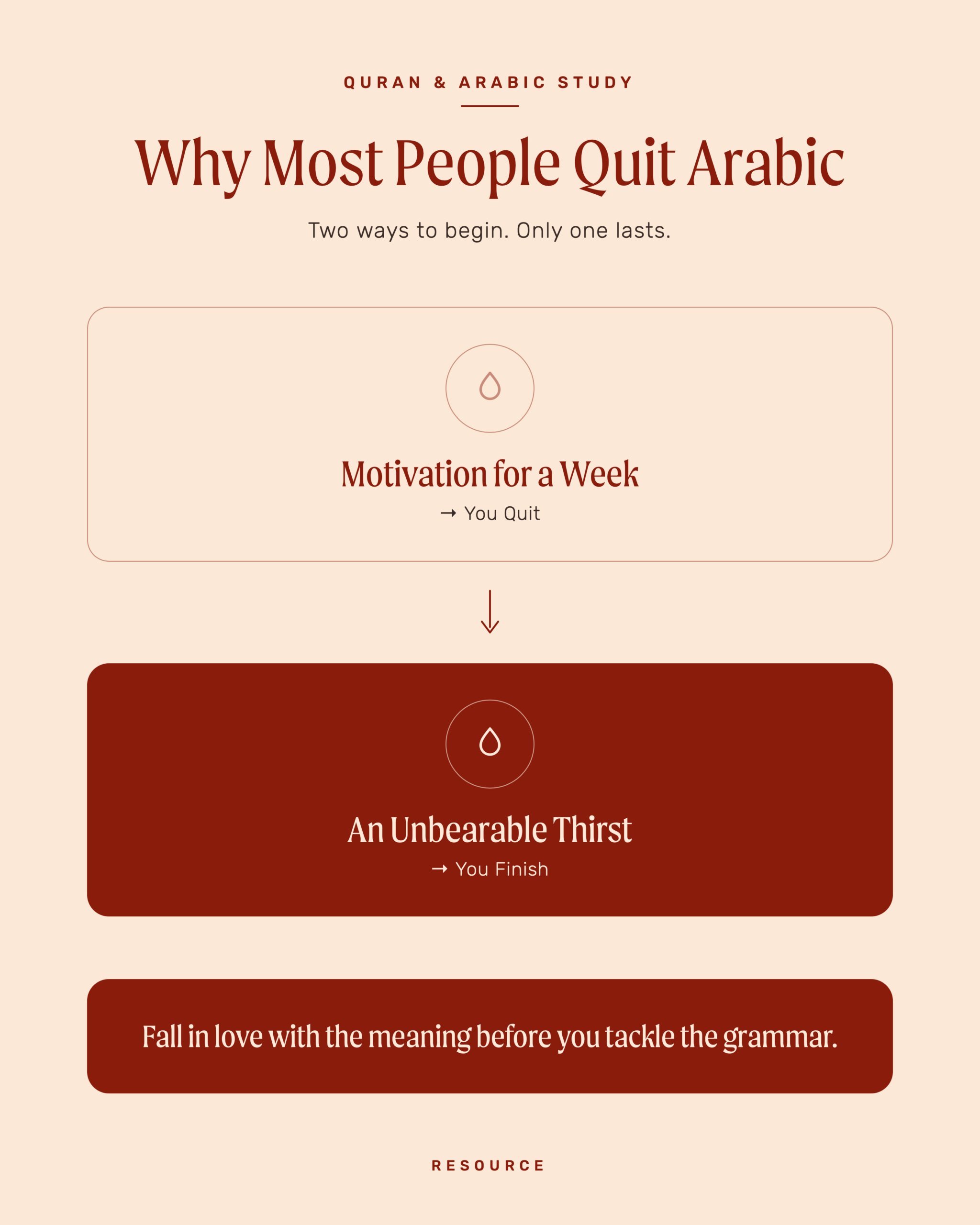
Learning the Arabic language well enough to access the Quran on your own is real work, roughly two to three hundred hours even once you can read the script. Most people who start there are fired up for a week or two, hit the grind and quit, then feel guilty about it. The honest reason is not laziness, it is that the thirst has not yet become unbearable. Motivation that lasts a week is not enough to carry anyone through hundreds of hours. So the first real job is not vocabulary or grammar. It is to fall so deeply in love with the Quran’s meanings that not understanding the original becomes a constant ache you cannot ignore. Build the thirst first and the language will have something to feed.
That is why the roadmap opens with something small and doable, learning to read, then spends most of its energy on the meanings and saves the full study of the language for the moment you are truly ready for it.
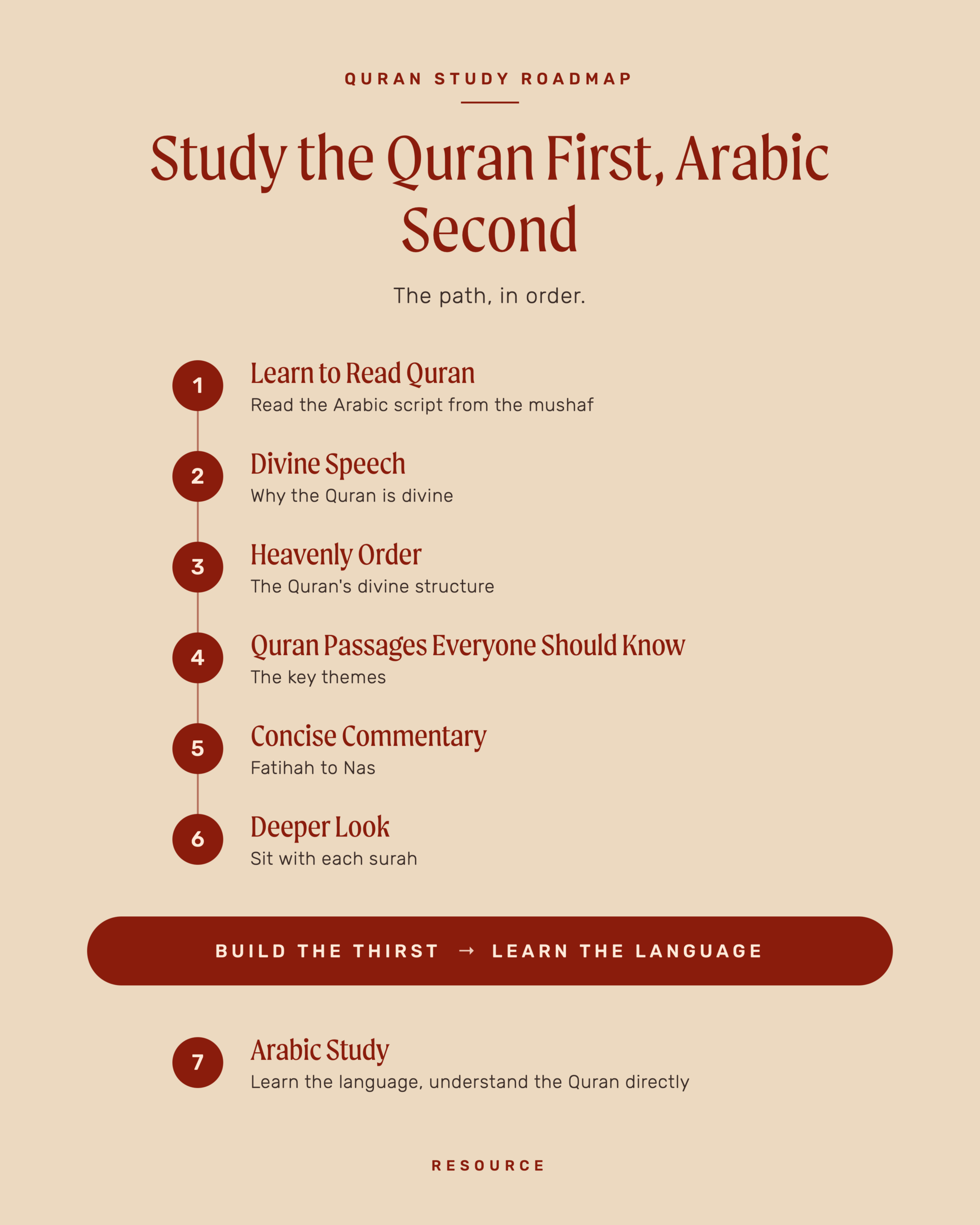
The Quran Roadmap
Step 1 — Learn to Read Quran. Start with the one step that is quick, concrete and gives you an early win: being able to read the Arabic script from the mushaf. This is not learning the language, it is simply learning to recognize the letters and pronounce the words and a complete beginner can get there in about ten days at roughly two hours a day. Tens of thousands of people have done exactly this. Being able to read, even before you understand a word, means you can follow along in the mushaf and in prayer from the very start and it makes everything that comes next feel within reach.
Step 2 — Divine Speech. With your reading underway, let the Quran make its own case for being divine. This course (around sixteen hours and suitable for ages thirteen and up) lays out the intellectual reasons to believe the Quran is from Allah, not human-authored. It is the step that turns belief from something inherited into something you have seen the evidence for. Listen on your commute, your walk or your daily routine; you do not need a desk and a notebook.
Step 3 — Heavenly Order. Once you are convinced the Quran is divine, see how that design shows up in the arrangement itself. Heavenly Order uncovers the structure of the Quran, how its ayahs and surahs are placed with intent rather than by chance, so the book you are about to walk through starts to feel less like scattered pieces and more like a single deliberate whole. It deepens the conviction that Divine Speech builds and hands you a map of how the Quran fits together before you step inside it.
Step 4 — Quran Passages Everyone Should Know. Next, get the bird’s-eye view: the most important themes and passages of the Quran, chosen around the real challenges of life, purpose, peer pressure, loneliness and ambition. Think of these as the pillars holding up the whole building. It also makes an excellent family curriculum; memorize these passages together so that when the prayer is led at home, everyone knows and has reflected on what is being recited.
Step 5 — The Concise Commentary. Now go from Al-Fatihah all the way to An-Nas, a guided walkthrough of the entire Quran (around three hundred hours, often a page in about half an hour). No notes; just listen, the way you would a long series of radio episodes, until you are familiar with the whole book. It is far more effective than reading a translation cover to cover, which tends to leave most people zoning out and full of unanswered questions. The goal is simple but rare: to actually know what is in the Quran from beginning to end.
Step 6 — Deeper Look. By now you know the whole Quran in outline, so you are ready to slow down and sit with it. Deeper Look is the surah-by-surah deep study, where the language, structure and connections of a passage are unpacked at length. This is where the surahs you have come to love become places you return to again and again and where you will feel, more than anywhere else, how much more is waiting on the other side of the Arabic.
One rule to write down for this whole phase: quality over quantity. There are thousands of hours of material available; the aim is not to consume all of it but to make the Quran a regular, living part of your life.
When You’re Ready for the Language
By the time you have worked through that foundation, the thirst should have become a constant pain, the kind that does not come and go. That is the signal you are finally ready to learn the Arabic language in earnest. You can already read the script from Step 1, so the work now is understanding what you read, the two-to-three-hundred-hour investment that at this point finally feels worth every minute. This is the goal the whole roadmap has been pointing toward, the moment the Quran stops reaching you through a translator and starts speaking to you directly.
Going Further
The roadmap does not end there. Once the language is within reach and the core sequence is behind you, Bayyinah TV opens into deeper thematic study: the Quran’s philosophy and how it guides toward truth, hikmah and how the Quran defines and applies wisdom across cultures and time, as well as the Quran’s relationship with the Bible and the stories it shares with the Torah and the Gospels. These are where a settled student goes to keep growing for years.
The Bigger Vision
There is a larger hope behind all of this. For generations, communities in other languages had a rich tradition of regular Quran study gatherings; in English, that culture has been thinner, even as more and more young people around the world live primarily in English. The point of building this roadmap is not to keep you listening forever, but to train you, so that one day you are the one teaching. The vision is ordinary Muslims who, every Ramadan, walk their own families and neighborhoods through the meanings of the Quran, year after year, until knowing the contents of the Quran is normal again rather than rare. The resources exist to give you a starting point; the work of becoming a lifelong student and eventually a teacher, is yours.
The Takeaway
If you have wanted to study the Quran but never known where to start, here is the whole map: begin by learning to read the script, then build an unbearable thirst by engaging the Quran’s meaning, see why it is divine, learn how it is ordered, learn its major themes, walk through it cover to cover and then sit with it more slowly. Once not knowing the original becomes a constant ache, learn the language itself, then go deeper still. Quality over quantity, the Quran as a daily companion and the goal always in view: not just to learn it, but to live it and one day pass it on.
Every resource in this roadmap, Learn to Read Quran, Divine Speech, Heavenly Order, Quran Passages Everyone Should Know, the Concise Commentary and the Deeper Look series, lives on Bayyinah TV. Start wherever you are and let the thirst grow.
Notes
[1] Sahih al-Bukhari 5027, https://sunnah.com/bukhari:5027 ↩

At Bayyinah, we are dedicated to helping you connect directly with the words of Allah beyond translation. Founded by Ustadh Nouman Ali Khan, our mission is to create transformative experiences that deepen your understanding and engagement with the Quran.
Study the Quran and Arabic in a systematic and personalized way through Bayyinah TV. Get started today for free.
Check out our newest articles, fresh off the press and ready for you to dive into!