Successful subscription! Thank you for subscribing.
Successful subscription! Thank you for subscribing.

November 19, 2026
The most common reason Muslims never learn Quranic Arabic has very little to do with wanting it, since almost everyone wants it. What stops people is a belief they hold quietly and rarely examine, which is that this particular door only opens for those who can give it years of their life.
It is an understandable belief, because Arabic has a reputation and most of us have met someone who studied it seriously and rearranged everything else in order to do so. So we file it away as something we would love to do in a different life with a different schedule, go back to reading a translation and hope that it is close enough.
That belief deserves to be tested rather than quietly accepted, because the experience of actually beginning this study tends to contradict it within days.
A three week course, taken after work
In 1999, a student in Queens, New York saw an announcement for a three week Arabic course at a local masjid, six nights a week from seven in the evening until ten. He was in his third year of college and working in the city, which meant that attending at all required the train, then another train, then a bus, and on a good day the trip took an hour and fifteen minutes in each direction. He could read the Quran perfectly well, but understood none of it.
By the end of the first week his teacher had covered two small things: that every noun in Arabic carries a handful of properties, including a marker that tells you what role it is playing in its sentence, and that when a description is attached to a noun it has to agree with that noun on those properties. That was the entire content of six evenings, after which he stood up to pray.
What happened in that prayer
Standing in salah he began with Bismillah ir-Rahman ir-Raheem, the line every Muslim says more often than almost any other words in their life, except that this time he did not simply recite it. He took it apart as he said it, recognizing that the opening word was built from a particle attached to a noun, that the noun was joined to the name of Allah, and that the two descriptions which followed carried exactly the same markers as the name they were describing, which is how he could tell they belonged to it rather than to anything else in the line.
For the first time, with no translation beside him and after one week of study, he understood the architecture of a complete ayah of the Quran. That student was Ustadh Nouman Ali Khan, and he has said since that he cried through the rest of that prayer, and that the du’a he made at the end of it was a simple one, asking Allah to open the rest of the Quran to him in the same way.
The barrier was never the language
It is worth being careful about what that first week proves, because it does not prove that Quranic Arabic is easy, that a week is sufficient or that anybody can shortcut their way into the Book of Allah. None of those things are true, and anyone who promises them deserves suspicion rather than your money.
What the story does show is that the reward in this study is not held back until the far end of it. It begins arriving almost immediately, in small pieces, and then keeps arriving, which means you are not working in the dark for three years before something finally opens.
That matters because the real obstacle for most people was never the difficulty of the language. It is the assumption that nothing will happen for a very long time, and once that assumption is in place, postponing until a quieter season of life becomes an entirely reasonable decision, even though the quieter season never quite arrives.
What a translation cannot give you
A translation is a decision that somebody else has already made on your behalf. A translator read the Arabic, weighed the possible meanings, selected one and wrote it down for you, which means that the word Allah chose, along with the words He chose it over, is nowhere visible on the page you are holding.
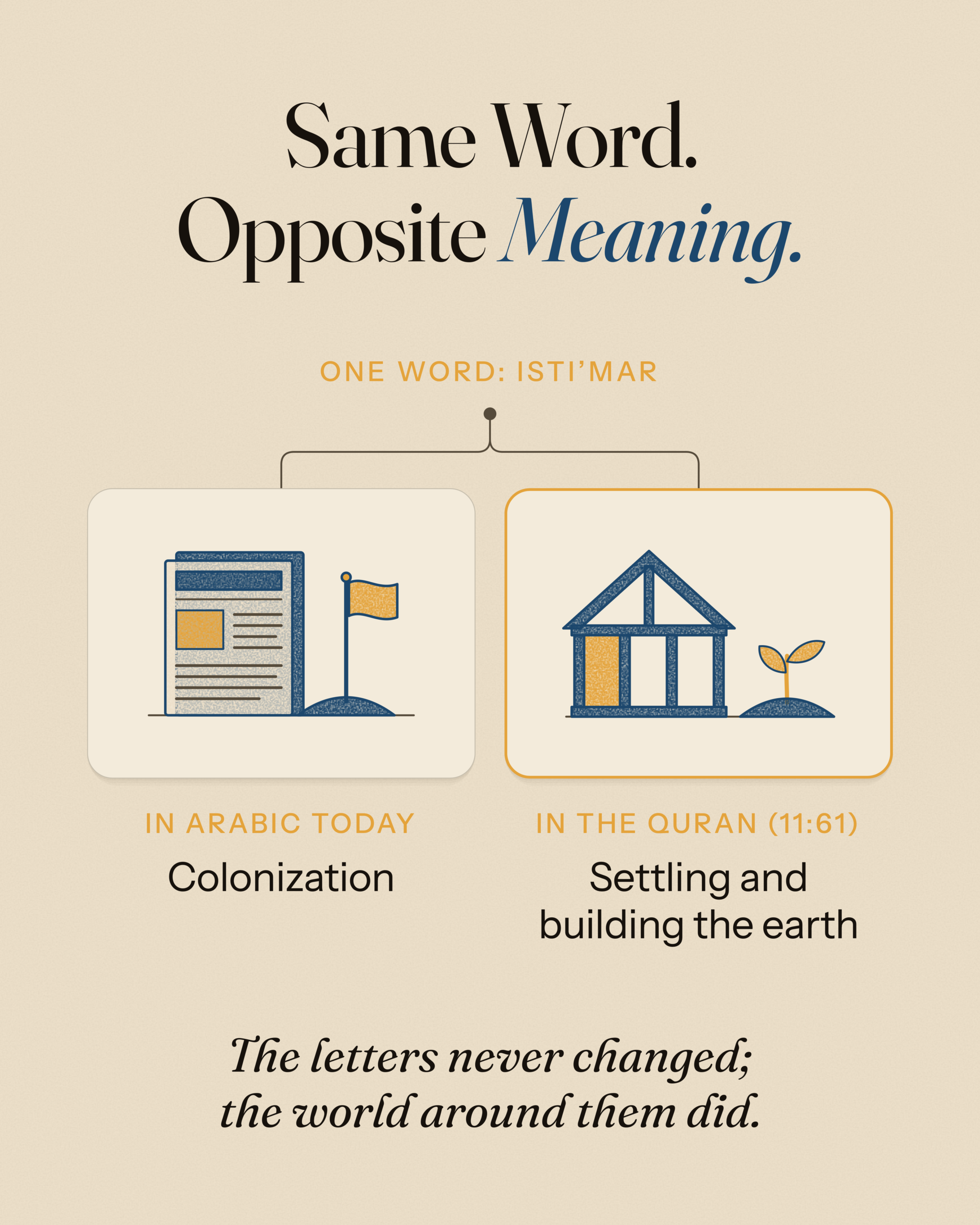
Consider what can happen to a single root across time. In Arabic today the word isti’mar means colonization, and it is the word you will find in newspapers and political writing across the Arab world, whereas in the Quran, revealed fourteen centuries ago, that same root carries the sense of Allah placing human beings on the earth and wanting them to settle it and build on it (11:61). A careless rendering of that ayah would have Allah instructing people to colonize the earth, which is close to the opposite of what is being said.
The letters never changed at all; the world around them did, and the meaning moved along with it. This is exactly the kind of thing a translation cannot show you, because by the time the page reaches your hands the choice has been made and the alternatives have been cleared quietly away.
The question that is still open
Allah says in Surah Al-Qamar:
وَلَقَدْ يَسَّرْنَا الْقُرْآنَ لِلذِّكْرِ فَهَلْ مِن مُّدَّكِرٍ
“And We have certainly made the Quran easy for remembrance, so is there any who will remember?”
(54:17)
Notice the shape of that ayah, in which Allah makes a statement about His Book and then asks a question about us. The ease has already been given and is not in question; what remains open is whether anybody will take Him up on it. That question has never been withdrawn, and it is addressed to people with jobs, children, commutes and ordinary amounts of energy, which is to say almost all of us. You do not need a different life in order to begin, only an hour you can protect and the willingness to come back to it tomorrow.
Ready to begin? Explore the Bayyinah Arabic app and start studying the language of the Quran at your own pace.

At Bayyinah, we are dedicated to helping you connect directly with the words of Allah beyond translation. Founded by Ustadh Nouman Ali Khan, our mission is to create transformative experiences that deepen your understanding and engagement with the Quran.
Study the Quran and Arabic in a systematic and personalized way through Bayyinah TV. Get started today for free.
Check out our newest articles, fresh off the press and ready for you to dive into!