
Successful subscription! Thank you for subscribing.
Successful subscription! Thank you for subscribing.

July 29, 2026
Surah Al-Qalam may have been revealed early, but it is anything but simple in its design. Read as a whole, it opens and closes with the very same accusation, that the Prophet ﷺ is insane and between those two bookends it tells two strikingly parallel stories of people who felt completely safe and then suffered a rude awakening. This post traces that structure and the lesson it builds toward, closing with one of the most moving examples in the Quran of a prophet who faltered and was still redeemed.
Framed by a Single Accusation
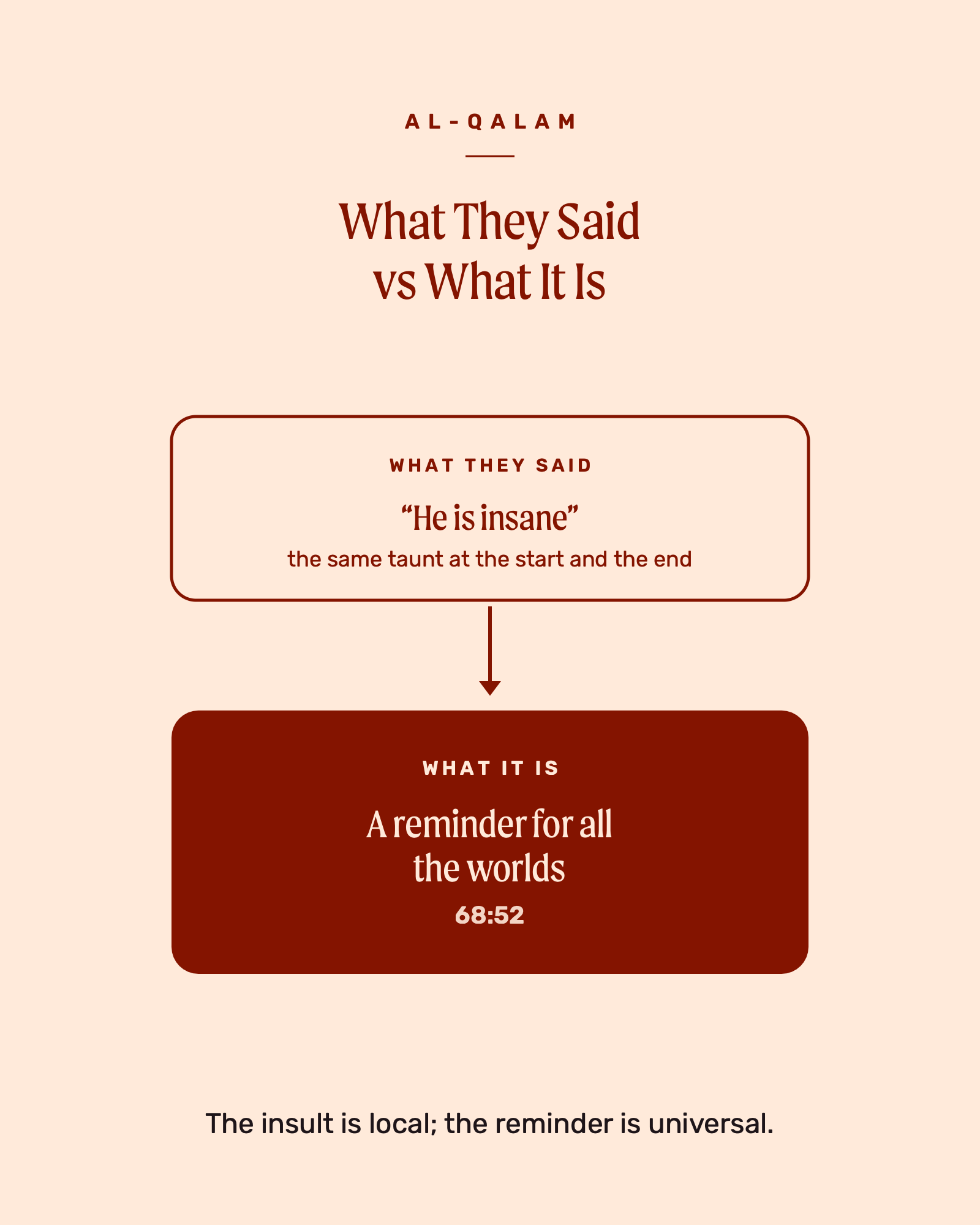
The surah is wrapped in symmetry. It begins by telling the Prophet ﷺ he is not insane and near its very end the deniers are described glaring at him, desperate for him to slip, muttering that he is mad. The same slander opens and closes the surah. But notice what sits beside it at the end: the declaration that this revelation is nothing but a reminder for all the worlds. The structure itself answers the insult, they call him crazy, while the book he carries becomes guidance for every nation that comes after. The accusation is small and local; the reminder is universal and lasting.
The First Awakening: The People of the Garden
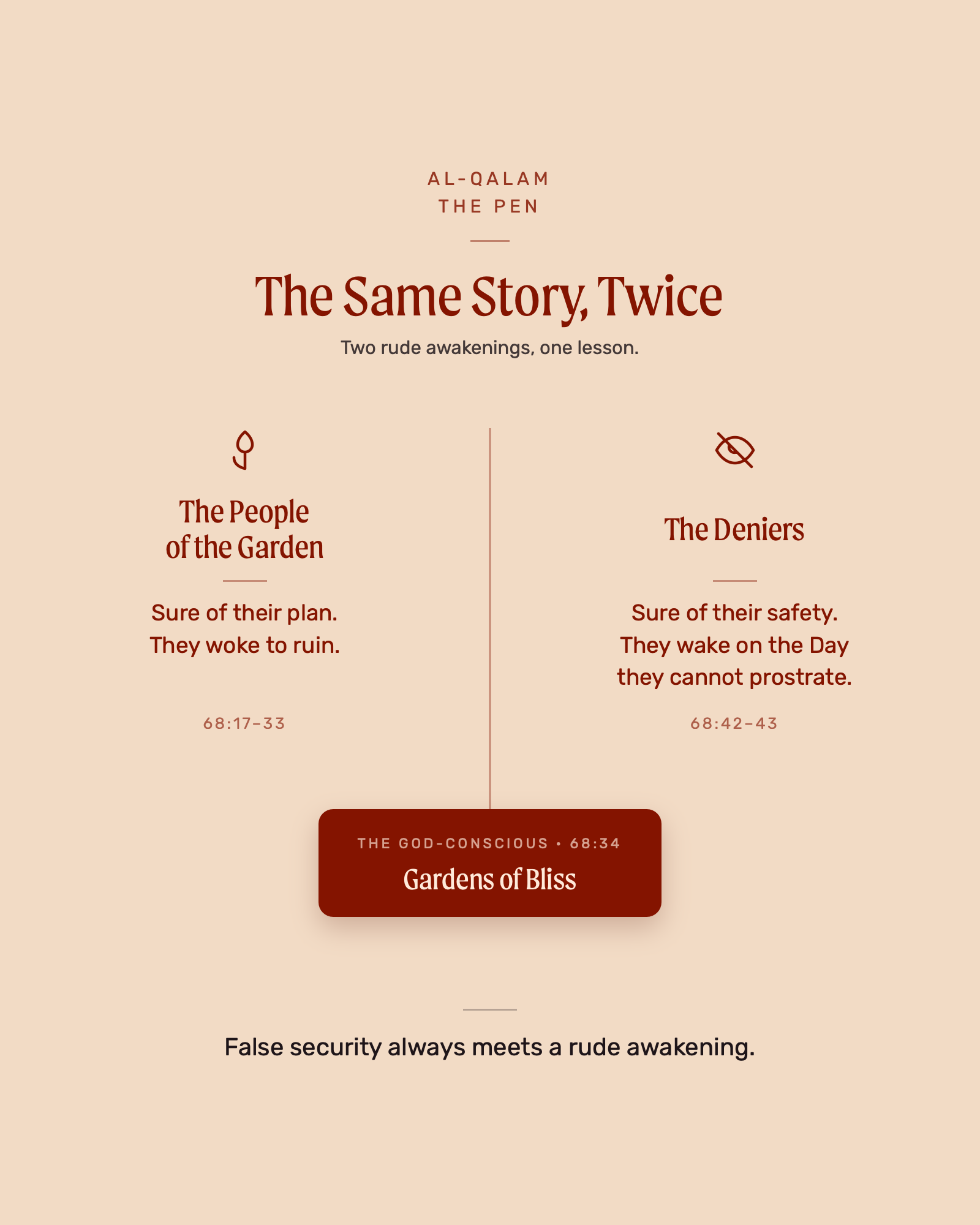
At the heart of the surah is the story of the owners of a lush garden (68:17-33)1. They resolved to harvest their fruit at the crack of dawn, quietly, so they could keep the entire crop for themselves and give nothing to the poor. They were utterly confident. But while they slept, a calamity from their Lord passed over the garden and left it black and barren. They set out in the morning whispering their selfish plan, only to arrive at devastation. It was a rude awakening: the security they felt was an illusion and their scheme to cut out the needy cost them everything. The surah then adds a sobering line, that the punishment of the Hereafter is far greater.
The Second Awakening: The Deniers on the Day
That earthly parable is deliberately mirrored by a heavenly one. The deniers of Makkah, like the gardeners, feel perfectly safe; they mock the warning and ask when this so-called reckoning will ever arrive. The surah answers by carrying them forward to the Day they are called to prostrate and find they cannot, their eyes downcast, humiliation covering them, when in this life they had been called to prostrate while safe and sound and refused (68:42-43)2. Two groups, the same shape of story: false security, a sudden summons and a rude awakening from which there is no recovery. What the garden was to the schemers, the Day of Judgment is to the deniers.
The Reward in the Middle
Set between these two awakenings is a quiet, luminous verse about an entirely different group (68:34)3.
إِنَّ لِلْمُتَّقِينَ عِندَ رَبِّهِمْ جَنَّاتِ النَّعِيمِ
“Indeed, for those mindful of Allah are Gardens of Bliss with their Lord.”
(68:34)
While the heedless lose the garden they hoarded and the deniers lose everything on the Day, the people of taqwa are promised gardens of bliss with their Lord. The placement is the message: real security is never in what you grasp and guard for yourself, but in what you hold with Allah. The surah even pauses to ask the deniers directly how they reason, do they have a book, a binding oath, any ground at all for treating those who submit to Allah like criminals? They have nothing to stand on.
The Close: Persevere, Unlike the Man of the Fish
The surah ends by turning back to the Prophet ﷺ with both a warning and a comfort (68:48)4. Be patient with your Lord’s decree, it says and do not be like the companion of the fish, Yunus, who cried out in distress after leaving his people in frustration. Yet the surah does not leave Yunus condemned; it immediately recalls that grace from his Lord reached him and he was made among the righteous (68:49-50)5. The example is perfectly chosen: even a prophet who faltered under the weight of his mission was caught, forgiven and restored. The call to persevere is wrapped in the assurance that the door of mercy never closes.
The Takeaway
Surah Al-Qalam is built like an answer to an insult. Framed by the accusation of madness, it sets two awakenings side by side, the schemers who lost their garden and the deniers who lose the Day and places the gardens of the God-conscious safely in the middle. Then it steadies the Prophet ﷺ and every believer carrying a heavy burden, with the example of Yunus: persevere and trust that mercy reaches even those who stumble. Its closing word says it all (68:52)6: what they dismissed as the ravings of one man is, in truth, a reminder for all the worlds.
There is far more to Surah Al-Qalam than a single article can hold. You can explore the full Al-Qalam: A Deeper Look series on Bayyinah TV, alongside the other surahs being opened up in the Deeper Look collection.
Related reading: By the Pen: An Introduction to Surah Al-Qalam (the companion post in this series).
Notes
[1] Quran, 68:17-33, https://quran.com/68/17 ↩
[2] Quran, 68:42-43, https://quran.com/68/42 ↩
[3] Quran, 68:34, https://quran.com/68/34 ↩
[4] Quran, 68:48, https://quran.com/68/48 ↩
[5] Quran, 68:49-50, https://quran.com/68/49 ↩
[6] Quran, 68:52, https://quran.com/68/52 ↩

At Bayyinah, we are dedicated to helping you connect directly with the words of Allah beyond translation. Founded by Ustadh Nouman Ali Khan, our mission is to create transformative experiences that deepen your understanding and engagement with the Quran.
Study the Quran and Arabic in a systematic and personalized way through Bayyinah TV. Get started today for free.
Check out our newest articles, fresh off the press and ready for you to dive into!