
Successful subscription! Thank you for subscribing.
Successful subscription! Thank you for subscribing.
July 29, 2026
Surah Al-Qalam is one of the very earliest surahs of the Quran, revealed in Makkah at the dawn of the Prophet’s mission, some say it was among the second or third passages he ever received. In the order of the mushaf it sits right after Surah Al-Mulk, near the start of the long closing run of Makki surahs. It arrives at a raw, painful moment: the people with the most power and prestige in Makkah had looked at the Prophet ﷺ and pronounced him insane. This post introduces the surah, its striking oath by the pen and the way it answers that accusation, not with anger, but with a declaration about the Prophet’s character that has echoed for fourteen centuries.
Where the Surah Sits
Al-Qalam is the second surah in the final, almost entirely Makki, stretch of the Quran. It is worth pausing on the shape of the whole book: the Quran opens with its great Madani surahs, Al-Baqarah, Ali ‘Imran and the restand closes with the short, early Makki surahs. So as we move into Al-Qalam we are stepping back into the earliest days of revelation, into the streets of Makkah where the message was new, fiercely opposed and carried by a single man whom the city’s elite had already written off.
Nun. By the Pen.
The surah opens with one of the Quran’s mysterious letters and an oath that would have stunned its first listeners (68:1)1.
نٓ ۚ وَٱلْقَلَمِ وَمَا يَسْطُرُونَ
“Nun. By the pen and what they inscribe.”
(68:1)
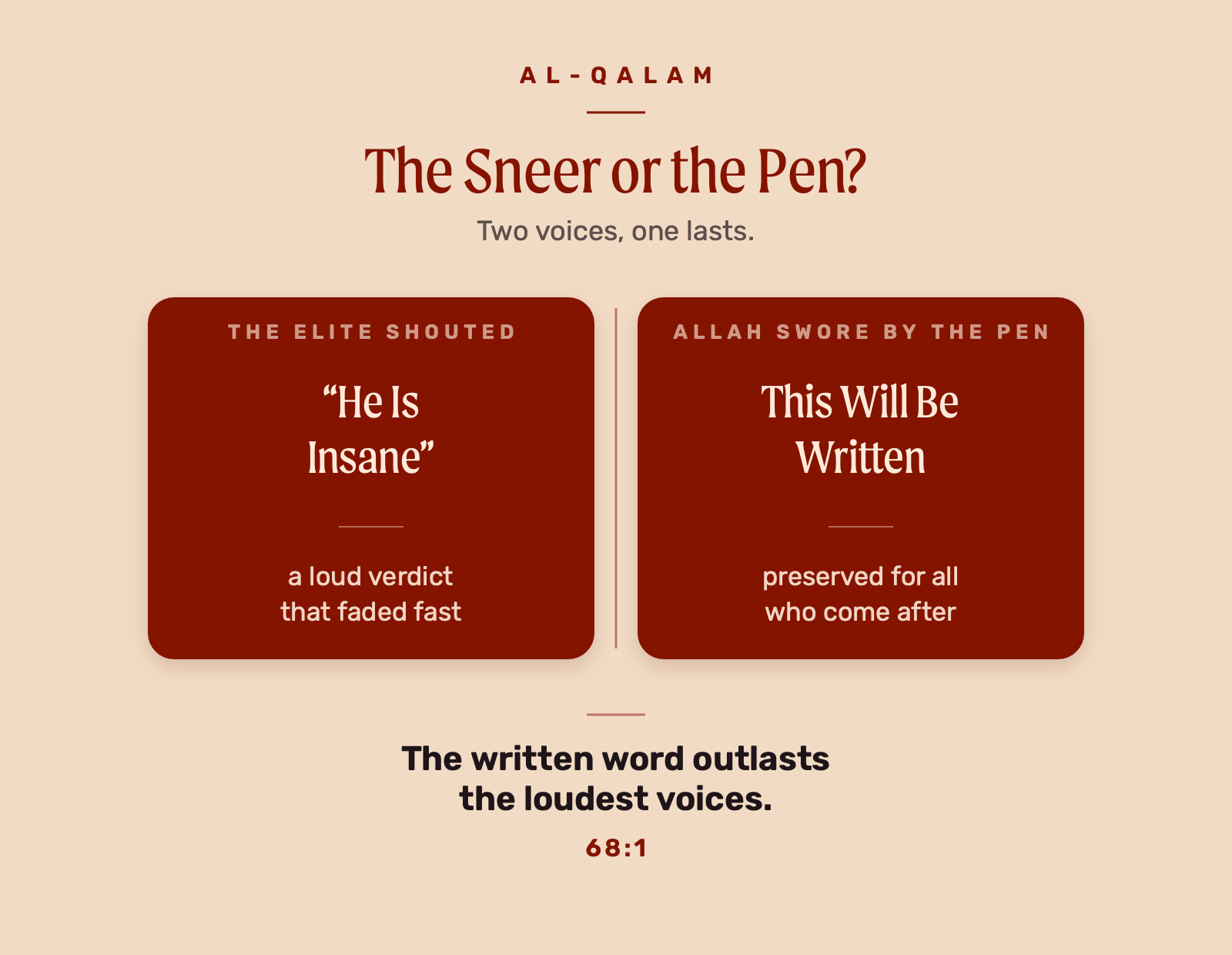
Allah swears by the pen and by what is written with it. In a largely oral society that prized memory and the spoken word, an oath by the written word points to something enduring, something that will outlast the voices shouting in the marketplace. It is a quiet promise at the very start of the surah: what is being revealed here will be written down, preserved and carried forward, long after the insults have faded. The pen, not the sneer, gets the last word.
You Are Not, by the Grace of Your Lord, Insane
Then comes the heart of the opening, a direct and tender reassurance to the Prophet ﷺ (68:2)2. You are not, by the grace of your Lord, a madman. The accusation of insanity was the favourite verdict of Makkah’s elite and there was a logic to why people listened to them: the wealthy and powerful are assumed to be the clever ones, the people who really understand how the world works. So when they declared the Prophet ﷺ crazy, the city took note. The surah refuses that verdict outright and reframes the whole situation: it is not the Messenger who has lost his mind, but the society that cannot recognise the truth standing in front of it.
And Indeed, You Are of a Tremendous Character
Having denied the slander, the surah lifts the Prophet ﷺ to a height given to no one else in the Quran (68:4)3.
وَإِنَّكَ لَعَلَىٰ خُلُقٍ عَظِيمٍ
“And indeed, you are of a tremendous character.”
(68:4)
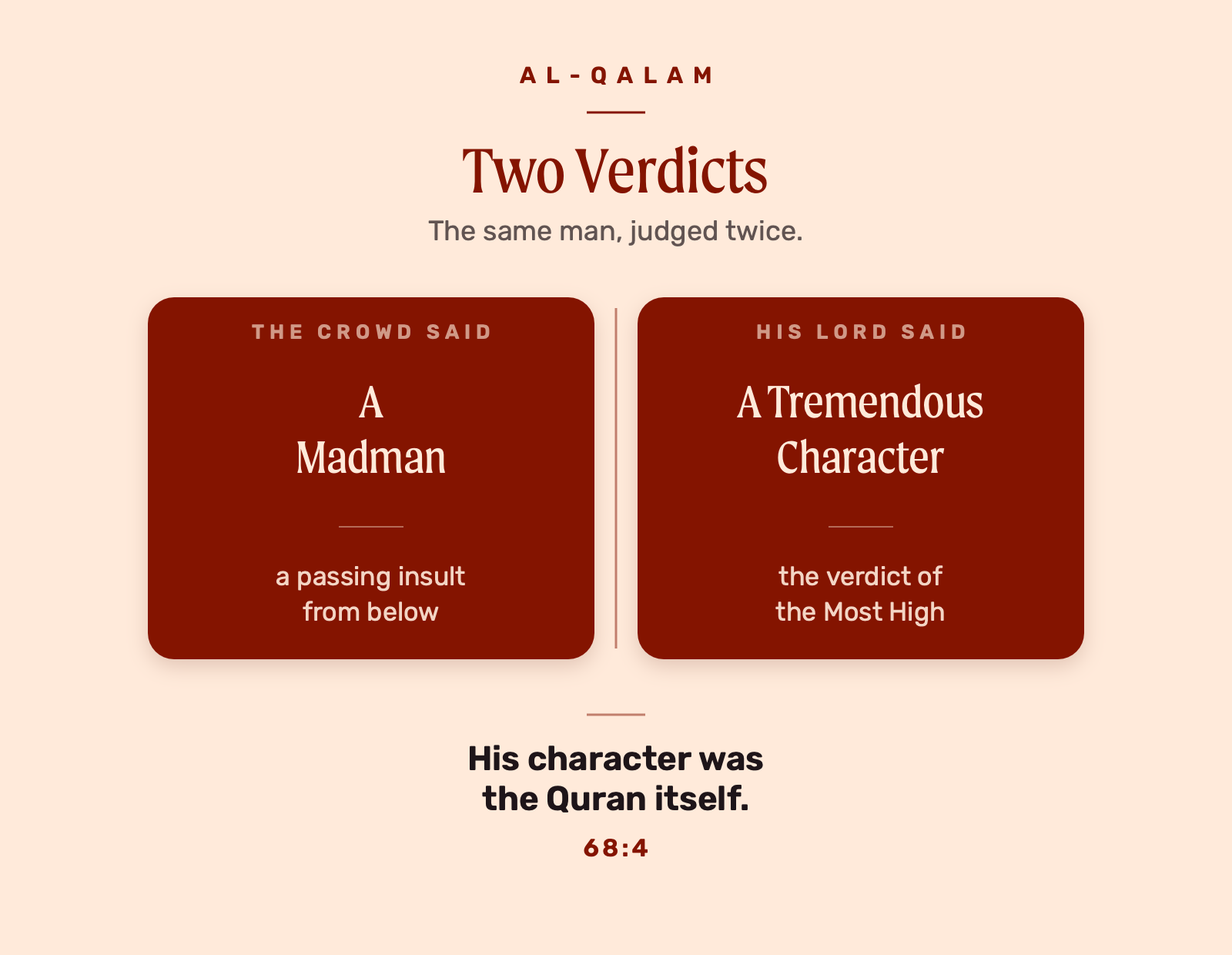
Far from being unstable, the man they mocked is described as standing upon a magnificent moral character. Years later, when ‘Aisha was asked what the Prophet ﷺ was like, she answered simply that his character was the Quran (Sahih Muslim 746)4. He did not merely recite the book; he was its living embodiment. For anyone who has ever been misjudged by people who never bothered to look closely, the contrast here is profound: the crowd called him mad and Allah called him magnificent. Reputation in the eyes of the powerful is one thing; standing in the eyes of Allah is another entirely.
The Takeaway
Surah Al-Qalam meets one of the hardest human experiences, being misunderstood and slandered by people whose opinion the world respects and answers it from above. It swears by the pen that the truth will be preserved, denies the lie that the Prophet ﷺ was insane and crowns him with a character so great that Allah Himself praised it. The lesson reaches every believer who has felt dismissed or mocked for holding on to what is right: the verdict that matters is not the one shouted by the confident and the powerful, but the one written by your Lord. Live by His standard and let the pen record the rest.
There is far more to Surah Al-Qalam than a single article can hold. You can explore the full Al-Qalam: A Deeper Look series on Bayyinah TV, alongside the other surahs being opened up in the Deeper Look collection.
Related reading: Two Rude Awakenings: The Structure of Surah Al-Qalam (the companion post in this series).
Notes
[1] Quran, 68:1, https://quran.com/68/1 ↩
[2] Quran, 68:2, https://quran.com/68/2 ↩
[3] Quran, 68:4, https://quran.com/68/4 ↩
[4] Sahih Muslim 746, https://sunnah.com/muslim:746 ↩

At Bayyinah, we are dedicated to helping you connect directly with the words of Allah beyond translation. Founded by Ustadh Nouman Ali Khan, our mission is to create transformative experiences that deepen your understanding and engagement with the Quran.
Study the Quran and Arabic in a systematic and personalized way through Bayyinah TV. Get started today for free.
Check out our newest articles, fresh off the press and ready for you to dive into!