
Successful subscription! Thank you for subscribing.
Successful subscription! Thank you for subscribing.

July 29, 2026
Surah Al-Ma’arij begins with the confident and the powerful sneering at the warning and it ends by showing exactly where that confidence leads. Its final verses are among the most vivid scenes of the Day of Judgment in the Quran and they complete a quiet argument the whole surah has been making: that the hierarchy of this world, who is on top and who is beneath them, is about to be turned completely upside down. This post follows the surah to its close and the great reversal it unveils.
The Lord of the Ascending Ways
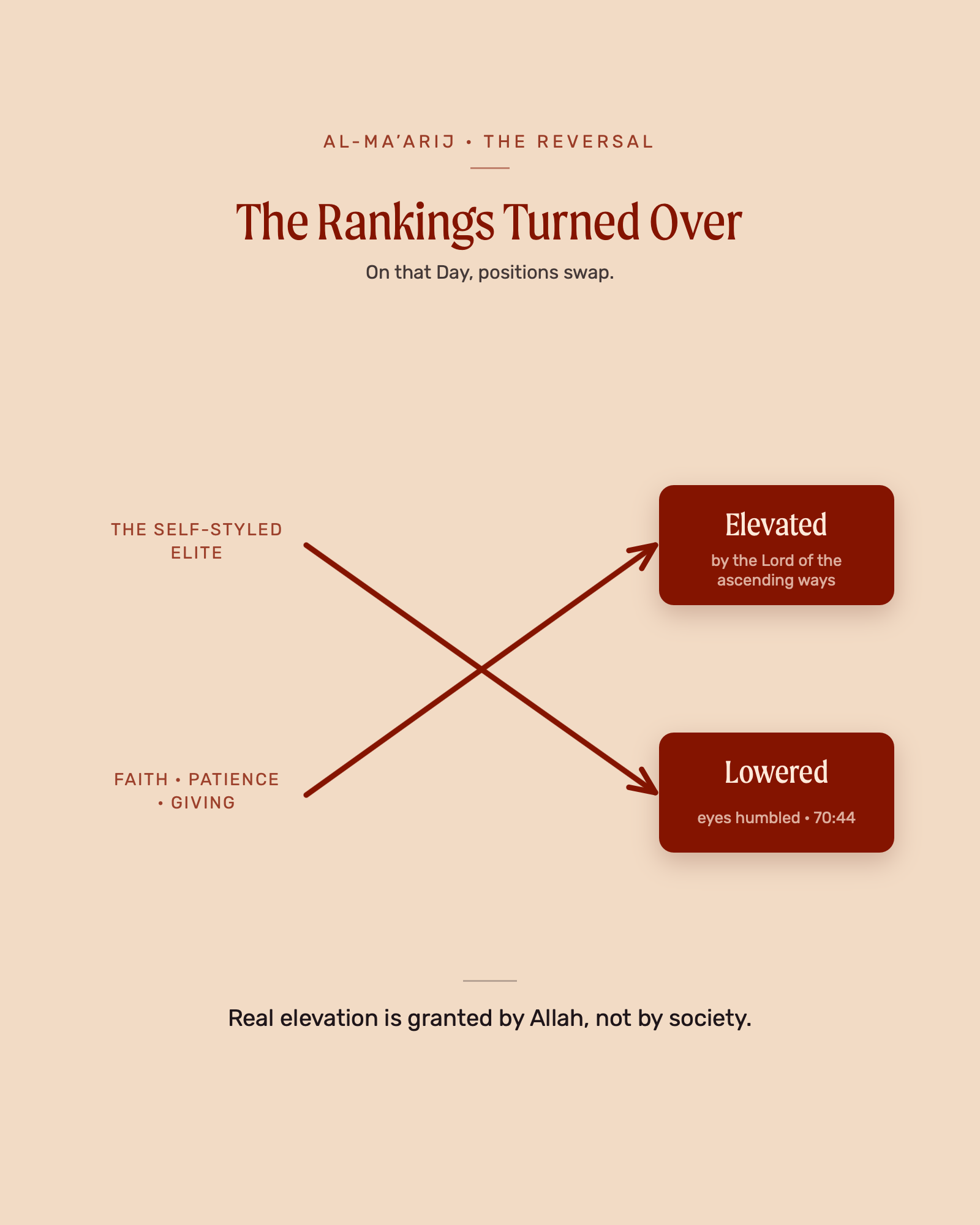
The surah’s very name carries its theme. Allah is called Dhi al-Ma’arij, the Owner of the elevations, the ascending ways. Throughout the surah He elevates a group that society would never elevate, the people of faith, patience and quiet generosity and lowers a group that society places at the very top, the self-styled elite who look down on the poor and treat those who serve them as nobodies. The surah is, in a sense, a courtroom where the world’s rankings are reviewed and reversed. The ones who thought themselves above need are about to discover how needy they truly are.
Leave Them to Their Games
Before the final scene, the deniers are dismissed almost casually (70:42)1. Leave them, the surah says, to plunge into their idle talk and play until they meet their Day, the very Day they were promised. There is a stinging calm in that instruction. The people who demanded the punishment be hurried up, who mocked the idea that they were ever accountable, are simply left to their distractions a little longer. Their confidence does not need to be argued with; it only needs to be outlasted. The Day will do the rest.
Rushing From the Graves
Then the scene arrives (70:43)2.
يَوْمَ يَخْرُجُونَ مِنَ الْأَجْدَاثِ سِرَاعًا كَأَنَّهُمْ إِلَىٰ نُصُبٍ يُوفِضُونَ
“The Day they come out of the graves rushing, as if hurrying toward a goal.”
(70:43)
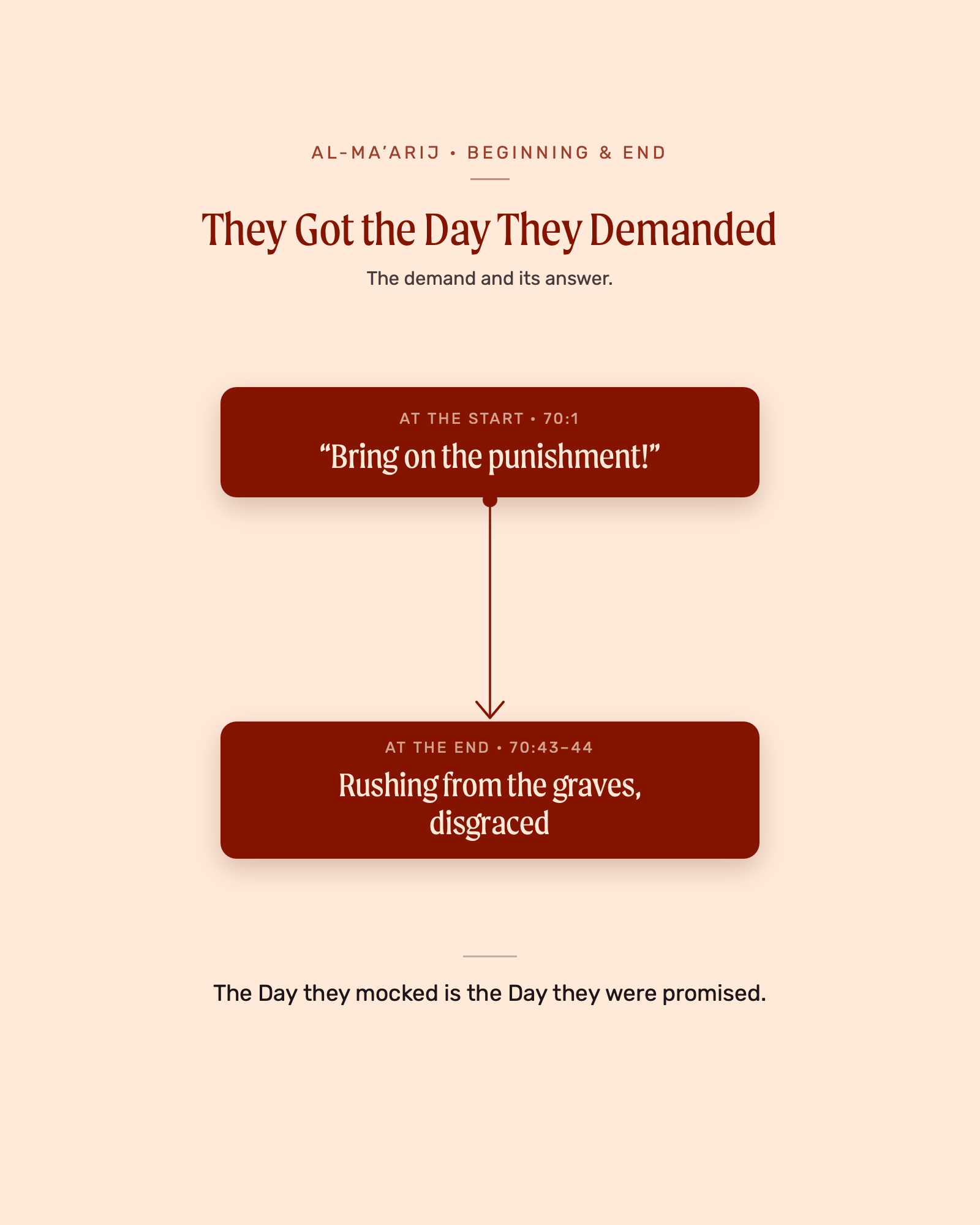
They pour out of their graves at speed, as though racing toward a goalpost, an image that recalls the way idolaters once rushed at dawn toward their idols. There is a bitter irony in it: in this life these were the people others rushed toward, the ones who set the pace and expected the world to follow them. Now they themselves are the ones running, summoned, not in command of anything, swept along toward a reckoning they cannot delay or escape.
Eyes Lowered, Covered in Disgrace
And the surah’s final image is the complete undoing of their old standing (70:44)3.
خَاشِعَةً أَبْصَارُهُمْ تَرْهَقُهُمْ ذِلَّةٌ ۚ ذَٰلِكَ الْيَوْمُ الَّذِي كَانُوا يُوعَدُونَ
“Their eyes humbled, covered in disgrace. That is the Day they were promised.”
(70:44)
The eyes that once looked down on everyone are now lowered; the faces that radiated status are now covered in humiliation. The surah ends precisely where the powerful least expected to end, at the bottom. And it closes by reminding everyone that this was never a surprise: this is the Day they were promised all along, the same Day they had demanded be brought forward at the start of the surah. They got exactly what they asked for, only not in the way they imagined.
The Takeaway
Surah Al-Ma’arij ends by quietly dismantling one of the deepest illusions we live with, that the rankings of this world are permanent and that the powerful are safe. The Lord of the ascending ways elevates the humble believer and brings the arrogant elite down to a Day of lowered eyes and covering shame. For anyone tempted to measure themselves by status, wealth or who looks up to them, the close of this surah resets the scale: real elevation is not granted by society but by Allah and it goes to the people of patience, prayer and generosity, never to those who simply sat on top. Live for the ranking that lasts.
There is far more to Surah Al-Ma’arij than a single article can hold. You can explore the full Al-Ma’arij: A Deeper Look series on Bayyinah TV, alongside the other surahs being opened up in the Deeper Look collection.
Related reading: Patience, Prayer and the Right of the Poor: An Introduction to Surah Al-Ma’arij (the companion post in this series).
Notes
[1] Quran, 70:42, https://quran.com/70/42 ↩
[2] Quran, 70:43, https://quran.com/70/43 ↩
[3] Quran, 70:44, https://quran.com/70/44 ↩

At Bayyinah, we are dedicated to helping you connect directly with the words of Allah beyond translation. Founded by Ustadh Nouman Ali Khan, our mission is to create transformative experiences that deepen your understanding and engagement with the Quran.
Study the Quran and Arabic in a systematic and personalized way through Bayyinah TV. Get started today for free.
Check out our newest articles, fresh off the press and ready for you to dive into!