
Successful subscription! Thank you for subscribing.
Successful subscription! Thank you for subscribing.

July 29, 2026
Surah Al-Mumtahanah is a Madani surah and it deals with one of the most delicate questions a believing community faces: where do your deepest loyalties lie? It belongs to a run of surahs concerned with the life of the community and it tackles the tension between faith and the bonds of kinship, friendship and politics. This post introduces the surah through the incident that prompted it, the towering example it points to and the unusual name it carries.
A Surah About Allegiance
Where one cluster of surahs in this part of the Quran builds the believer’s worldview, this group, from Al-Hadid onward, turns to the practical life of the community: its social, family and political bonds. Al-Mumtahanah sits here as the Quran’s sustained reflection on allegiance. Who gets your loyalty and your affection and what happens when those natural human attachments pull against your commitment to Allah and His Messenger ﷺ? That is the nerve the surah presses from its very first verse.
The Letter That Prompted It
The surah opens in response to a real and painful incident: a sincere companion, out of concern for his family still in Makkah, secretly sent word of the Muslims’ plans to the very people preparing to fight them. The opening verse addresses that impulse directly (60:1)1.
يَٰٓأَيُّهَا ٱلَّذِينَ ءَامَنُوا۟ لَا تَتَّخِذُوا۟ عَدُوِّى وَعَدُوَّكُمْ أَوْلِيَآءَ
“O you who believe, do not take My enemy and your enemy as allies, extending to them affection.”
(60:1)
The companion was not a traitor in his heart; he was a believer whose love for his family clouded his judgment. That is exactly why the verse is so instructive. The surah is not addressing obvious enemies of faith but sincere believers whose loyalties can get tangled and it gently but firmly resets the order: allegiance to Allah comes first and it cannot be quietly handed to those actively working against the faith.

The Example of Ibrahim
To show what clear loyalty looks like, the surah points to the one figure the Arabs revered most, Ibrahim (AS) (60:4)2.
قَدْ كَانَتْ لَكُمْ أُسْوَةٌ حَسَنَةٌ فِىٓ إِبْرَٰهِيمَ
“There has already been for you an excellent example in Ibrahim.”
(60:4)
Ibrahim (AS) openly disassociated himself from his people’s worship of false gods, even as he continued to long for their guidance and prayed for his father. His example draws the crucial line: he rejected their false way completely, yet his heart remained merciful toward the people themselves. Loyalty to Allah did not turn him cold or cruel; it clarified what he could and could not endorse, while leaving room for hope and kindness.
The Woman Who Is Examined
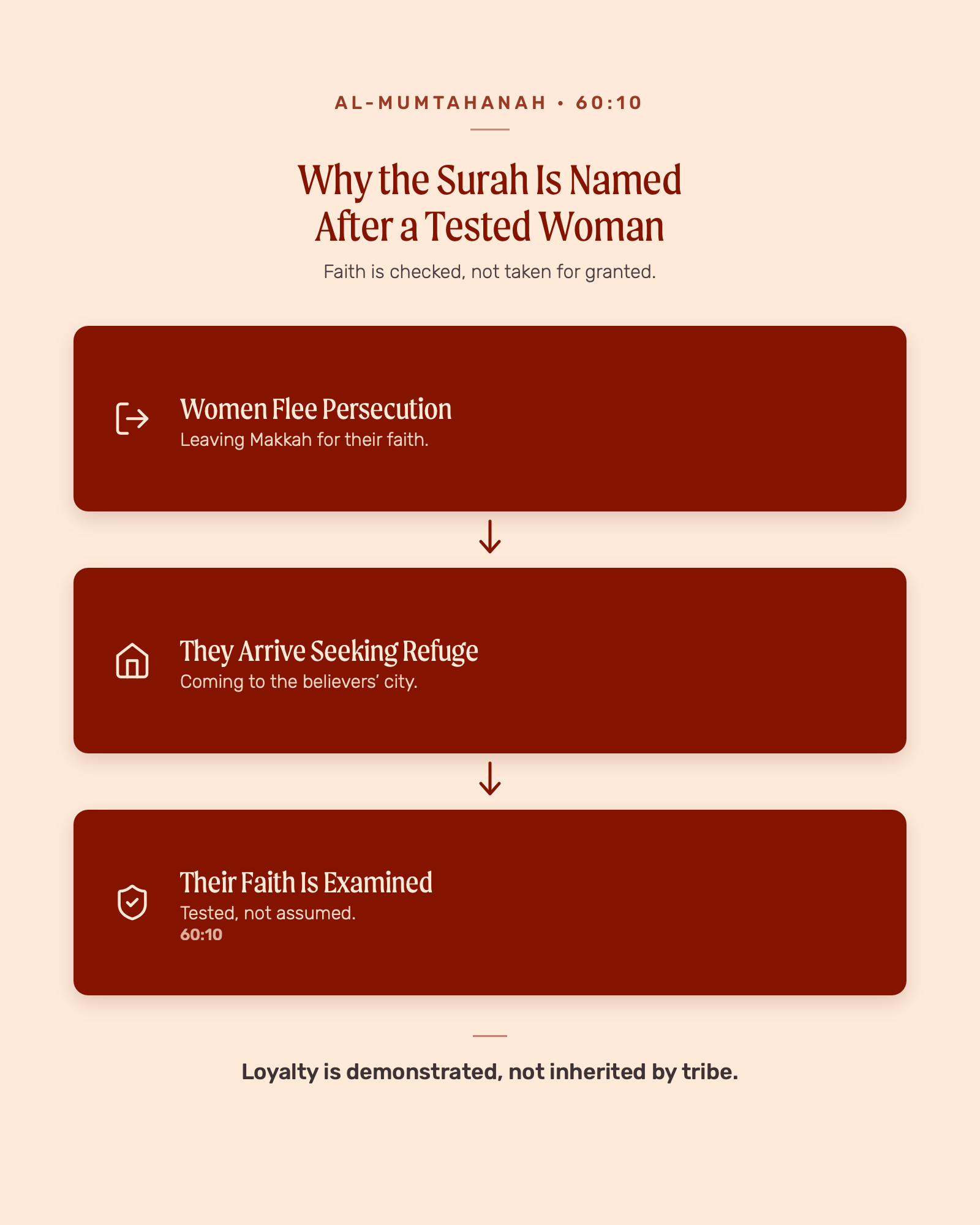
The surah takes its name, Al-Mumtahanah, the woman who is examined, from a later passage about believing women who fled persecution and arrived in Madinah seeking refuge. The believers are told to examine their faith before turning them away to the enemy (60:10)3. The name is telling. Loyalty in this surah is not something assumed by birth or tribe; it is something demonstrated and verified. These women had left everything for their faith and the surah honours that proof of sincerity, making one tested woman the very title of the chapter.
The Takeaway
Surah Al-Mumtahanah opens up the question of loyalty with rare honesty. It does not pretend that family ties, friendships and politics are simple, it begins with a sincere believer who got it wrong precisely because he loved his family. Its answer is not to harden the heart but to order it: put allegiance to Allah first, take Ibrahim (AS) as the model of clear-eyed commitment and recognize that real loyalty is proven, not presumed. Read this way, the surah becomes a guide for anyone navigating the pull between faith and the people they love.
There is far more to Surah Al-Mumtahanah than a single article can hold. You can explore the full Al-Mumtahanah: A Deeper Look series on Bayyinah TV, alongside the other surahs being opened up in the Deeper Look collection.
Related reading: Disassociation Is Not Hostility: The Balance of Surah Al-Mumtahanah (the companion post in this series).
Notes
[1] Quran, 60:1, https://quran.com/60/1 ↩
[2] Quran, 60:4, https://quran.com/60/4 ↩
[3] Quran, 60:10, https://quran.com/60/10 ↩

At Bayyinah, we are dedicated to helping you connect directly with the words of Allah beyond translation. Founded by Ustadh Nouman Ali Khan, our mission is to create transformative experiences that deepen your understanding and engagement with the Quran.
Study the Quran and Arabic in a systematic and personalized way through Bayyinah TV. Get started today for free.
Check out our newest articles, fresh off the press and ready for you to dive into!