
Successful subscription! Thank you for subscribing.
Successful subscription! Thank you for subscribing.

October 15, 2026
There are Muslims today, unfortunately, who very casually say critical things about the Messenger of Allah ﷺ.
Very casually. They do not realize what they are doing. They do not realize the gravity of speaking casually about him ﷺ.
Let me take you back to the original conversation I had with you. We are living in times when we speak about things in a trivial way and it is not a big deal to us. What is the big deal? I did not say anything that bad.
But when we question the integrity of any one of his statements or one of his actions or his marriages, that is a common one, right? His marriages. We question any one of those things and we sound a little bit cynical, a little bit critical.
Here are the words to remember. That all of the good deeds you have ever done get multiplied by zero. Canceled out. You will not even realize it.1
You will not even realize it, when you call on him like that.
So You Read a Hadith and It Did Not Sit Right With You
Great question and here it is. As a student of Islam, you are reading a hadith and it did not quite make sense to you, or it did not sit well with you, or you did not figure out what it is trying to say. You are not satisfied with the understanding you currently have and you need to inquire more.
What is a safe approach to that, without falling into trouble?
First and foremost. A confusion about the religion and especially about sacred text, should not be brought up among friends. Or among fellow students. Or with anybody who does not know significantly better than you do.
Second of all, you should take that confusion and frame your question very carefully.
So there is a hadith about such and such, in which the Prophet ﷺ told somebody to do such and such. You are thinking, why did he say that?
Instead of saying why did he say that, I would go find a muhaddith. Until I find one, I will keep the question to myself. I will not bring it up. Just out of honor of Rasulullah ﷺ.
Because think about what happens when you do bring it up. You are at a gathering and you say, you know, I am confused about this one. I am confused about it.
What are you doing?
You are opening the door for others to be cynical about the Messenger ﷺ.
That is on your head. Watch it. Do not do that. Do not be casual about it.
Find Safe Words
Now, when you do find the muhaddith, here is how you say it.
I was hoping you could explain the wisdom in this hadith to me.
I was hoping you could tell me a little bit about this hadith.
I was hoping you could comment on this.
I was hoping you could tell me a few things about this narration. Give me a better understanding.
Even saying explain this hadith to me, I would actually be careful about using. Can you explain this? What does that sound like? What might it sound like?
This needs an explanation. I mean, you need to justify this to me.
No, no, no.
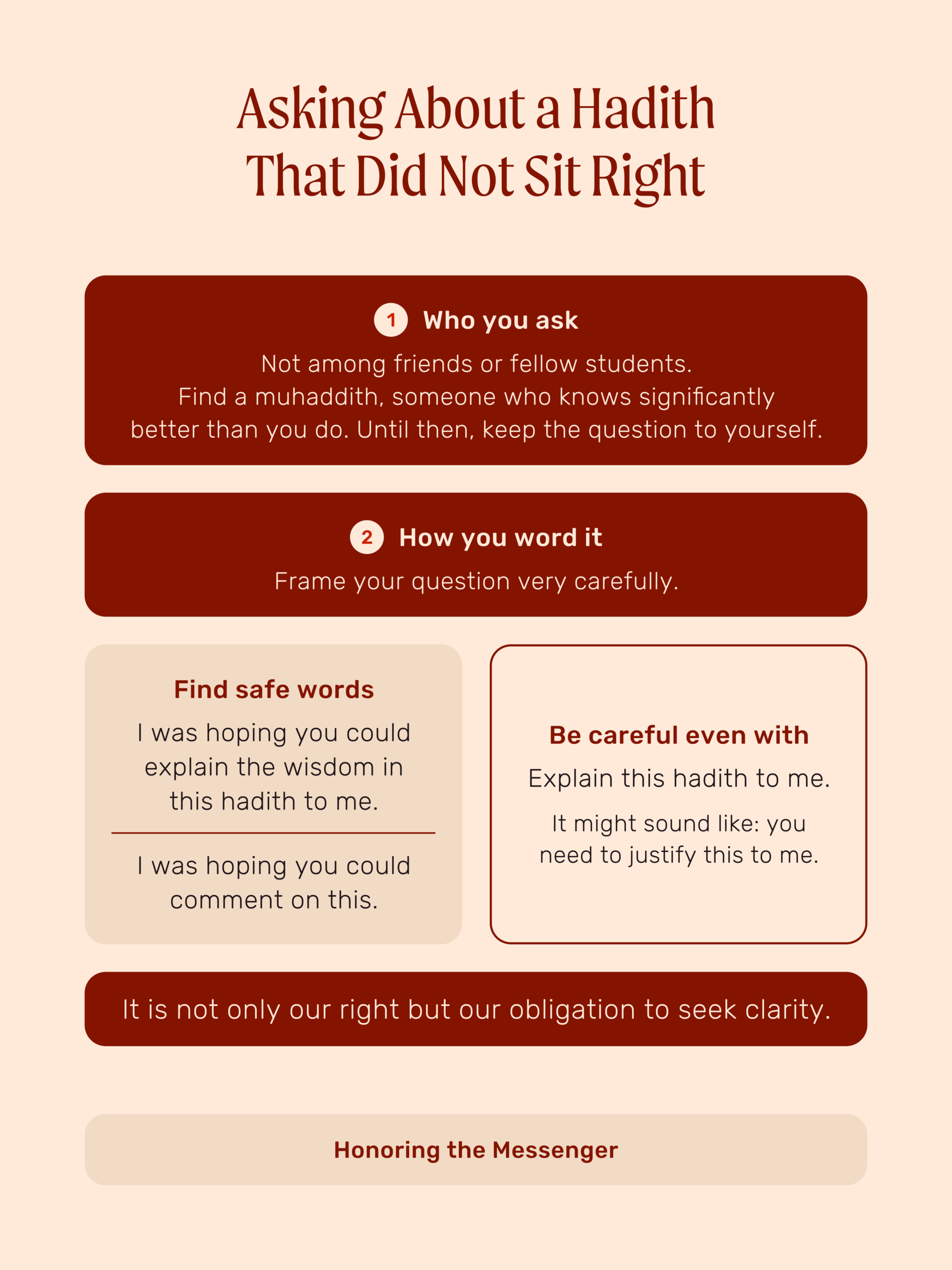
Find safe words to talk about the ahadith of the Messenger ﷺ.
You do not have to take this approach for any other study. But we are talking about some highly sensitive material here. Handle with extreme caution. That is what we are talking about.
So on the one hand, seeking clarity is critical. It is not only our right but our obligation to seek clarity. That is part of being true to the Messenger ﷺ.
But the way in which we do it should not be the casual approach we take with anything else.
Do Not Call On Him the Way You Call On Anybody Else
That is my walk-away lesson from this ayah. Do not make your calling on the Messenger ﷺ among yourselves like your calling on one another.2
Do not call on him like you call anybody else.
Which implies, also, do not talk about him like you talk about anything else.
Do not question him like you question anything else.
Do not inquire about him like you inquire about anything else.
Do not criticize like you criticize anything else.
What If Somebody Tells You the Hadith Is Weak
Somebody says, this hadith is weak. What about that?
I do not know enough to say that the Prophet ﷺ absolutely did not say this. I know enough to say he may have said it, but we are not sure.
Does that leave the possibility that it could be his word?
So instead of criticizing that hadith, somebody says, it is weak. Sure. I do not know. Just walk away.
If it is from him, I need to be quiet. If I ended up saying something that was not supposed to have been said, I am going to be in big trouble.
I am not saying you follow it. I am not saying you apply it. But at least still respect it, because there is a possibility that it is attributed to Rasulullah ﷺ. So long as that possibility is there, our respect has to stand.
See, this is more about attitude than anything else.
Two Limbs That Are Just Really Out of Control
So now. Do not raise your voice. Do not call on him in that way.
Those who have learned to lower their voice in the presence of the Messenger of Allah ﷺ, around the Messenger of Allah ﷺ. By extension, in the company of his teaching, because we are not in his gathering, but we are in the presence of his teaching.
Those, Allah says, are the ones whose hearts He has tested for taqwa. For them is forgiveness and a huge compensation.3
That is taqwa.
Taqwa by definition means caution. Precaution. So that is real caution. That is really learning to be cautionary.
You see, of all the limbs of our body, there are two limbs that are just really out of control. Eyes and tongue. They are just really out of control.
We do not even realize what we say. We just say it. It just comes out.
We do not even realize what we are looking at. We just look at it.
So that is taqwa, when you can control your tongue. When the answer came into your head, when a rebuttal came into your head and you just held back.
Those are the people Allah says have been tested for taqwa.
They Should Have Stood at the Door and Waited
Then there were these Bedouins who came and called out to the Prophet ﷺ loudly. Allah says, watch it. Watch how you talk to him. If you address him even a little bit out of line, what is the consequence? All of your good deeds will be taken away. All your goodness will be gone and you will not even realize it.
Now, these may have been people who fought at Badr.
These may have been people who were by the Prophet’s ﷺ side in some pretty heavy duty things and none of that counts anymore. Because they just got out of line and called out, Muhammad ﷺ.
That is serious business.
So then Allah says, in their defense, those who are calling you from behind the chambers, most of them do not even realize. They do not understand how heavy this is.4
Had they patiently waited until you came out to them, it would have been better for them.5
Now Allah is teaching them manners. Do not go there and call him. Stand there and do not even call him. Wait for him to come out. Because you are afraid you might inconvenience him.
Would he ﷺ have ever turned anybody away? If somebody knocked on his door, would he say, just wait, come back later?
No. He would never.
His expectations are different. So whose expectations are being revealed here? Allah is saying, if you wanted to ask something of the Prophet ﷺ, here is what I expected you to do. Go outside his door and stand there until he shows up.
That would have been better for them.
This is Allah teaching us His expectations.
How much respect do you have to have for someone that when you go to respectfully ask them a question, you stand outside and you do not even ring the bell?
I did not want to disturb you.
If and When They Ask You About Me
Your closeness to Allah depends on how much you learn from the Messenger ﷺ. That is actually in an ayah.
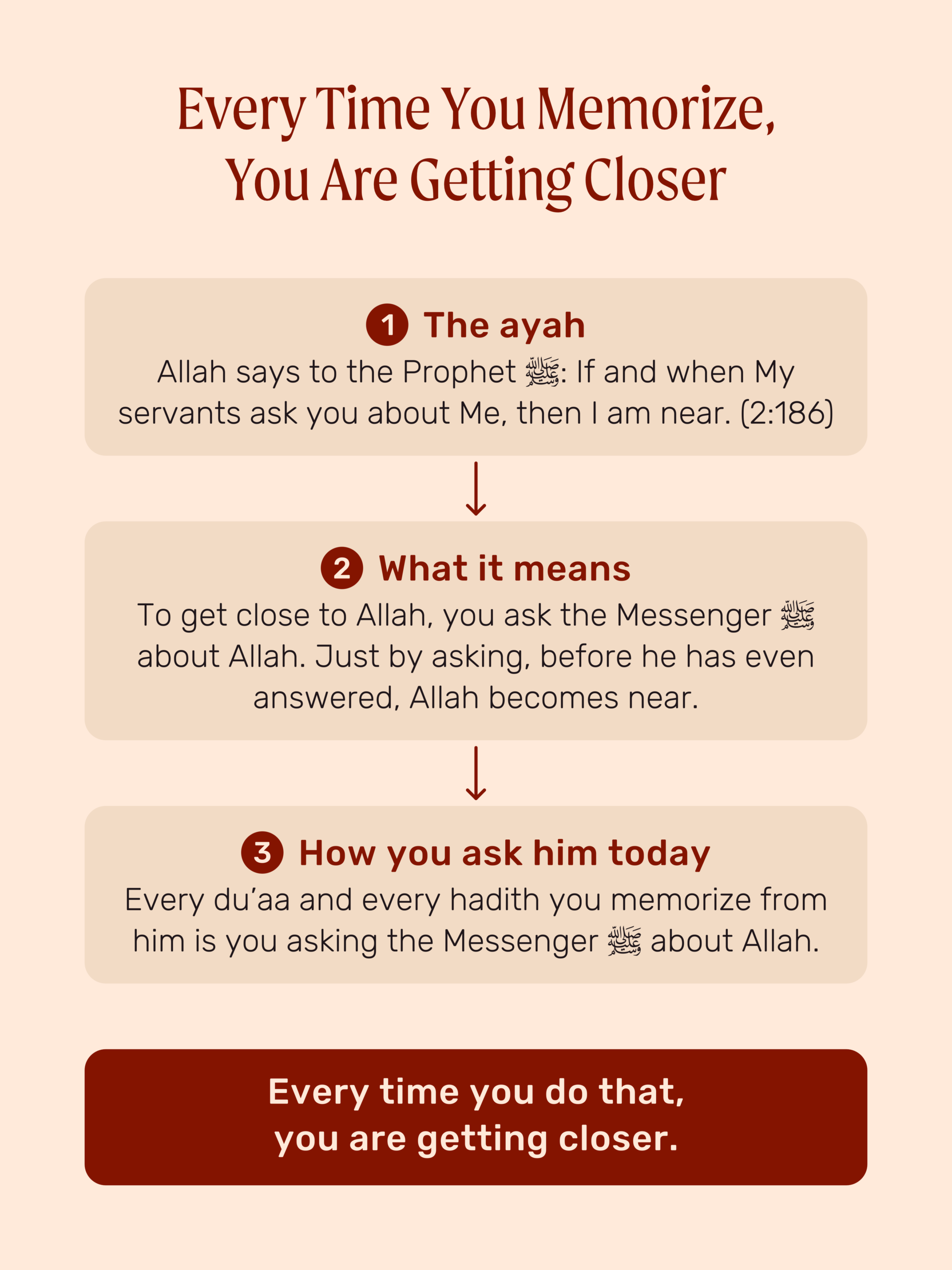
Listen. If and when My servants ask you about Me, then I am near.6
So Allah is near when we ask who?
It is a conditional. That is part of the meaning of the ayah.
To get the closeness of Allah, to feel the closeness of Allah, you turn to the Messenger ﷺ and you ask him about Allah.
That is one of the essences of that ayah. How are you going to get close to Allah while you are far from His Messenger ﷺ?
But what does it mean to go and ask the Messenger ﷺ about Allah? Tell me, how do you get close to Allah? Who is closer to Allah than you? Even physically, nobody has ever been closer to Allah than him. Jibreel (AS) has not been closer to Allah than him.
If I want to learn about how to get close to Allah, there is no creation in existence I should be asking other than him ﷺ.
So Allah says, when they ask you about Me, then I am near. Allah loves the one who comes to the Messenger ﷺ to ask so much that just by the act of asking, before he has even answered, Allah becomes near to that person.
You memorized the du’aa for going into the house. You memorized the du’aa for coming out of the house. That is how Allah taught us to be near to Allah.
Every single time you memorize one of those du’aas, you are asking the Messenger ﷺ about Allah. That is what you are doing.
Every time you memorize a hadith, you are asking the Messenger ﷺ about Allah. That is what you are doing.
Every time you are doing that, you are getting closer.
This is the nature of the relationship we are supposed to have with him.
I Would Have Crossed That Line a Hundred Times
So this is the conclusion of what I wanted to share with you about our relationship with our Messenger ﷺ. How high we are supposed to hold it. How sensitive we are supposed to be in this particular matter.
I thought this was one of the most important things I ever learned.
Because if I had not learned it, I do not think I would have. I would probably have crossed that line a hundred times without realizing it. We are just in the times where we cross lines without realizing them. That is just the time we live in.
So this is something that has to be spread. This sensitivity about Rasulullah ﷺ has to be spread. It has to be maintained.
This session sits late in the course and the ones before it build the case it rests on. Study Honoring the Messenger with Ustadh Nouman Ali Khan on Bayyinah TV: Bayyinah TV
Notes
This post is adapted from session eighteen of Honoring the Messenger on Bayyinah TV and is written in the voice of that session. Every teaching claim, example and aside in it is taken from the session itself.
[1] Al-Quran, Surah Al-Hujurat, 49:2, https://quran.com/49/2
[2] Al-Quran, Surah An-Nur, 24:63, https://quran.com/24/63
[3] Al-Quran, Surah Al-Hujurat, 49:3, https://quran.com/49/3
[4] Al-Quran, Surah Al-Hujurat, 49:4, https://quran.com/49/4
[5] Al-Quran, Surah Al-Hujurat, 49:5, https://quran.com/49/5
[6] Al-Quran, Surah Al-Baqarah, 2:186, https://quran.com/2/186

At Bayyinah, we are dedicated to helping you connect directly with the words of Allah beyond translation. Founded by Ustadh Nouman Ali Khan, our mission is to create transformative experiences that deepen your understanding and engagement with the Quran.
Study the Quran and Arabic in a systematic and personalized way through Bayyinah TV. Get started today for free.
Check out our newest articles, fresh off the press and ready for you to dive into!