
Successful subscription! Thank you for subscribing.
Successful subscription! Thank you for subscribing.

November 2, 2026
The flyer just said one word. Shame.
I kept the title ambiguous on purpose, because explaining my intentions in a title would have been too difficult. Which leaves you with a fair question. What am I going to talk about for seven hours? How much can anybody say about shame for seven hours?
The word in Arabic for bashfulness or shyness is haya. In the Quran it is used only very, very rarely. Its opposite is the bigger subject. Al-fahsha. Shamelessness, lewdness, indecency.
The Mother Passage
The first passage I am going to share with you is, I feel, the gold standard passage. If you understand this passage, you understand what Allah has to say about shame and shamelessness in the Quran.
This is Surah Al-A’raf. Surah number seven. A Makki surah. An early Makki surah and one of the biggest Makki surahs of the entire Quran.
I am going to start at ayah ten. The story of humanity begins with Adam (AS).
So we are going to start with the story of Adam, because in my opinion that is the best place to learn about shame. It is the best place. This is the mother passage. This is the central passage on the subject of al-fahsha and on the subject of al-haya. Everything else comes underneath it.
You Were Not Put on This Earth as a Punishment
Allah says: We settled you down on the earth. We gave you good housing on the earth.1 Makkana means to give good housing.
We do not believe what people of other religions believe, that we are on this earth as a punishment. Do not think that Muslims believe that. We were put on this earth and that is a gift from Allah, not a punishment. Allah Himself says, We settled you on the earth.
Then: especially for you, We put all kinds of ma’ayish. That is from ma’isha, which means a life that is well lived. Al-‘aish is a good life. Allah says We put means of a good life for you here. You are supposed to have a good life here.
That is the other misconception, by the way. Islam has so many rules, it does not want you to live a good life, a fun life, it does not want you to enjoy yourself.
The same word is used to describe the life of paradise. Allah says there is a glimpse of that even in this world. There are glimpses of ma’ayish, means of living really, really well on this earth, enjoying yourselves.
Now, before I go further, where does enjoyment come from? Because this is directly related to our topic.
Enjoyment comes when you get what you desire. It is very simple. You have a craving, you fulfill that craving and that is what enjoyment is.
I am really craving to play some basketball. I got to play. I enjoyed myself. I am craving playing a video game. I play it. I enjoy myself. I am craving some chocolate ice cream. I have it. I enjoy myself.
Cravings, when they are fulfilled, that is when enjoyment happens. Enjoyment does not happen outside of that. That is what enjoyment is.
So here is the turn. Our temptations are also a craving. The attraction a man has toward a woman is also a craving. Allah says, on this earth I gave you the means by which you can enjoy yourself. You can even fulfill that craving. That is even covered already.
Then the line at the end of it: how little you are grateful.
Very simple ayah.
Then a brief transition before we get to the heavy subject. We created you.2 We are the ones who created you. We are the ones who molded you.
Which means: I know what you like, because I made you. I know how I fashioned you. I know the things I put inside of you. I know every one of your body parts, I know every one of your cravings and I know every one of your temptations.
Then, after creating your physical body, He mentions something else. He says, We said to the angels, make sajdah to Adam. All of them did, with the exception of Iblis.
Notice the wording. He was not going to be from those who made sajdah. Not that he did not do it. He was never going to do it. Allah knew all along that he was not going to do it.
His Disbelief Was His Disobedience
So Allah says, what possibly prevented you from making sajdah when I told you, when I commanded you?3
He says: I am better than him. You made me from fire and You made him from clay.
You know the story. That is not the focus today, but it is important to build this conversation.
A kafir does not believe that Allah made him. A kafir does not believe that Allah is Khaliq.
These are the words of Iblis and Iblis says, You made me. He is not somebody who fails to believe in Allah. He is talking to Allah and he is acknowledging that Allah is his creator.
So his kufr is not that he does not believe Allah exists. His disbelief is actually his disobedience.
I will say that three times. His disbelief is his disobedience. His disbelief is his disobedience. His disbelief is his disobedience.
Why am I saying it three times?
Because there are people in the audience who disobey Allah and then say, it is not that bad. At least I still believe. At least I am still. It is not like I am a kafir. I do some stuff, I know it is messed up, but it is not like I am a disbeliever.
His disbelief was his disobedience.
Shaytan does not need to get you to disbelieve. You can keep calling Allah your creator. All Shaytan has to do is get you to what? Disobey. All he needs is to get you to disobey. You have to understand that.
If you keep telling yourself, at the end of it, at least I still believe in Allah, that should be good enough for me, then Shaytan believed in Allah too. He did exactly that.
That is why I am repeating it three times. You got that point? That is really important for this conversation.
Somebody Behind the Door With a Baseball Bat
Then he says it out loud. I will sit waiting for them.4
Qa’ada lahu in Arabic means to sit somewhere and wait. To ambush somebody means to sit somewhere and with the lam it means to wait. You are waiting to ambush somebody.
Imagine outside the door. One of you guys is behind the door of the masjid with a baseball bat, waiting for your friend to come out.
Not with a baseball bat. Maybe flowers or something, I do not know.
But the idea is that you hide, you wait for somebody to show up, then you attack them.
Somebody who is waiting in ambush, is he exposing himself or not? He is not exposing himself. Does he attack all the time, or at the right moment? He waits for the right moment, then he attacks.
That is what is captured inside the word. I will be on the straight path, but I will not come out all the time. I will find the right moment, then I will slip something in and slip out before they can even realize I was there and that I said something to them.
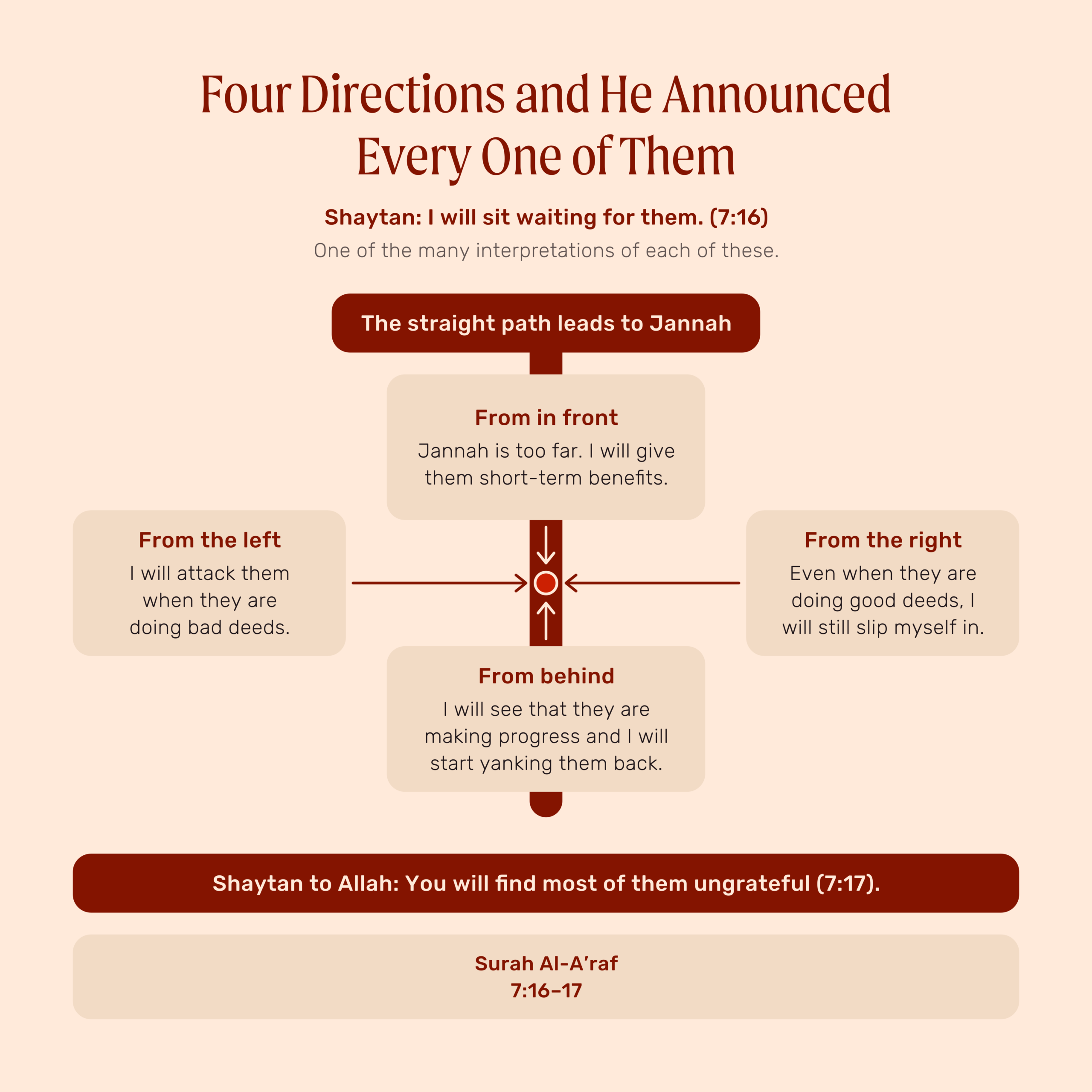
Four Directions and He Announced Every One of Them
Then I will come at them from right in front of them.5
What is right in front of us? The straight path. The straight path leads to Jannah. So I will come at them and say, do not go here. Do not go to Jannah. Jannah is too far, man. I gave you something right now. Why do you have to work for Jannah? I will give them short-term benefits.
I am giving you one of the many interpretations of each of these, by the way.
I will come at them from behind them. Pulling them. Somebody who is attacking you from behind wants you to stop. You are making progress and they want you to stop and they want you to head back. This expression is used in the Quran. You are going to turn back on your heels. You are going to reverse. You were making progress toward Allah and you start reversing. I will see that they are making progress and I will start yanking them back.
I will come at them from their right and from their left. This has been interpreted in many ways. Their right means they will be among good company and I will still come to them. They will be in bad company and I will still come to them.
Your yameen, your right side, is associated with good deeds. The left side is associated with bad deeds. So from their right, even when they are doing good deeds, I will still slip myself in.
Even when you are reading Quran, I will slip myself in.
That is why Allah says, when you are reading Quran, seek refuge in Allah from Shaytan.6 Why? You are doing a good deed. What does Shaytan have to do with a good deed?
No. I will come at them when they are doing good deeds. I will attack them when they are doing bad deeds. I will not stop. I will find the opportunity and then You will see.
You will find most of them are ungrateful. You are not going to find most of them grateful at all.
In other words, when they disobey You, when they obey me, that means they are not grateful to You.
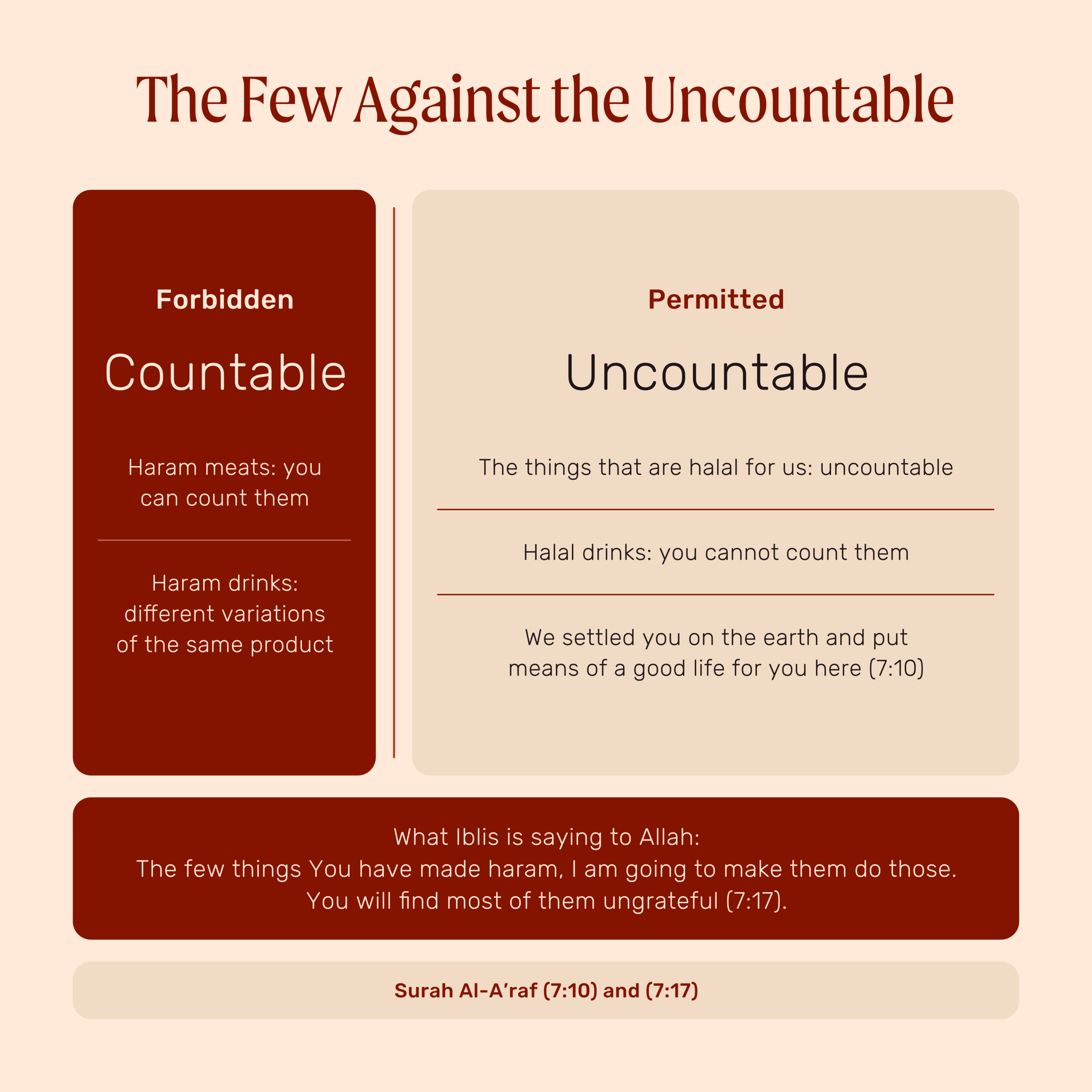
Count the Haram. Now Count the Halal.
Where did this passage begin?
Allah said, We put you on the earth and We gave you lots of means to live well. Remember that? Look at how the continuation of the speech is going here. Allah is teaching us something.
Allah asked us for a few things that we should not do. There are a few things we are not supposed to do. Most of what is on this earth is halal for us.
How many meats are haram for us? You can count them. Now compare that to the things that are halal for us. Uncountable.
How many drinks are haram for us? Basically different variations of the same product. How many kinds of drinks are halal for us? You cannot count them. That is an uncountable amount.
So the comparison between what Allah opened up for us to enjoy and the things Allah said stay away from these, there is no comparison.
You still go after the few things He told you not to do. Then you are ungrateful.
That is exactly what Iblis is saying. Look, the entire world You have opened for them and made halal for them. But the few things You have made haram, I am going to make them do those and You will see. They are not grateful. They do not appreciate all the things You did give them. They only want to go for the things that are forbidden to them.
Whoever Follows You Among Them
Get out of here. You are guilty. You are humiliated. You are being cast away, pushed out, kicked out.7
Then the wording. Whoever follows you among them.
Whoever follows you among them.
Read it again and notice what Allah does not say. Allah does not say whoever disbelieves in Me. That is not the condition. The only condition Allah put here is whoever listens to you. Whoever pays attention to you.
Whoever follows Shaytan among them.
Is it possible a Muslim will listen to Shaytan?
This is the first of eleven sessions and the rest work through the subject the same way. Study Shame with Ustadh Nouman Ali Khan on Bayyinah TV: Bayyinah TV
Notes
This post is adapted from session one of Shame on Bayyinah TV and is written in the voice of that session. Every teaching claim, example and aside in it is taken from the session itself.
[1] Al-Quran, Surah Al-A’raf, 7:10, https://quran.com/7/10
[2] Al-Quran, Surah Al-A’raf, 7:11, https://quran.com/7/11
[3] Al-Quran, Surah Al-A’raf, 7:12, https://quran.com/7/12
[4] Al-Quran, Surah Al-A’raf, 7:16, https://quran.com/7/16
[5] Al-Quran, Surah Al-A’raf, 7:17, https://quran.com/7/17
[6] Al-Quran, Surah An-Nahl, 16:98, https://quran.com/16/98
[7] Al-Quran, Surah Al-A’raf, 7:18, https://quran.com/7/18

At Bayyinah, we are dedicated to helping you connect directly with the words of Allah beyond translation. Founded by Ustadh Nouman Ali Khan, our mission is to create transformative experiences that deepen your understanding and engagement with the Quran.
Study the Quran and Arabic in a systematic and personalized way through Bayyinah TV. Get started today for free.
Check out our newest articles, fresh off the press and ready for you to dive into!