
Successful subscription! Thank you for subscribing.
Successful subscription! Thank you for subscribing.

November 5, 2026
The first thing that the slave will be asked for on the Day of Judgment is his prayer.
These were the last words of the Prophet ﷺ when he was on his deathbed.
What is salah linguistically and what does it mean in the deen of Islam?
Salah Means to Send Peace and Blessings
Linguistically, salah means to send peace and blessings and mercy.
We see this in the words of Allah when He says that Allah and His angels send peace upon the Prophet ﷺ and then He turns to the believers and tells them to ask Allah to send peace upon him and to ask Him to send peace and blessings in abundance.1
You already do this. Every time you say the name of the Prophet and follow it with sallallahu alaihi wasallam, that is what you are doing. You say his name and then you ask Allah to send peace and blessings upon him.
The Prayer Starts With Allahu Akbar and Ends With Salam
Islamically, the prayer is an action that begins with the statement of Allahu Akbar.
It is concluded by saying assalamu alaykum wa rahmatullah, assalamu alaykum wa rahmatullah.
Between those two, there are specified actions and specified statements.
Now that we have the meaning of the salah, linguistically and technically, let us talk about the salah with meaning. What is the meaning behind it? What is the goal, or the goals, behind it?
It Is the Second Pillar and That Placement Is Telling You Something
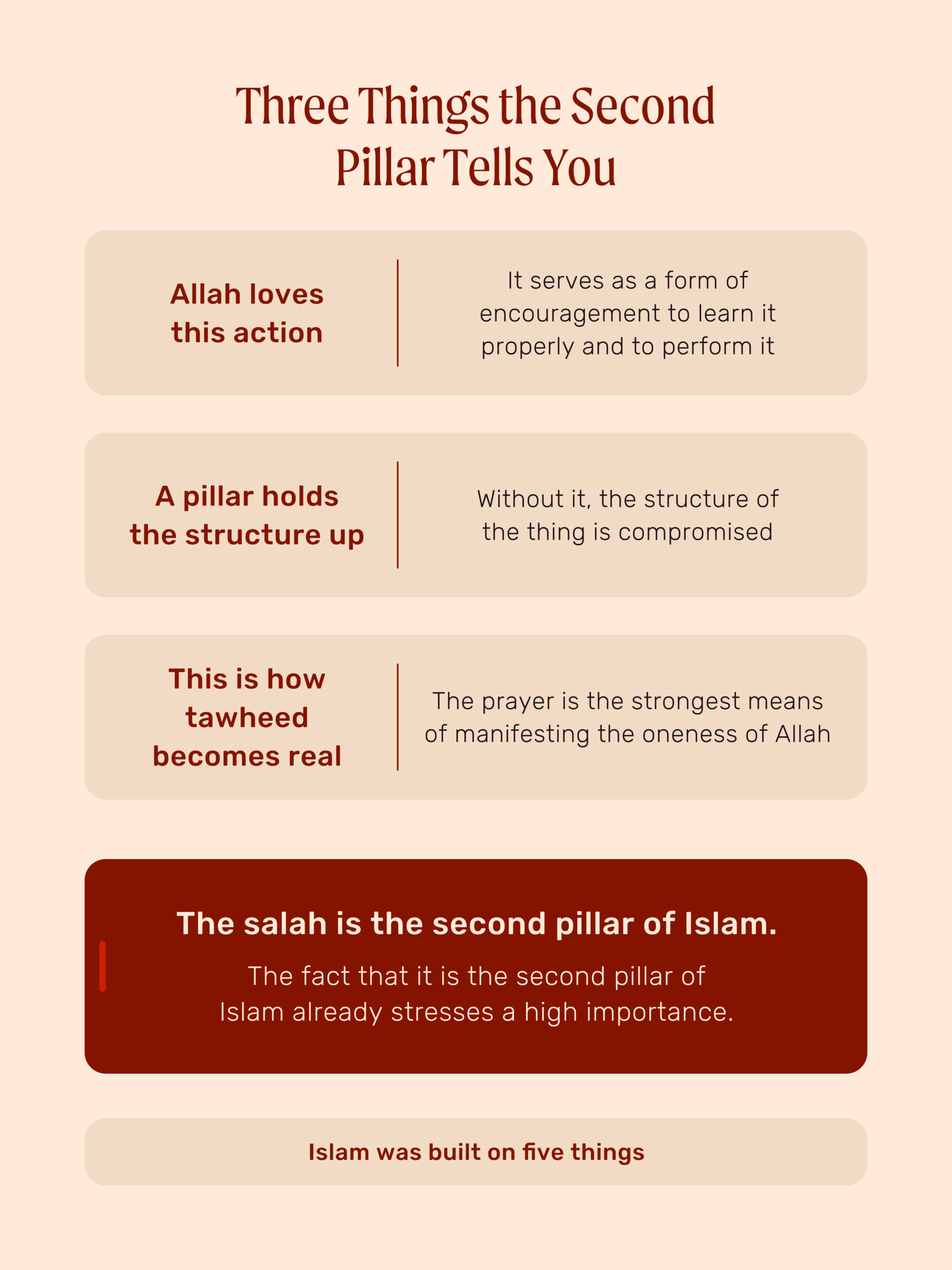
The first thing we should understand is that the salah is the second pillar of Islam.
The fact that it is the second pillar of Islam already stresses a high importance. I want to touch on three things we can gather from that.
The First Thing: Allah Loves This Action
Allah the Exalted loves this action. He loves this action.
Why is it important for you to know that? Because it serves as a form of encouragement. It should make you want to learn more about the salah and what is said inside it.
Think about how many times somebody comes to you and says, I prayed, but I am not feeling anything.
In times of hardship, when you may not taste the sweetness of faith, when you may not taste the sweetness in your own salah, it is very important for you to remember something. Remember the greatness of Allah. Remember His names and His attributes. Remember what He is capable and able of doing, which is all things. Then remember that this same Allah has ordered you to do this pillar, the second pillar of Islam.
Understand that He loves this.
That should encourage you to want to learn it properly and to want to perform it, so that you receive His blessings.
The Second Thing: A Pillar Is What Holds the Structure Up
When we see that this is a pillar of Islam, we should always go back and look at what a pillar actually is.
A pillar is something that, without it, the structure of the thing is compromised.
So take a person who believes in Allah and in the last messenger and in all of the messengers. If they do not pray, then the basis of their faith, the basis of their implementation of that faith, is compromised.
The Prophet ﷺ said that Islam was built on five things. One of them is the prayer.
The Third Thing: This Is How Tawheed Becomes Real
When we see the prayer, the person standing there praying to Allah, we are looking at the strongest means of manifesting and actualizing and implementing that feeling in the heart of the oneness of Allah.
Those of you who have come back to the religion, who voluntarily tried to come to Allah, those of you who have converted or reverted to Islam, know this already. The strongest form of showing your devotion and your love to Allah is the prayer.
It is also the strongest means of purification. Purification of the heart. Purification of the mind and the soul.
When we stop what we are doing and we pray to the Creator of the heavens and the earth, remembering His actions upon us, we are showing that tawheed in our lives.
Establish the Prayer and It Relinquishes You From Evil Deeds
Allah says to the Prophet ﷺ in the Quran:
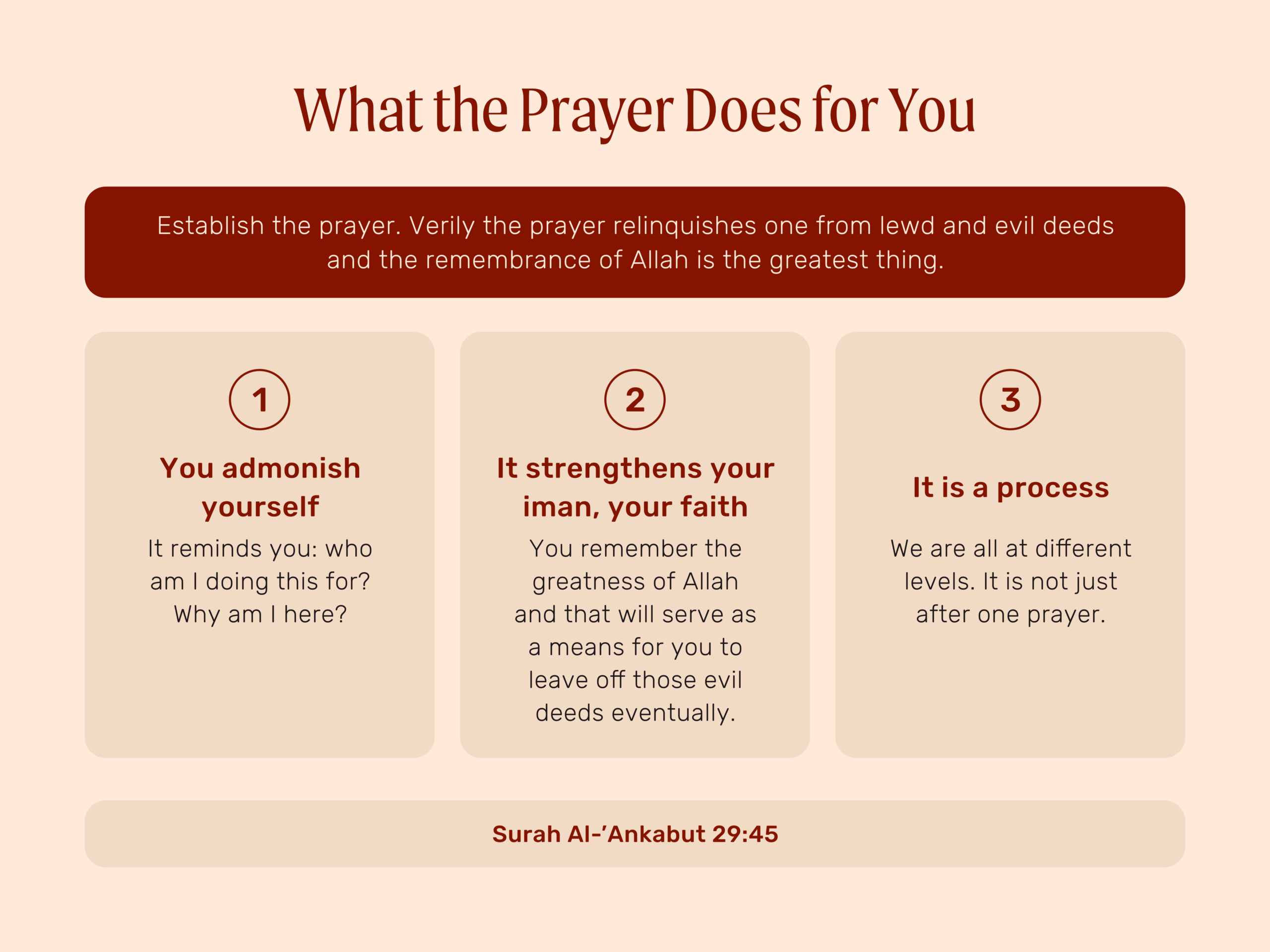
Recite what has been revealed to you from the Book and establish the prayer. Verily the prayer relinquishes one from lewd and evil deeds and the remembrance of Allah is the greatest thing and Allah is well aware of what you do.2
Allah orders the Prophet ﷺ to recite and to establish the prayer, from what has been revealed to him. From the Kitab, which is the Quran that we read.
Then the purpose is given plainly. The prayer relinquishes the evil and the bad deeds. That is purification.
From this we can derive a few benefits about the prayer and about what the prayer means.
The Prayer Is You Admonishing Yourself
The first benefit is that when we pray, it serves as a personal admonishment of ourselves.
When you think of the names of Allah, when you say SubhanAllah, when you say Allahu Akbar, Allah is the greatest, you are thinking about His actions upon you. You are thinking about what has happened in your life.
That in return reminds you: who am I doing this for? Why am I here? What is the purpose of this prayer?
It reminds you of His greatness. Which in return makes you a better individual, wholeheartedly, in general.
It Strengthens Your Iman and the Iman Does the Rest
The second benefit is that it increases and boosts and strengthens your iman.
Your faith. Your security with your belief, which is what iman means. The prayer strengthens that.
When it strengthens your iman, you remember the greatness of Allah and that will serve as a means for you to leave off those evil deeds eventually.
That is the relinquishment of the evil deeds. You will eventually leave them, when you are constantly thinking about what Allah has done for you in this life.
You Are Not Going to Get There in One Prayer
The third benefit is that you have to remember we are all at different levels.
Life is a process. Trying to get better is a process. It is not just after one prayer or after Salat al-Eid or after the Jumu’ah salat we offer on Fridays. It is a process.
There will be days where you may not be in it.
The more you try, the more you concentrate, the more you think about Allah and His bounties, the more this serves as a means for your evil deeds to be relinquished and for you to be spiritually purified. Spiritually renovated. Spiritually sound.
Islam Is Surrender and Surrender Is the Means to Peace
We see from this, brothers and sisters, that this prayer is something magnificent.
It is the means of patience. It is the means of patience and peace.
Many people say that Islam means peace. Rather, I want to say that Islam is submission and surrender to the Creator of the heavens and the earth, for the sake of peace and salvation.
Once a person submits and surrenders to the Creator by himself, that is the means to obtain peace.
Without a doubt, that is the salah. Consistently trying to offer this prayer is what will make you peaceful.
Seek Help in Patience and Prayer
Allah says in the Quran:
Seek help in patience and prayer. Verily it is heavy, except upon the khashi’in, the ones who have mindfulness of Allah.3
So understand that this prayer, once you consistently offer it, is a means to purification.
Five Times a Day for the Rest of Your Life
Think about it. Five times a day, for the rest of your life. Five times a day, spread across the span of the day.
How will that make you as an individual?
What happens to a person who is constantly thinking about their Creator? Thinking about His actions upon them. How you were blessed with a child. How someone passed away and it became a reminder to you about life, how death reminds you of life. All of these ayat in the Quran, all of this thinking about the greatness of Allah.
It reminds you of Allah. In return, you want to please Him, based on His greatness and His bounty.
My Du’aa for You
We ask Allah to make us firm in establishing these five prayers.
We ask Him to make us of those who are attentive to His names and His attributes in every aspect of our life.
We ask Allah to make us attentive in everything that we do, so that we turn back to Him, especially in the times of need.
This is the opening session and five more follow in the course. Study How to Pray on Bayyinah TV: Bayyinah TV
Notes
This post is adapted from the opening session of How to Pray (Story of Prayer) on Bayyinah TV and is written in the voice of that session. Every teaching claim, example and aside in it is taken from the session itself. The session gives its own renderings of the ayat rather than reading a published translation and it does not state ayah numbers aloud; the references below locate the ayat it quotes.
[1] Quran, 33:56, https://quran.com/33/56 ↩
[2] Quran, 29:45, https://quran.com/29/45 ↩
[3] Quran, 2:45, https://quran.com/2/45 ↩

At Bayyinah, we are dedicated to helping you connect directly with the words of Allah beyond translation. Founded by Ustadh Nouman Ali Khan, our mission is to create transformative experiences that deepen your understanding and engagement with the Quran.
Study the Quran and Arabic in a systematic and personalized way through Bayyinah TV. Get started today for free.
Check out our newest articles, fresh off the press and ready for you to dive into!