
Successful subscription! Thank you for subscribing.
Successful subscription! Thank you for subscribing.

July 29, 2026
Surah Al-Mumtahanah is sometimes read as a blanket command to keep every non-Muslim at arm’s length. Read whole, the surah says something far more careful. It distinguishes sharply between those actively fighting your faith and those who are simply not Muslim and it commands kindness and justice toward the latter. This post follows that balance: the verse that draws the line, the example that models it and the pledge the surah builds toward.
Two Kinds of People
The surah’s most important move is a distinction. It does not lump all non-believers into one category. On one side are those who fought you over your religion and drove you from your homes; allying with them is forbidden (60:9)1. On the other side is everyone else and about them the surah is explicit (60:8)2.
لَّا يَنْهَىٰكُمُ ٱللَّهُ عَنِ ٱلَّذِينَ لَمْ يُقَٰتِلُوكُمْ فِى ٱلدِّينِ أَن تَبَرُّوهُمْ وَتُقْسِطُوٓا۟ إِلَيْهِمْ
“Allah does not forbid you, regarding those who did not fight you over religion, from being kind to them and acting justly toward them.”
(60:8)
The verse even adds that Allah loves those who act justly. So the surah’s caution about loyalty is aimed precisely at hostility, not at difference of faith. Toward peaceful neighbours, colleagues and relatives who happen not to share our religion, the standard is birr and qist, active kindness and scrupulous justice. The line is drawn around aggression, not around belief.

Kindness and Justice, Not Coldness
This matters because the surah is easy to weaponize when one verse is pulled from it and the next is ignored, which is exactly the danger of reading verses outside the whole chapter. Taken together, 60:8 and 60:9 are a complete, balanced teaching: do not give your allegiance to those waging war on your faith and do treat everyone else with kindness and fairness. Disassociation, in this surah, is from a cause of hostility, not from human beings as such. A believer can hold firm convictions and still be the most just and gracious person in the room.
Ibrahim’s Balance
This is the very balance the surah finds in Ibrahim (AS), held up as an excellent example (60:4)3. He disassociated openly from his people’s false worship, he would not pretend to endorse what he knew to be untrue and yet he kept praying for his father and longing for his people’s good. He shows that rejecting a false idea and mistreating a person are two entirely different things. You can refuse to bless what is wrong while still wishing well and doing good, to the one who holds it.
A Pledge Worth Making
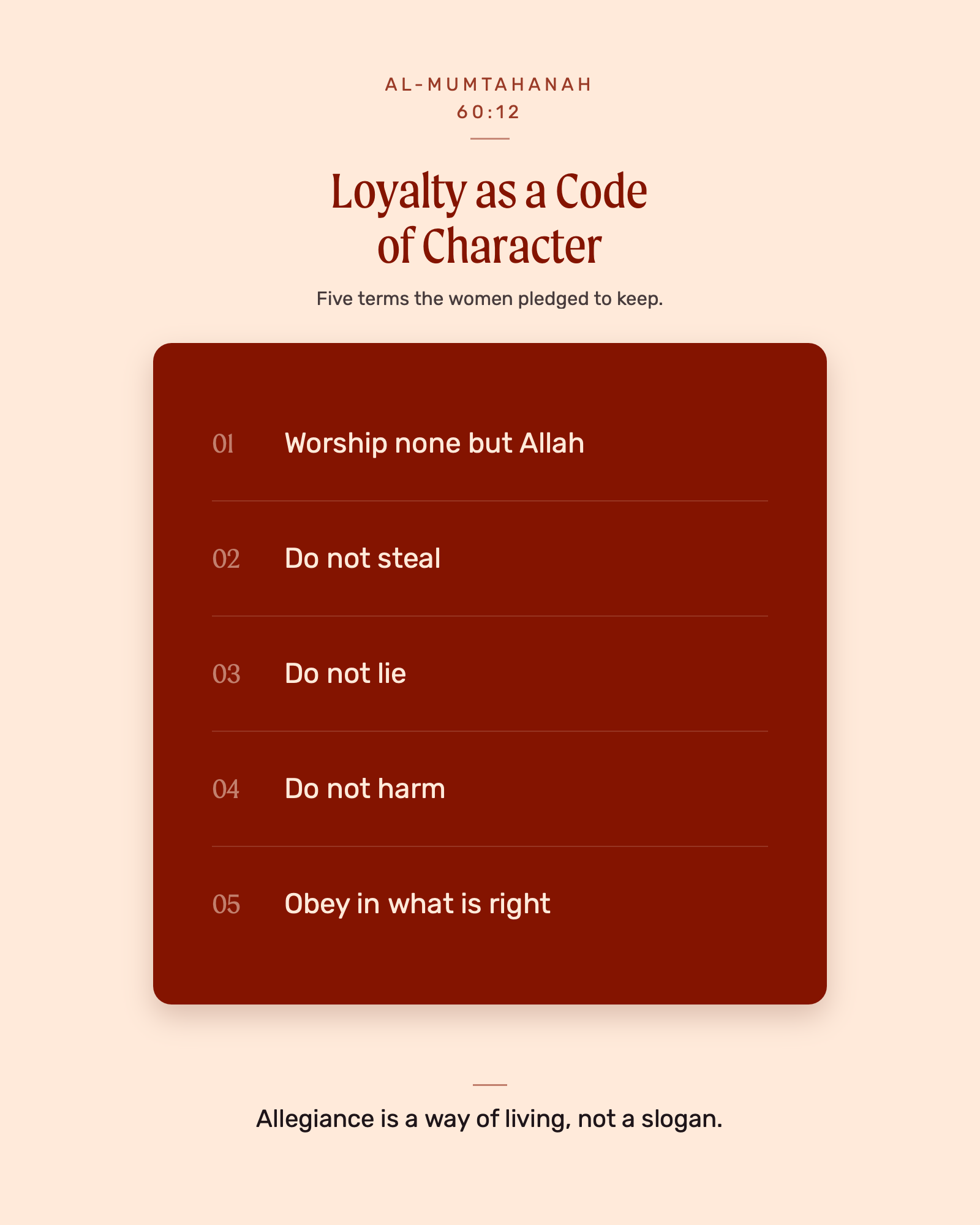
Near its close, the surah describes the pledge of allegiance taken from believing women (60:12)4.
يُبَايِعْنَكَ عَلَىٰٓ أَن لَّا يُشْرِكْنَ بِٱللَّهِ شَيْـًٔا
“They pledge to you that they will not associate anything with Allah.”
(60:12)
The pledge then lists a code of character: not to steal, not to lie, not to harm, to obey in what is right. This is what loyalty to Allah actually looks like in practice, not slogans about who to shun, but a commitment to a way of living. The surah that began by untangling a sincere believer’s confused loyalty ends by spelling out, concretely, the allegiance it has been calling for all along: a covenant of belief and good conduct, open to anyone willing to make it.
The Takeaway
Surah Al-Mumtahanah corrects a misreading before it can take hold. Its caution is about loyalty to those at war with faith, not about kindness to people who differ from us, whom it commands us to treat with justice and goodness. Its model is Ibrahim (AS), who rejected falsehood without abandoning mercy and its destination is a pledge of upright character. Read whole, the surah is not a charter for hostility. It is a lesson in how to hold deep conviction and open-hearted justice at the same time.
There is far more to Surah Al-Mumtahanah than a single article can hold. You can explore the full Al-Mumtahanah: A Deeper Look series on Bayyinah TV, alongside the other surahs being opened up in the Deeper Look collection.
Related reading: Where Your Loyalty Lies: An Introduction to Surah Al-Mumtahanah (the companion post in this series).
Notes
[1] Quran, 60:9, https://quran.com/60/9 ↩
[2] Quran, 60:8, https://quran.com/60/8 ↩
[3] Quran, 60:4, https://quran.com/60/4 ↩
[4] Quran, 60:12, https://quran.com/60/12 ↩

At Bayyinah, we are dedicated to helping you connect directly with the words of Allah beyond translation. Founded by Ustadh Nouman Ali Khan, our mission is to create transformative experiences that deepen your understanding and engagement with the Quran.
Study the Quran and Arabic in a systematic and personalized way through Bayyinah TV. Get started today for free.
Check out our newest articles, fresh off the press and ready for you to dive into!