
Successful subscription! Thank you for subscribing.
Successful subscription! Thank you for subscribing.

July 29, 2026
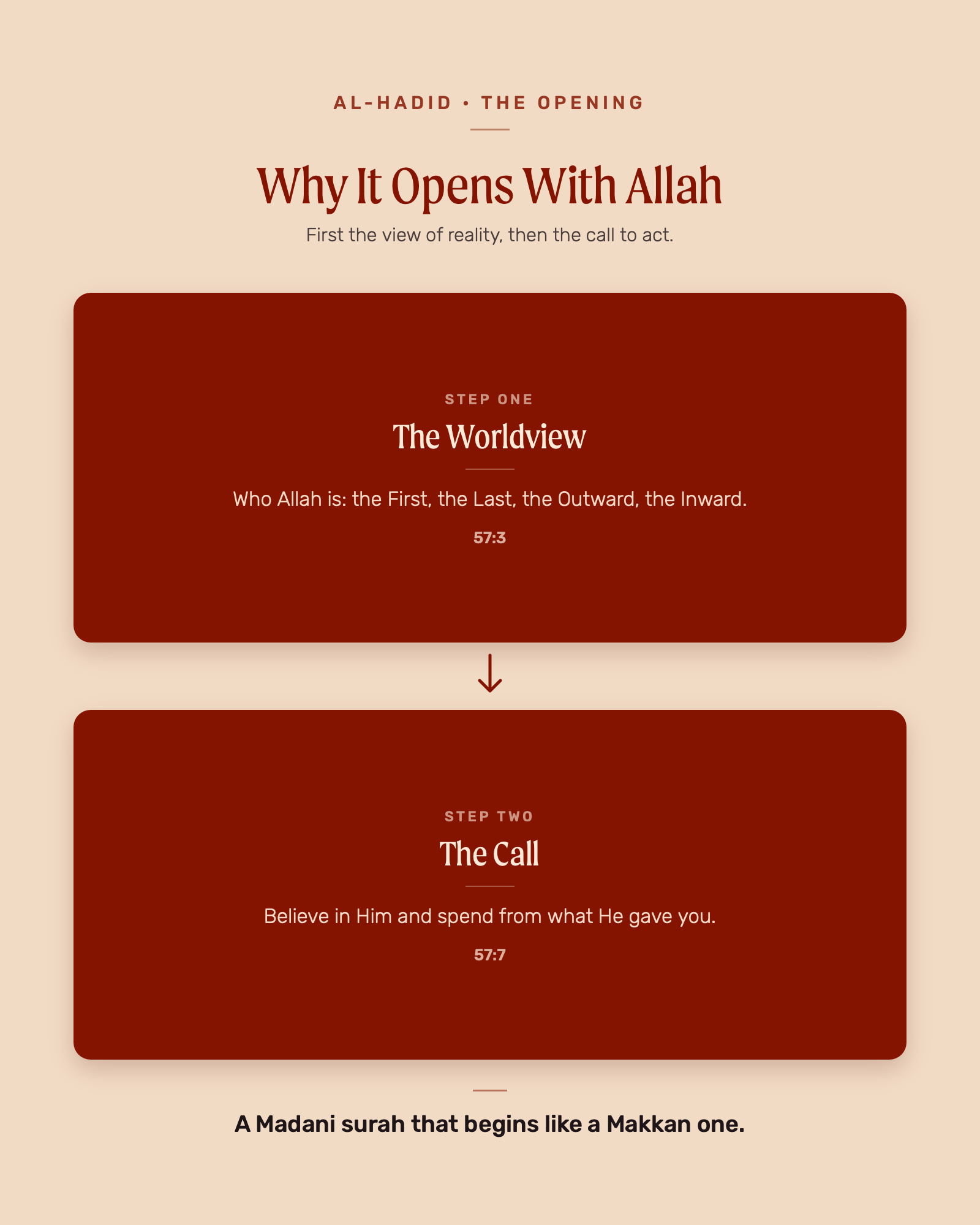
Surah Al-Hadid is a Madani surah, revealed in a community already building a society, yet it opens in a way that sounds Makkan: six verses devoted entirely to who Allah is. That choice is deliberate and it tells us how the surah wants to be read. Before it makes any demand of us, it resets our view of reality. This post introduces Surah Al-Hadid, why it begins by rebuilding the worldview, the three kinds of believers it speaks to and the call to action it is moving toward.
A Madani Surah in a Makkan Voice
The Quran’s Makkan surahs largely build a worldview: who Allah is, what creation means, where history is going, what comes after death. The Madani surahs then build on that foundation with law and social guidance, the practical how-to of a believing community. Al-Hadid is Madani, but it opens with the worldview, the kind of material you would expect in Makkah, before turning to its very practical concerns. That is a clue: the surah is about to ask a lot of its audience, so it first grounds them in the only frame in which those demands make sense.
Everything Already Glorifies Him
The surah opens by telling us what the whole universe is already doing (57:1)1.
سَبَّحَ لِلَّهِ مَا فِى ٱلسَّمَٰوَٰتِ وَٱلْأَرْضِ
*”Whatever is in the heavens and the earth glorifies Allah.”
(57:1)
Then it gives one of the most profound descriptions of Allah in the whole Quran (57:3)2.
هُوَ ٱلْأَوَّلُ وَٱلْءَاخِرُ وَٱلظَّٰهِرُ وَٱلْبَاطِنُ
“He is the First and the Last, the Outward and the Inward.”
(57:3)
Before there was anything, there was Him; after everything ends, there is Him; He is more evident than anything you can see and closer than anything you can reach. These opening verses are not abstract theology for its own sake. They place the believer inside a universe entirely held by Allah, so that everything the surah asks next, to trust, to give, to stay committed when it is hard, lands as the only reasonable response to such a Lord.
Three Kinds of Believers
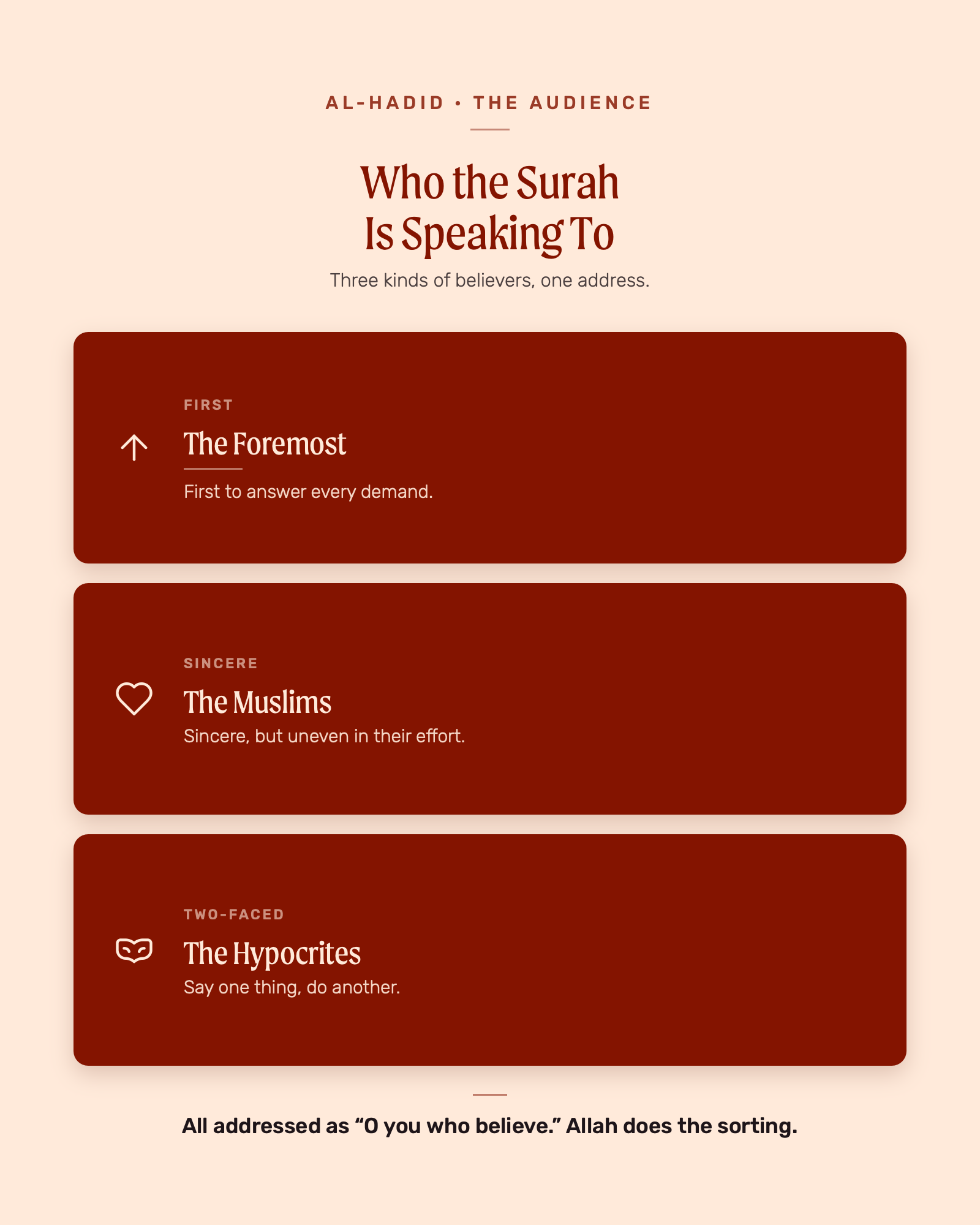
Al-Hadid was revealed to a community that, unlike early Makkah, now contained more than one kind of believer. There were the foremost, the truest believers who raced to every demand of faith. There were the ordinary Muslims, sincere but uneven, who sometimes faltered and slipped and then owned it. And there were the hypocrites, who said one thing and did another. When the surah calls out, O you who believe, it is speaking to all of them at once, deliberately, so that the community does not spend its energy sorting one another into ranks. Allah does the sorting; our job is to hear the call and respond.
From Belief to Action
Having set the worldview, the surah makes its turn (57:7)3: believe in Allah and His Messenger and spend out of that which He has made you trustees over. The pivot is the whole point. What we own is not really ours; we are caretakers of it and faith that is real shows up as willingness to give. That is the bridge from the towering opening about Allah to the very practical, sometimes costly, demands the rest of the surah will make.
The Takeaway
Surah Al-Hadid begins by rebuilding how we see everything, a universe glorifying its Maker, a Lord who is the First and the Last, the Outward and the Inward, because only on that foundation do its later demands make sense. It speaks to every kind of believer, the foremost, the struggling and even the hypocrite and asks each to move from belief to action. Read this way, its Makkan-sounding opening is not a detour. It is the ground the whole surah is built on.
There is far more to Surah Al-Hadid than a single article can hold. You can explore the full Al-Hadid: A Deeper Look series on Bayyinah TV, alongside the other surahs being opened up in the Deeper Look collection.
Related reading: The Book, the Balance and Iron: The Message of Surah Al-Hadid (the companion post in this series).
Notes
[1] Quran, 57:1, https://quran.com/57/1 ↩
[2] Quran, 57:3, https://quran.com/57/3 ↩
[3] Quran, 57:7, https://quran.com/57/7 ↩

At Bayyinah, we are dedicated to helping you connect directly with the words of Allah beyond translation. Founded by Ustadh Nouman Ali Khan, our mission is to create transformative experiences that deepen your understanding and engagement with the Quran.
Study the Quran and Arabic in a systematic and personalized way through Bayyinah TV. Get started today for free.
Check out our newest articles, fresh off the press and ready for you to dive into!