
Successful subscription! Thank you for subscribing.
Successful subscription! Thank you for subscribing.

June 4, 2026
What does it actually take to believe? Not to inherit faith from your parents or absorb it from your surroundings, but to own it for yourself.
In the first episode of the Foundations of Faith series, Ustadh Nouman Ali Khan answers that question in an unexpected way. The foundations of faith, he argues, do not begin with proofs or lectures. They begin with the ability to think clearly and independently and that ability is under attack in an age of endless information.
A Journey Many of Us Will Recognize
Ustadh Nouman opens the episode with his own story. He was raised mostly in the Muslim world and moved to New York at around 14. In two years of public high school he did not have a single Muslim friend and the prayers quietly fell away. What shocked him at first became normal within months, until he began to wonder whether the way he used to live was the strange thing. By the time he reached college, he was surrounded by friends who mocked religion and he had adopted their arguments as his own.
The turning point was not a debate. It was honesty. He describes the kind of conversation with yourself that can only happen when the pressures are removed and the noise stops. Deep down he knew something was wrong, but avoiding that conversation is easy. You stay busy around people, turn on the TV, play a game and keep the mind occupied so it never has a quiet moment to reflect.
The First Foundation: Independent Thought
From that story, Ustadh Nouman draws the first foundation of the Islamic faith: the ability to think clearly. He grounds it in an Ayah from Surah Ali ’Imran (3) that many of us have heard countless times:
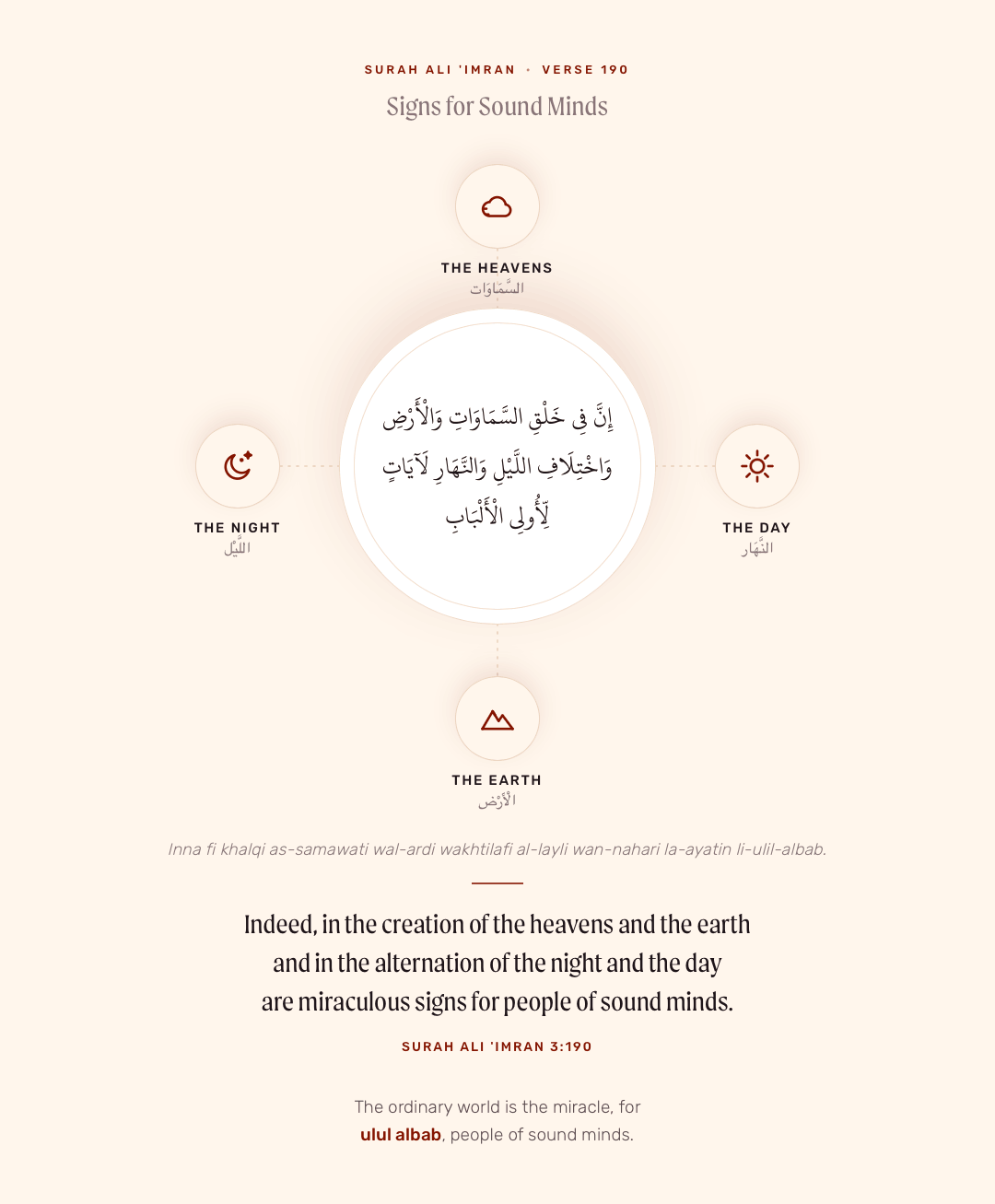
إِنَّ فِي خَلْقِ السَّمَاوَاتِ وَالْأَرْضِ وَاخْتِلَافِ اللَّيْلِ وَالنَّهَارِ لَآيَاتٍ لِّأُولِي الْأَلْبَابِ
“Indeed, in the creation of the heavens and the earth and in the alternation of the night and the day are miraculous signs for people of sound minds.” (3:190) 1
Notice what Allah calls a sign. Not only the staff of Musa (AS) turning into a snake2, but the sky, the earth, the night and the day. The Quran is demanding that we look at the ordinary world and recognize the miraculous in it. That recognition, however, is not promised to everyone. It is reserved for ulul albab, people of sound minds.
Who Are the People of Sound Minds?
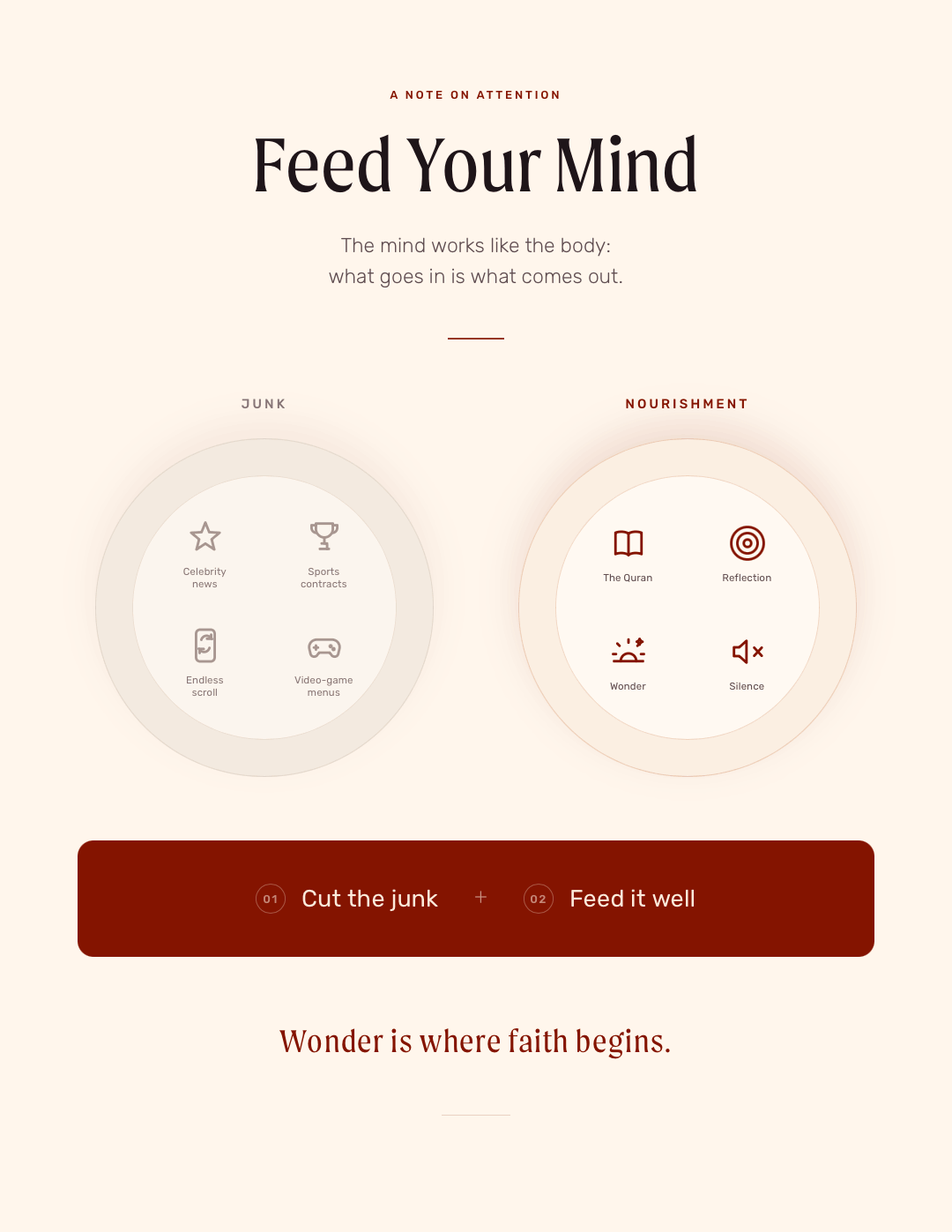
The Arabic word lubb describes a pure mind, a mind free from vanities. Ustadh Nouman translates that into modern terms: a mind that is not drowning in useless information. We are bombarded with data that does not make us better human beings, from player contracts and celebrity news to the endless menus of a video game. Information for the sake of information is fluff and the more of it we take in, the less capable we become of processing what actually benefits us.
He compares it to food. If you eat junk all day, adding an apple does not undo the damage. Getting healthier requires two things at once: cutting the junk and eating well. The mind works the same way. If you listen to Quranic reminders but stay addicted to entertainment, you may find yourself asking why nothing ever changes. As the old saying goes, the container only pours out what it contains.
Where to Begin
Start with an honest audit. What do you forward on WhatsApp? What do you watch when no one is looking? Unlike past generations, who all read the same newspaper and watched the same channels, we choose what enters our minds every single day. That choice makes us responsible. Cut down the useless, even if you cannot eliminate it entirely and give your mind room to be amazed by a sunset again. Wonder is where faith begins.
Faith does not begin with winning arguments. It begins with a clear mind that has space to think, reflect and recognize the signs Allah has placed everywhere.
Ready to keep building? Watch the full Foundations of Faith series and explore hundreds of hours of Quranic study on Bayyinah TV.
Notes
[1] Al-Quran, Surah Ali ‘Imran, 3:190, https://quran.com/ali-imran/190 ↩
[2] Al-Quran, Surah Taha, 20:19-20, https://quran.com/taha/19-20 ↩

At Bayyinah, we are dedicated to helping you connect directly with the words of Allah beyond translation. Founded by Ustadh Nouman Ali Khan, our mission is to create transformative experiences that deepen your understanding and engagement with the Quran.
Study the Quran and Arabic in a systematic and personalized way through Bayyinah TV. Get started today for free.
Check out our newest articles, fresh off the press and ready for you to dive into!